
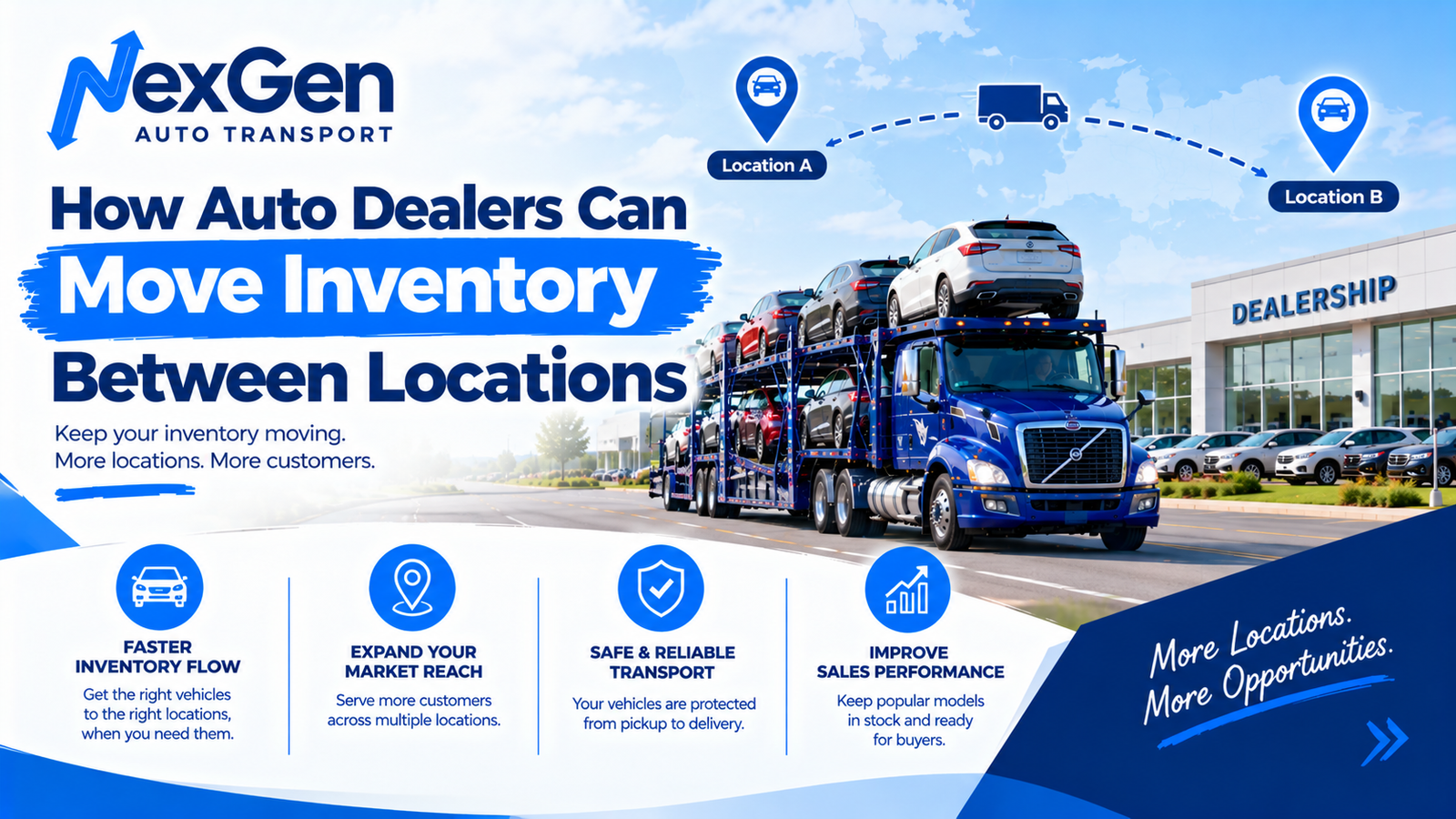
Short answer: Auto dealers can move inventory between locations by driving cars with dealer plates, using an in-house truck and trailer, or hiring a licensed car hauler (often through a broker). Driving usually works for nearby lots, in-house hauling works if you have steady volume and the compliance to run a truck, and third-party haulers usually win on longer routes and larger batches. The right choice depends on distance, volume, urgency, insurance, and your floorplan lender’s rules. The goal is the same in every case: get each car to the lot where it will sell fastest, at the lowest all-in cost.
Last updated: October 23, 2026 | Reading time: about 10 minutes
Key Takeaways
- Why move inventory: the same car can sell faster, or for more, at a different location.
- Three main options: drive it, haul it yourself, or hire a hauler. Most groups use a mix.
- Count the whole cost: staff time, fuel, wear, insurance, and the days a car sits in transit.
- Check the rules before you move cars: floorplan lender, plates, insurance, and (for in-house hauling) federal motor carrier requirements.
- Start with one lane, measure cost, days to front line, and damage, and then scale.
What’s in This Guide
- Why Dealers Move Inventory Between Locations
- Your Options Compared
- In-House Hauling: What to Consider
- How to Compare Costs
- Does Moving a Car Pay Off? An Example
- Floorplan, Paperwork, Plates, and Insurance
- Operational Details That Prevent Problems
- How to Set Up a Transfer Program: 7 Steps
- KPIs to Track
- Questions to Ask a Transport Provider
- How NexGen Can Help
- Frequently Asked Questions
Why Dealers Move Inventory Between Locations
- Match inventory to demand. A truck that sits at one store may be in high demand at another. Local preferences, weather, and pricing make the same car sell at different speeds.
- Cut days on lot. Aged inventory costs money through floorplan interest, depreciation, and lost lot space.
- Fill customer orders. Dealer trades and customer requests often need a car from another store in your group.
- Balance mix and age. Moving slow movers to other markets, and redistributing fresh trade-ins, keeps each store’s mix healthy.
- Move auction and wholesale purchases. Cars bought at auction need to get to the right store quickly. See car dealer auction transport, Manheim shipping, and auction car transport.
- Send cars for reconditioning. Body work and repairs may happen at a central shop. See transport for auto body shops and transport for auto repair shops.
Dealers can legally ship cars to other dealerships. Read can a dealership ship a car to another dealership? for the basics, and see our dealership transport service.
Your Options Compared
| Option | How It Works | Best For | Watch Out For |
|---|---|---|---|
| Drive it (porter or employee) | A staff member drives the car, usually with dealer plates, to the other lot | Nearby lots, same-day needs, single cars | Labor and return trips, added miles, accident risk, plate and insurance rules |
| In-house truck and trailer | You own or lease a hauler and run your own routes | Steady, predictable volume between fixed lots | Capital cost, driver, maintenance, insurance, and federal and state compliance |
| Third-party hauler (through a broker) | A licensed, insured carrier picks up one or more cars and delivers them | Longer routes, batches, uneven volume, many lanes | Pickup and delivery windows, cargo insurance limits, lot access |
| Hybrid | Drivers for short or urgent moves, haulers for longer or bulk moves | Most dealer groups | Needs clear rules for which method to use |
A simple distance guide
| Situation | Often the Best Fit |
|---|---|
| Under about 100 miles | Drive it, or an in-house trailer |
| About 100 to 500 miles, a few cars | Mix: drive urgent units, haul batches |
| 500+ miles, or several cars on one lane | Third-party hauler |
| New, low-mileage, or premium units | Hauler, so you do not add miles. Enclosed if the car is high value |
| Non-running or damaged units | Winch-equipped hauler. See shipping a car that doesn’t run |
These are general guidelines. Your own cost data should set your cut-offs. For how distance affects price, see is car shipping cheaper short or long distance?
In-House Hauling: What to Consider
Owning a truck and trailer can work for groups with steady lanes, but it adds responsibilities that many dealers underestimate:
- Capital and upkeep. Trucks, trailers, tires, repairs, fuel, and downtime.
- Drivers. You need trained drivers. Depending on the weight of your truck and trailer, a commercial driver’s license may be required.
- Federal rules. A truck and trailer combination used in interstate commerce above a certain weight is generally subject to federal motor carrier safety rules, including USDOT number registration, driver qualification, and hours-of-service limits. Check the requirements with the FMCSA registration page and your state.
- Insurance. Your garage policy may not automatically cover a loaded trailer on the road. Confirm coverage with your insurer.
- Empty miles. A truck that drives back empty wastes fuel and time. Backhauls need planning.
- Utilization. A truck that sits idle between runs is expensive.
Many dealers keep a small in-house setup for local moves, and use a hauler for everything else. For a look at how to evaluate outside carriers, see best carrier for dealer-to-dealer car transport and top auto transport companies for dealers.
How to Compare Costs
A hauler quote looks simple. An in-house or driver move has many hidden costs. Build an all-in cost per vehicle for each method.
| Cost Item | Drive It | In-House Hauler | Third-Party Hauler |
|---|---|---|---|
| Driver wages or transport price | Yes, per hour | Yes | In the quote |
| Fuel | Yes | Yes, diesel | Included |
| Return trip or empty miles | Yes | Yes | No |
| Truck, trailer, maintenance, tires | No | Yes | No |
| Insurance and compliance | Your policy | Yes, and added rules | Carrier’s cargo insurance |
| Added mileage and wear | Yes | Minimal | Minimal |
| Staff time away from selling or recon | Yes | Some | Little |
| Days in transit | Fast | Depends on schedule | Depends on pickup and delivery windows |
What affects third-party hauler pricing? Distance, number of units, vehicle size, open or enclosed trailer, season, fuel, and your flexibility on dates. See car shipping cost factors, how much it costs to ship a car, and why car shipping costs more in 2026. Volume helps. See bulk vehicle transport for dealerships, bulk car shipping rates for dealer networks, and dealer auto transport discounts.
Moving inventory between your stores?
Tell us your lanes, volumes, and vehicle types. No upfront deposit, licensed FMCSA broker.
Does Moving a Car Pay Off? An Example
Before you move a car, estimate whether the transfer will earn its keep. Here is an illustration. The numbers are assumptions, so replace them with yours.
| Assumption | Example Value |
|---|---|
| Vehicle floorplan balance | $25,000 |
| Floorplan interest rate | 8% per year (about $5.48 per day) |
| Extra days to sell if it stays | 20 days (about $110 in interest) |
| Expected price difference at the other store | +$1,000 |
| All-in transport cost | $500 |
| Net benefit of moving | About +$610 ($1,000 + $110 – $500) |
If the price difference is only $200, the same move loses money. That is why dealers who track sell-through by store, and by vehicle type, make smarter transfer decisions.
Floorplan, Paperwork, Plates, and Insurance
- Floorplan lender. Ask your lender what it needs when inventory moves between locations, including reporting, location records, and audits. Some lenders require notice when units leave a store.
- Titles and ownership. Moves between your own stores may not change ownership, but dealer-to-dealer sales do. Keep clear records of who owns each unit and who holds the title. Your state’s rules decide the paperwork.
- Dealer plates. Driving a car with dealer or trade plates is governed by state law, and rules differ on when and where they can be used. Check with your state motor vehicle agency before using them for out-of-state or non-sales moves.
- Insurance. Know what your garage policy covers when cars are driven or hauled between lots. For third-party hauling, ask for the carrier’s cargo insurance certificate, and confirm that the limit covers the combined value of a full load, not just one car. Check coverage in the FMCSA Licensing and Insurance system.
- Pre-existing damage. Cargo insurance generally covers damage the carrier causes in transit, not damage that existed before pickup. Record the condition at every handoff. See does car shipping insurance cover damage?, our Claims & Damage Process, and insurance information. With NexGen, damage must be reported within 24 hours of delivery.
- Recalls and safety. Before moving a unit to sell, check for open recalls on the NHTSA recalls page.
Rules vary by state, so check with your lender, insurer, and state agency, or a compliance professional.
Operational Details That Prevent Problems
- Standard condition reports. Take dated photos at pickup and delivery, and sign the Bill of Lading at both ends.
- VIN lists and load sheets. Send a clear list of VINs, locations, and contacts for every move.
- Lot access. Tell the driver about gates, hours, tight turns, low clearance, and where trucks can unload.
- Keys and fobs. Decide how keys travel, and who signs for them at each store.
- Fuel and charge. Haulers usually need about a quarter tank. For EVs, confirm the charge level. See how to ship an electric vehicle.
- Clean and ready. Move cars that are ready to list so they can go straight to the front line. See our car shipping preparation checklist.
- Timing. Plan transfers around sales cycles and promotions. See how far in advance to book car shipping and expedited auto transport for urgent moves.
- Seasonality. Peak seasons and winter weather can change pricing and speed. See the cheapest time of year to ship a car and shipping a car in winter.
Also see how to ship a car from a dealership, auto transport for used car dealerships, and dealership in-house trade and transport services. Dealers selling out of state may find can you trade in a leased car to another dealership? useful, and fleets can read nationwide fleet relocation for dealers.
How to Set Up a Transfer Program: 7 Steps
- Map your lanes. List store pairs, monthly volumes, and typical vehicle types.
- Set transfer rules. Decide when a car should move: aged beyond X days, a better market, or a customer order.
- Pick a pilot lane. Choose one high-volume, longer route to test a hauler against your current method.
- Confirm insurance and compliance. Check your own coverage, the carrier’s cargo limit, and your lender’s requirements.
- Standardize paperwork. Use one condition report, VIN list, and Bill of Lading process for every move.
- Assign contacts. Name a transfer coordinator at each store and a dispatch contact at your provider.
- Measure and scale. Compare results with your current method, then add lanes.
KPIs to Track
| KPI | Why It Matters |
|---|---|
| All-in transfer cost per vehicle | Shows which method is truly cheapest |
| Days from decision to front line | Shows how quickly a moved car can start selling |
| Days to sell, by store | Shows whether transfers are working |
| On-time pickup and delivery rate | Measures provider reliability |
| Damage claims per 100 moves | Measures handling and paperwork discipline |
| Aged inventory percentage | Shows whether you are moving slow cars fast enough |
Questions to Ask a Transport Provider
- What are your USDOT and MC numbers, and are you a broker or a carrier on each load?
- What is the cargo insurance limit per load, and can I see the certificate?
- Can you handle recurring lanes and batches, and how are they priced?
- What are your pickup and delivery windows, and what happens if they are missed?
- How do you handle dealer lot access, gates, and after-hours delivery?
- What fees apply for rescheduling, missed pickups, or cancellations?
- How do you document condition and handle claims, and how fast must I report?
- Can you move non-running units, EVs, trucks, and vans?
- How will I get status updates?
Learn how to evaluate any provider in how to choose a car shipping company, understand auto transport broker vs. carrier, and see how load boards and dispatch services work. If you also run rental or delivery fleets, see how rental car companies transport vehicles between branches and cargo van transport.
How NexGen Can Help
NexGen Auto Transport LLC is a licensed FMCSA property broker (USDOT 3969190, MC-1482694). We arrange vehicle transport with vetted, insured carriers for dealers and individuals. Verify us in the FMCSA SAFER system. We do not charge an upfront deposit. We keep a valid card on file to secure your reservation, and the balance is paid as stated in your order confirmation. Fees for rescheduling, a dry run, or cancellation apply only in specific situations, as described in our Cancellation & Refund Policy and Terms & Conditions. Contact us with your lanes and volumes, browse the FAQs, learn about us, or see our state and city pages. For individual shipments, get a quote.
Frequently Asked Questions
How do car dealers move inventory between locations?
Dealers drive cars between lots (often with dealer plates), run their own truck and trailer, or hire a licensed car hauler. Most groups use a mix, with drivers for short or urgent moves and haulers for longer routes and batches.
Is it cheaper to haul cars in-house or hire a transport company?
It depends on volume and distance. In-house hauling can work for steady, short lanes, but it adds truck, driver, insurance, and compliance costs. Third-party haulers often cost less per car on longer routes and for irregular volumes, because you pay only per move.
Can I drive a dealer car to another location with dealer plates?
Dealer plate rules vary by state and by the type of move. Check with your state motor vehicle agency before using them for out-of-state moves or non-sales uses.
Do I need a USDOT number to haul my own dealership cars?
A truck and trailer combination used in interstate commerce above a certain weight generally falls under federal motor carrier safety rules, including USDOT registration. Check the FMCSA requirements and your state rules, or ask a compliance professional.
What does cargo insurance cover when a hauler moves my inventory?
Carrier cargo insurance generally covers damage the carrier causes in transit, subject to limits and exclusions. It generally does not cover pre-existing damage. Ask for the certificate and confirm the limit covers a full load of vehicles.
Does my floorplan lender need to know when inventory moves?
Often yes. Lenders usually track where financed vehicles are, and some require notice when units move between locations. Ask your lender about its process before you move cars.
How do I know if moving a car between stores is worth the cost?
Compare the all-in transport cost with the expected benefit: a higher selling price, fewer days on lot (lower floorplan interest), and freed lot space. If the benefit does not exceed the cost, keep the car.
Can NexGen transport dealer inventory?
Yes. NexGen Auto Transport arranges dealer and fleet vehicle transport with licensed, insured carriers. Contact us with your lanes and volumes for a quote. We do not charge an upfront deposit.
Final Thoughts
Moving inventory between locations is one of the simplest ways for a dealer group to sell more cars faster. Match the method to the route: drive nearby cars, use a hauler for longer lanes and batches, and be clear about the true all-in costs. Check your lender, insurance, and plate rules, document every handoff, and begin with a pilot lane. Done well, transfers turn slow inventory into sales.
Ready to move inventory between your stores?
Licensed FMCSA broker, vetted carriers, and no upfront deposit.
