
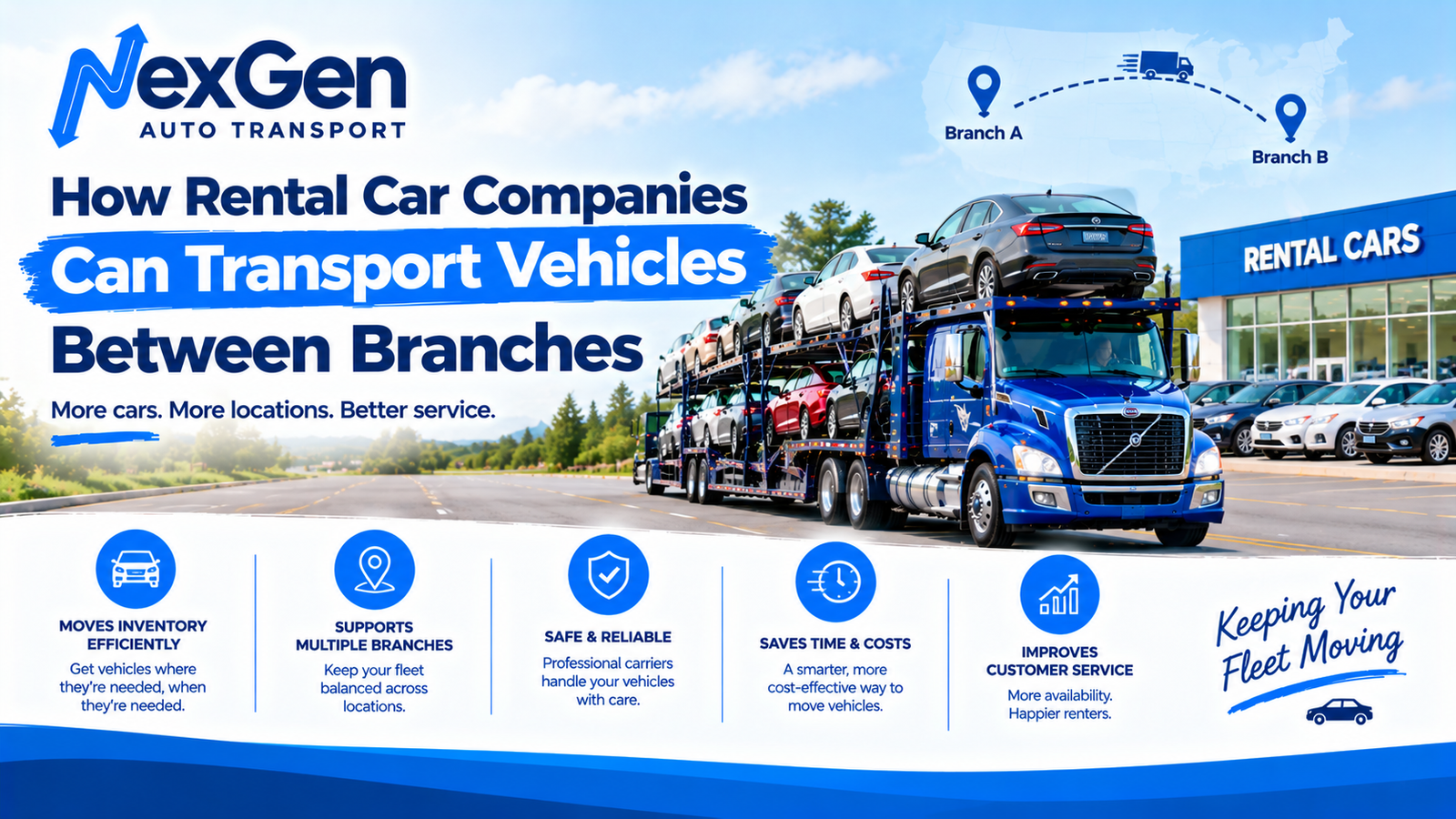
Short answer: Rental car companies move vehicles between branches in four main ways: car hauler transport (a licensed carrier moves several cars per truck), professional or staff drivers (a person drives each car), customer relocations (discounted one-way rentals), and mixed strategies that use each where it costs least. As a rule of thumb, drivers and customer relocations tend to work best on short, high-frequency routes, while hauler transport tends to win on longer routes and larger batches. The best choice depends on distance, volume, urgency, vehicle type, and your insurance requirements.
Last updated: October 23, 2026 | Reading time: about 10 minutes
Key Takeaways
- The problem: one-way rentals and seasonal demand leave some branches overstocked and others short. Idle cars lose money while they depreciate.
- No single method wins. Most fleets use a mix of hauler, driver, and customer relocation.
- Compare all-in cost per vehicle, not just the quote. Include driver time, fuel, return travel, wear, and downtime.
- Insurance matters more at fleet scale. Check that cargo coverage covers a full truckload of vehicles, not just one car.
- Start with a pilot lane, measure cost, transit time, and damage, then scale.
What’s in This Guide
- Why Rental Fleets Need to Move Cars Between Branches
- Your Options Compared
- When Hauler Transport Makes Sense
- How to Compare Costs
- Insurance, Liability, and Contracts
- Rental-Specific Details to Plan For
- Seasonal Flows and Routes
- How to Set Up a Program: 8 Steps
- KPIs to Track
- Questions to Ask a Transport Provider
- How NexGen Can Help
- Frequently Asked Questions
Why Rental Fleets Need to Move Cars Between Branches
Rental fleets are never in balance. Customers rent in one city and drop off in another, tourists flow in one direction, and demand swings with seasons, holidays, and events. Without repositioning, some branches pile up with unused cars while others turn customers away. Common signs that your fleet needs a better relocation plan include:
- Some locations are always full while others are constantly short.
- You pay staff to drive vehicles between branches, often with hotel, fuel, and return-travel costs.
- One-way rentals keep creating the same imbalances.
- You rely on last-minute transport and pay a premium for it.
- Customers cannot book the vehicle class they want, and book elsewhere.
Every idle vehicle keeps depreciating while it earns nothing, so the faster a car gets to a branch with demand, the sooner it earns revenue again.
Your Options Compared
| Method | How It Works | Best For | Watch Out For |
|---|---|---|---|
| Car hauler transport | A licensed carrier loads several cars on an open or enclosed truck and delivers them to the destination branch | Longer routes, batches of vehicles, cross-region moves | Pickup and delivery windows, truck access at your lot, cargo insurance limits |
| Staff drivers | Your employees drive vehicles between branches | Short routes, same-day moves, nearby branches | Labor, return travel, lost productivity, and added miles on each car |
| Professional relocation drivers | Contracted drivers move cars one at a time, often paid per move | Medium distances, flexible schedules, units that cannot be hauled | Driver quality, liability under your insurance, and added mileage |
| Customer relocations | Discounted or free one-way rentals for travelers already heading to the branch you need | Popular tourist routes with flexible timing | Unpredictable timing and uptake, with customers driving your cars under your rental agreement |
| Pricing one-way rentals to rebalance | You adjust one-way fees and rates to encourage customers to move cars where needed | Ongoing, gradual balancing | Slow, and may lose revenue or customers if rates are not right |
Most operators combine two or three of these methods. For a deeper look at how broker-arranged carriers work, see auto transport broker vs. carrier and car hauling dispatch service.
When Hauler Transport Makes Sense
A car hauler carries several vehicles on one truck, so the cost of the driver, fuel, and truck is shared across all of them. That is why it often becomes the better choice as distance and volume grow. As a rough guide:
| Situation | Often the Best Fit |
|---|---|
| Under about 150 miles, same-day need | Staff drivers or local professional drivers |
| About 150 to 500 miles, a few units | A mix: drivers for urgent units, hauler for batches |
| 500+ miles, or several units on the same lane | Hauler transport |
| Cross-country repositioning or seasonal shifts | Hauler transport, planned ahead |
| Cars that should not add miles (new, low-mileage, or premium) | Hauler transport, open or enclosed |
| Damaged or non-running units going to a body shop or auction | Hauler with a winch. See shipping a car that doesn’t run |
These thresholds are general guidance. Your own cost data should set the real cut-offs. Hauling also keeps miles off your cars, which matters for resale value and for service intervals. For distance effects on price, see is car shipping cheaper short or long distance?
How to Compare Costs
A transport quote looks simple, but a driver-based move has many hidden costs. Build a full cost per vehicle for each method.
Cost per vehicle: what to include
| Cost Item | Driver Move | Hauler Move |
|---|---|---|
| Transport price or driver wages | Yes, for every hour on the road | Yes, per vehicle in the quote |
| Fuel for the vehicle | Yes | Included in the price |
| Driver return travel (flight, bus, rideshare) | Yes | No |
| Hotel and meals on long trips | Yes | No |
| Wear, mileage, and depreciation | Yes, added miles per car | Minimal |
| Lost time for staff pulled off other work | Yes | Little |
| Accident, ticket, and toll risk | Yes | Carrier’s responsibility, covered by its insurance |
| Downtime before the car is rent-ready | Depends on speed | Depends on pickup and delivery windows |
A simple way to run the numbers
For each lane, calculate: (direct move cost + driver return and lodging + added wear + lost staff time + days of downtime x daily cost of an idle car) divided by the number of vehicles moved. Compare it with the hauler’s per-vehicle quote plus its downtime. The result will differ by route and volume, which is why a pilot on one lane is a good start.
What affects hauler pricing? Distance, vehicle size, open or enclosed trailer, season, fuel costs, number of units, and flexibility on dates. See car shipping cost factors, how much it costs to ship a car, why shipping costs more in 2026, and the cheapest way to ship a car. Larger and recurring volumes can often be quoted together. See bulk vehicle transport and bulk car shipping rates for dealer networks.
Planning fleet moves between branches?
Tell us your lanes, volumes, and vehicle types. No upfront deposit, licensed FMCSA broker.
Insurance, Liability, and Contracts
With a single car, insurance is a checkbox. With a fleet, it is a major risk decision.
- Cargo coverage per load. A car hauler may carry eight to ten vehicles. Ask for the carrier’s cargo insurance certificate and confirm that the limit is enough for the combined value of a full load, not just one car.
- Liability and certificates. Ask for certificates of insurance and whether your company can be named as a certificate holder or additional insured.
- Driver-based moves. If customers or contract drivers move your cars, check how your own policy and your rental agreement apply, and what happens in an accident.
- Pre-existing damage. Cargo insurance generally covers damage the carrier causes in transit, not damage that existed before pickup. Good condition records at pickup and delivery are essential.
- Claims timelines. Know the deadlines to report damage. With NexGen, damage must be reported within 24 hours of delivery. See our Claims & Damage Process, does car shipping insurance cover damage?, and insurance information.
- Registration. Verify the carrier’s USDOT and MC numbers and insurance filings in the FMCSA SAFER system and the FMCSA Licensing and Insurance system.
- Written terms. For recurring work, get a written agreement covering pricing, pickup and delivery windows, fees, and claims. See our Terms & Conditions and Cancellation & Refund Policy for how we spell these out.
Rental-Specific Details to Plan For
- Open safety recalls. Federal law generally restricts renting vehicles with open safety recalls, so check recall status before moving units. Search a VIN on the NHTSA recalls page, and tell your transporter if a unit is parked for a recall.
- Truck access at your lots. Airport and city lots may restrict large trucks or have tight turns and low clearance. Plan a staging area or an off-airport pickup point, and share gate codes and hours.
- Hand-off process. Decide who signs for the vehicles at each end, and how keys, fobs, and key cards travel. After-hours drop-offs need a clear plan.
- Condition reports. Take dated photos at every pickup and delivery, and have the driver and branch both sign the Bill of Lading. Match your own check-in and check-out photos to the BOL.
- Fuel and charge levels. Haulers usually need about a quarter tank. For electric vehicles, confirm the right charge level with your carrier. See how to ship an electric vehicle and our electric vehicle transport service.
- Remove personal items and tolls. Clear any customer belongings, toll tags, and temporary accessories before pickup. Follow our car shipping preparation checklist.
- Vehicle mix. Cargo vans, pickups, and larger units take more space. See cargo van transport and delivery van transport.
- Telematics and keys. If your cars have trackers or connected-car features, plan how to handle them in transit and on arrival.
- Cleaning and rent-ready time. Build in time for cleaning and inspection after delivery, so you can count the true “back in service” date.
Seasonal Flows and Routes
- Snowbird flows. Cars pile up in Florida, Arizona, and Texas in winter and move back north in spring. See snowbird car shipping and New York to Florida car shipping.
- Summer travel season. Demand spikes at vacation and airport branches. Book ahead. See how far in advance to book car shipping and the cheapest time of year to ship a car.
- Winter weather. Northern routes can add days. See shipping a car in winter.
- Major hubs. Orlando, Miami, Phoenix, Las Vegas, and Los Angeles often need steady repositioning. See our Orlando, Miami, Phoenix, Las Vegas, and Los Angeles pages, plus route guides such as Los Angeles to Houston.
- Fleet in and fleet out. Moving new vehicles in and retiring old ones to auction uses the same lanes. See Manheim shipping, dealer auction transport, and auction car transport. Body shop moves are covered in transport for auto body shops and transport for auto repair shops.
How to Set Up a Fleet Transport Program: 8 Steps
- Map your lanes. List the branch pairs you move cars between, how many units per month, and which are one-way imbalances.
- Segment by urgency. Separate same-day moves from planned moves that can wait a week or more.
- Pick a pilot lane. Choose one high-volume, longer route to test hauler transport.
- Define service levels. Set pickup windows, delivery windows, and who must be on-site.
- Confirm insurance and contracts. Check the cargo limit per load, certificates, and claim procedures.
- Standardize paperwork. Use the same condition report, photos, and Bill of Lading process for every move.
- Dispatch and communicate. Name a point of contact at each branch, and agree how you receive tracking updates.
- Measure and expand. Compare results with your driver-based costs, then add lanes.
KPIs to Track
| KPI | What It Tells You |
|---|---|
| All-in cost per vehicle moved | Whether a method is really cheaper |
| Days from request to rent-ready | How fast cars start earning again |
| On-time pickup and delivery rate | Provider reliability |
| Damage claims per 100 vehicles | Handling quality and paperwork discipline |
| Branch fill rate and lost rentals | Impact on revenue |
| Fleet utilization | Whether balancing is working |
Questions to Ask a Transport Provider
- What are your USDOT and MC numbers, and are you a broker or a carrier on each load?
- What is the cargo insurance limit per load, and can I see the certificate?
- How do you vet carriers and drivers?
- Can you handle recurring lanes and batches, and how are they priced?
- What are your pickup and delivery windows, and what happens if they are missed?
- How do you handle airport and city lot access?
- What fees apply for rescheduling, missed pickups, or cancellations?
- How do you document vehicle condition and handle damage claims, and how fast must I report?
- Can you move non-running units, vans, and EVs?
- How will I get tracking and status updates?
See how to evaluate any provider in how to choose a car shipping company, learn how load boards match carriers to orders, and check expedited transport for urgent moves.
How NexGen Can Help
NexGen Auto Transport LLC is a licensed FMCSA property broker (USDOT 3969190, MC-1482694). We arrange vehicle transport with vetted, insured carriers for individuals and businesses. For dealers and fleets, see dealership transport, nationwide fleet relocation, in-house trade and transport services, auto transport for used car dealerships, best carrier for dealer-to-dealer transport, and top auto transport companies for dealers. Contact us with your routes and volumes to discuss a fleet plan. Our policies are in writing: see the Cancellation & Refund Policy, Terms & Conditions, and FAQs. Learn about us, browse our state and city pages, or get a quote. You can also check company reviews on the Better Business Bureau.
Frequently Asked Questions
How do rental car companies move vehicles between branches?
They use car hauler transport, staff drivers, professional relocation drivers, discounted one-way customer relocations, or a mix. The best method depends on distance, volume, urgency, and cost.
Is it cheaper to use a car hauler or drivers to move rental cars?
It depends on distance and volume. Drivers are often better for short, urgent moves. Haulers often cost less per vehicle on longer routes and larger batches, because driver, fuel, and truck costs are shared. Compare all-in cost per vehicle, including return travel, wear, and downtime.
What is fleet repositioning?
Fleet repositioning is moving rental vehicles from branches with too many cars to branches with high demand, so cars earn revenue instead of sitting idle.
What is a one-way rental imbalance?
It happens when customers rent a car in one place and return it in another, leaving some branches with too many vehicles and others too few. Seasonal travel makes it worse.
What insurance should I check when hiring a car hauler for a fleet?
Ask for the carrier’s cargo insurance certificate and confirm the limit covers the combined value of a full truckload. Also check liability coverage, deductibles, exclusions, and who can be named as a certificate holder.
Can car haulers pick up from airport rental lots?
Often yes, but large trucks can be restricted at airports and tight city lots. Plan a staging area or off-airport pickup point, and share access instructions with your transporter.
Can electric vehicles and vans be moved between branches by hauler?
Yes. EVs need the right charge level and handling, and vans take more trailer space. Tell your transporter the vehicle types when you request a quote.
How do I get started with fleet transport?
Map your lanes and volumes, pick a pilot route, confirm insurance and service levels, standardize your condition reports, and track cost, speed, and damage. Then expand to more lanes.
Final Thoughts
Moving cars between branches is a core part of running a rental fleet. The best programs mix methods: drivers for short and urgent moves, and haulers for longer lanes and batches. Compare all-in costs, verify insurance and registration, standardize your paperwork, and start with a pilot lane. Done well, repositioning keeps more cars earning and fewer cars idle.
Ready to balance your fleet?
Licensed FMCSA broker, vetted carriers, and no upfront deposit.
