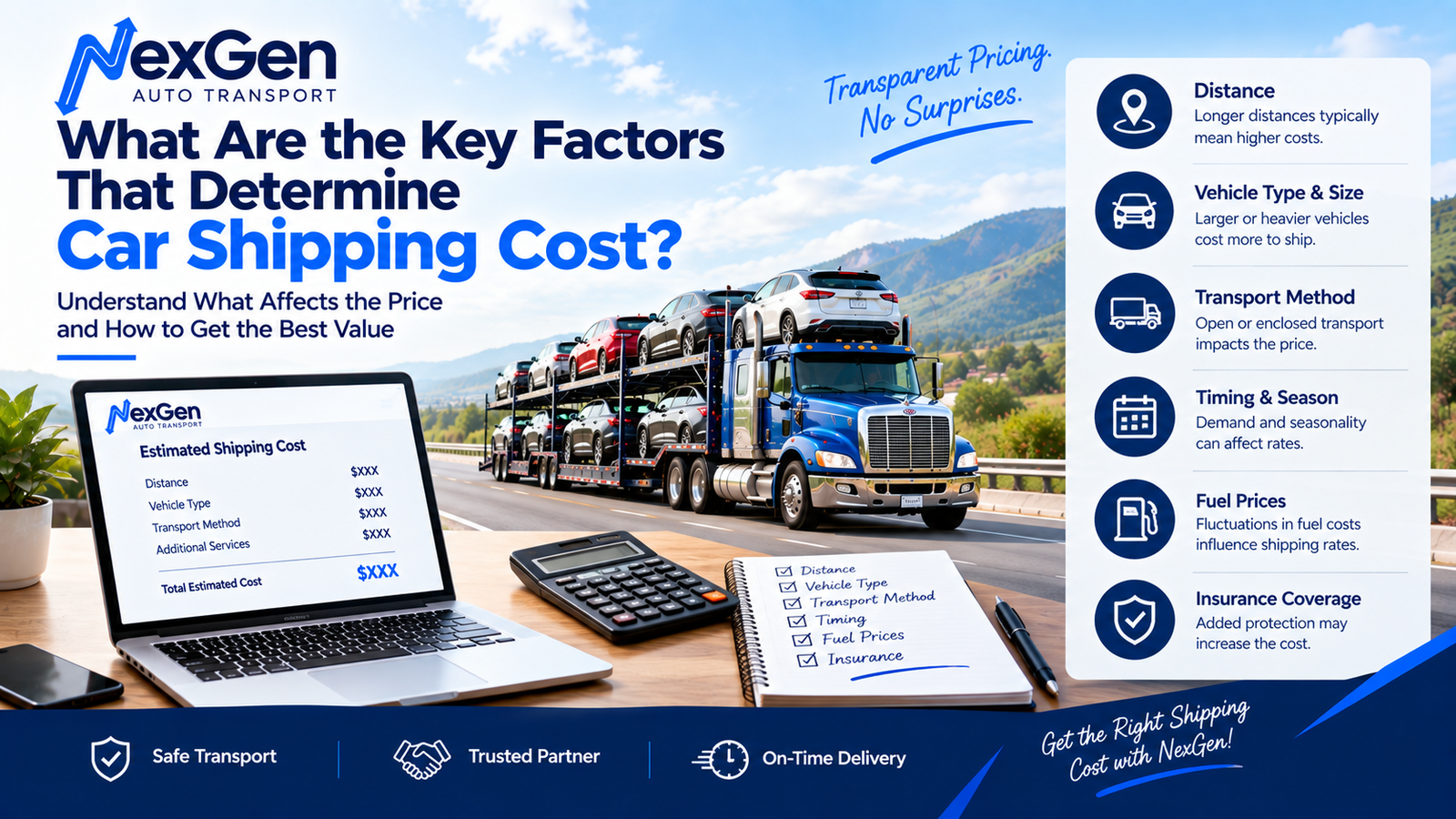
Two people can ship the same model car on the same day and pay noticeably different prices. That’s not random — car shipping cost is driven by a specific, predictable set of factors. Understanding them helps you read a quote accurately, spot a bad deal, and know when shipping actually makes more sense than driving.
The 8 Factors That Determine Car Shipping Cost
1. Distance
Distance is the single biggest factor affecting auto transport rates. Total cost rises with distance, but the per-mile rate actually drops — a 300-mile shipment might cost $1.50 per mile, while a 2,500-mile shipment often runs closer to $0.50 per mile. Fixed costs like loading and initial fuel get spread across more total miles on longer trips. See our full breakdown in
how much it costs to ship a car.
2. Vehicle Type and Size
Larger, heavier vehicles take up more trailer space and add weight, which increases fuel consumption and reduces how many other vehicles a carrier can transport alongside yours. A compact sedan ships for less than a full-size truck or SUV over the same route.
3. Route and Pickup/Delivery Locations
Shipping between major metro areas is generally cheaper, since carriers run those routes frequently and can fill trailers efficiently. Rural or hard-to-reach pickup and delivery points can raise cost, since fewer carriers service those areas regularly.
4. Carrier Availability
Pricing shifts based on how many carriers are actively running your specific route on your target dates. A popular, high-traffic corridor typically prices lower than a route with limited carrier presence.
5. Timing and Season
Prices rise during peak moving season (late spring through summer) when demand for carriers increases. Booking last-minute also tends to cost more, since carriers have less flexibility to fit your shipment into an efficient route. Off-season shipping (fall and winter, outside snowbird routes) generally means better rates.
6. Open vs. Enclosed Transport
Open transport is the standard, most affordable option, used for the vast majority of shipments. Enclosed transport typically costs 30–60% more, since it protects the vehicle from weather and debris and uses trailers with less capacity per trip. See our full comparison in
open vs. enclosed auto transport.
7. Vehicle Operability
A non-running vehicle requires a winch or forklift to load, which adds labor and equipment costs — typically $150–$300 more than an operable vehicle on the same route.
8. Delivery Method and Speed
Door-to-door delivery is slightly more expensive than terminal-to-terminal, since it requires the carrier to route directly to your specified addresses. Expedited or guaranteed pickup also carries a premium over standard scheduling.
Is It Cheaper to Ship or Drive a Car?
It depends on the distance and what you count as a cost. For short trips, driving is usually cheaper if you only count fuel. For long-distance moves, shipping is often comparable or cheaper once you factor in every real cost of driving, not just gas.
What Is the Cost of Driving 1,000 Miles?
A rough estimate for driving 1,000 miles includes several costs beyond gas alone:
| Expense | Estimated Cost (1,000 miles) |
|---|
| Fuel (at ~25 mpg, $3.50/gallon) | ~$140 |
| Lodging (1–2 nights) | $100 – $250 |
| Meals (2–3 days on the road) | $60 – $150 |
| Wear and tear on the vehicle (IRS mileage rate as a reference) | ~$650 – $700 |
| Your time (2+ days, unpaid or using vacation days) | Hard to quantify, but real |
| Total estimated cost | ~$950 – $1,240+ |
Compare that to a typical 1,000-mile open transport shipment, which generally runs $650–$950. Once lodging, meals, added mileage, and your own time are factored in, shipping is often the more cost-effective option for distances like this, not just the more convenient one.
When Does Shipping Make More Sense Than Driving?
Shipping tends to make more financial and practical sense when:
- The distance exceeds a single day’s comfortable drive (roughly 500+ miles), since overnight stays add real cost
- You’d rather not add mileage to a newer or higher-value vehicle
- Your time has real value — vacation days, missed work, or a tight moving timeline
- You’re moving more than one vehicle and can’t drive them all yourself
- The route crosses difficult terrain or weather, where driving carries more risk or fatigue
- You’re flying to your destination anyway, making driving logistically inconvenient regardless of cost
Driving still makes sense for shorter distances, when you enjoy the trip itself, or when you don’t mind the added mileage on the vehicle.
What Expenses Should I Include When Comparing Shipping vs. Driving?
A fair comparison should include more than just the shipping quote versus a tank of gas. Count:
- Fuel for the full driving distance, not just a rough guess
- Lodging for any overnight stops the drive requires
- Meals for the full duration of the trip
- Vehicle wear and tear, using a mileage-based estimate as a reference point
- Your time, valued honestly against what you’d otherwise be doing (working, using vacation days, or simply resting instead of driving)
- Risk factors, like weather, fatigue, or unfamiliar routes, which don’t have a dollar figure but are worth weighing
Leaving out lodging, meals, wear and tear, or the value of your time is the most common reason people underestimate what driving actually costs compared to shipping.
How These Factors Combine in a Real Quote
A shipping quote isn’t just one factor applied in isolation — it’s several layered together. For example, a full-size SUV (vehicle type) shipping 1,800 miles (distance) via enclosed transport (transport method) during peak summer season (timing) on a route with limited carrier density (route) will price meaningfully higher than a sedan shipping the same distance via open transport in the off-season. Understanding each factor individually helps you see exactly where your own quote sits, and where you might have room to adjust for a better rate.Here’s a simplified example of how stacking factors changes the final number for a 1,000-mile shipment:
| Shipment Profile | Estimated Cost |
|---|
| Sedan, open transport, off-season, flexible pickup | $650 – $750 |
| Sedan, open transport, peak season, fixed pickup date | $800 – $950 |
| Full-size SUV, enclosed transport, peak season | $1,300 – $1,600 |
The vehicle and distance stay constant in the first two rows — only timing and pickup flexibility change, and the price still moves by a few hundred dollars. This is why two seemingly similar shipments can carry noticeably different quotes.
How Carrier Supply and Demand Actually Move Prices
Carrier availability isn’t just about whether trucks exist on your route — it’s about how many vehicles are competing for space on them at any given moment. A few things drive this:
- Seasonal migration patterns, like snowbirds moving between northern and southern states each year, temporarily increase demand on specific routes during specific months.
- Regional economic activity, such as a surge in auction or dealership volume in one area, can tighten available trailer space and push prices up for everyone shipping through that region.
- Fuel price fluctuations affect carrier operating costs directly, which filters into per-mile pricing across the board, not just on your specific shipment.
- Empty backhaul routes — when a carrier needs to return from a delivery with an empty trailer — can sometimes mean lower pricing if your shipment happens to fill that gap efficiently.
This is part of why identical shipments booked on different days can carry different prices: the underlying supply and demand on that specific route shifts constantly, even when nothing about your vehicle or distance has changed.
How Multi-Vehicle Shipments Change the Math
If you’re shipping more than one vehicle — whether it’s two family cars during a move or a larger batch for a dealership — the cost factors above still apply, but volume adds another layer. Consolidating vehicles into a single shipment generally lowers the effective per-vehicle cost, since it makes more efficient use of a carrier’s available trailer space. This is a different pricing conversation than a single-vehicle shipment, and it’s worth understanding separately if it applies to you.
How to Get an Accurate Quote
Because so many factors affect the final number, an accurate quote requires specific details, not a rough guess. Have this ready:
- Pickup and delivery ZIP codes
- Vehicle year, make, and model
- Whether the vehicle is operable
- Preferred transport method (open or enclosed)
- Your target pickup date
With these details, a reputable provider can give you a firm, all-in quote rather than a broad estimate that changes later.
Frequently Asked Questions
Which single factor affects car shipping cost the most?
Distance has the largest overall impact, though the per-mile rate decreases as distance increases, so total cost doesn’t scale in a simple straight line.
Does the specific route matter, or just the total mileage?
Both. Two shipments of the same distance can price differently if one route has significantly more carrier traffic than the other.
Can I lower my cost without changing my vehicle or distance?
Yes. Booking in advance, offering a flexible pickup window, and shipping during the off-season are all ways to lower cost without changing anything about the vehicle or route itself.
Is enclosed transport ever worth the extra cost?
For classic, exotic, or otherwise high-value vehicles, yes — the added protection often justifies the 30–60% premium. For everyday vehicles, open transport is usually the more practical choice.
Should I always compare shipping against driving before booking?
It’s worth doing for any long-distance move, since the true cost of driving is often higher than people initially assume once every expense is counted.
Does a newer or more valuable car cost more to ship?
Not directly. Car shipping cost is based on physical factors — size, weight, and whether it’s operable — not the vehicle’s market value. A brand-new sedan and an older sedan of the same size and weight generally cost about the same to ship, though owners of higher-value vehicles sometimes choose enclosed transport for extra protection, which does add cost.
Why did my quote change between the estimate and the final price?
This can happen if any of the original details change — a different pickup date, a vehicle that turns out to be inoperable, or a route with less carrier availability than expected. A reputable provider should explain exactly which factor caused the change rather than adjusting the price without a clear reason.
Get an Accurate Quote for Your Vehicle
See exactly how these factors apply to your specific shipment — distance, vehicle type, and route all included in one transparent quote.
Get a free quote from NexGen Auto Transport and compare it against the real cost of driving. For longer routes, see our guide on
cross-country car shipping.