
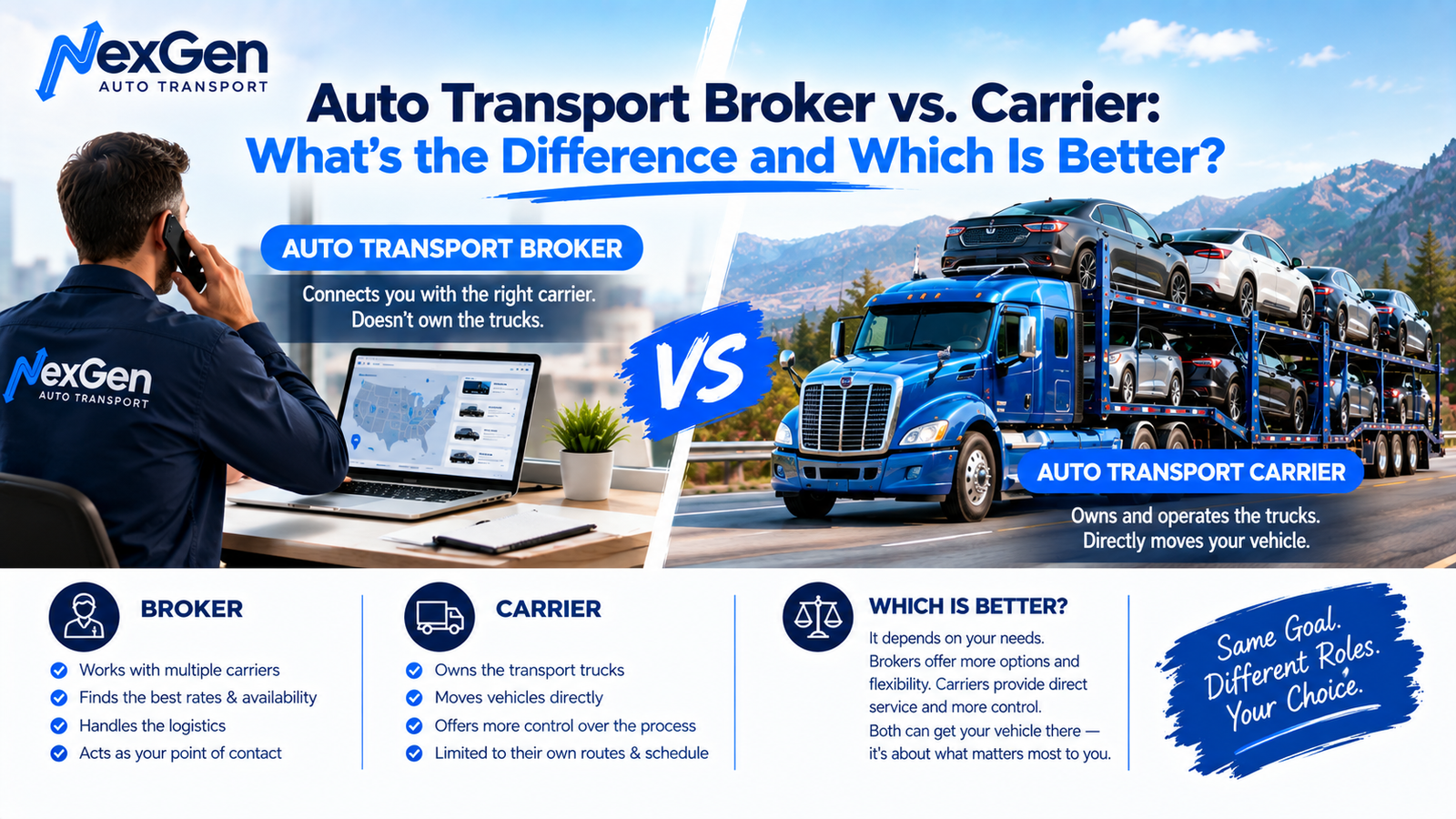
Short answer: An auto transport broker arranges vehicle shipping by connecting customers with licensed carriers, while a carrier is the company that physically transports the vehicle. Brokers can provide access to a larger carrier network, while booking directly with a carrier means working with the company responsible for the actual transportation. Neither option is automatically better. The right choice depends on your route, timing, and how much flexibility and support you need.
Last updated: October 7, 2026 | Reading time: about 10 minutes
Key Takeaways
- Carrier: owns the trucks, employs the drivers, and physically moves your car.
- Broker: does not move the car. It sells the shipment, finds and vets a carrier, and coordinates the job.
- Both must be registered with the FMCSA. You can verify either one for free by USDOT or MC number.
- Brokers usually offer more routes and flexible dates. Direct carriers can work well on routes they already run.
- Whichever you choose, the carrier’s cargo insurance and the Bill of Lading inspection are what protect you if damage happens.
What’s in This Guide
- Broker vs. Carrier at a Glance
- What Is an Auto Transport Broker?
- What Is an Auto Transport Carrier?
- Who Actually Transports Your Vehicle?
- How Brokers Find Carriers
- Cost Differences
- Pros and Cons of Each
- Pickup and Delivery Responsibilities
- Insurance and Damage Claims
- How to Verify a Legitimate Company
- Which Should You Choose?
- Frequently Asked Questions
A quick note on transparency: NexGen Auto Transport LLC is a licensed FMCSA property broker, so we have a point of view. In this guide we explain where brokers help, where a direct carrier can be the better fit, and how to protect yourself either way.
Broker vs. Carrier at a Glance
| Factor | Auto Transport Broker | Auto Transport Carrier |
|---|---|---|
| Role | Arranges the shipment and coordinates with carriers | Physically transports the vehicle |
| Owns trucks? | No | Yes |
| Federal registration | Broker authority (MC number) and required financial security | USDOT number and operating authority (MC number) with required insurance |
| Route coverage | Wide, through a network of carriers | Limited to its own routes and schedule |
| Scheduling flexibility | Can look for another carrier if one falls through | Tied to its own truck availability |
| Price | Includes the carrier’s pay plus the broker’s fee | No broker fee, but pricing depends on its own route and fill |
| Customer support | Single point of contact before and during the shipment | Often the dispatcher or driver directly |
| Insurance and claims | Carrier’s cargo insurance applies; broker helps with the claim | Carrier’s own cargo insurance applies; you deal with them directly |
| Best for | Most routes, flexible dates, comparing options, hands-on coordination | Routes a carrier already runs regularly, repeat customers, large fleets |
What Is an Auto Transport Broker?
An auto transport broker is a licensed intermediary between you and the carrier. The broker quotes your shipment, collects your details, finds a qualified carrier going your way, schedules pickup, and stays in touch until delivery. Think of a broker as a project manager for your shipment: it does not drive the truck, but it organizes everything around it.
In the United States, brokers must hold property broker authority from the Federal Motor Carrier Safety Administration (FMCSA) and maintain required financial security, such as a surety bond. You can check any company’s status in the FMCSA SAFER system.
What Is an Auto Transport Carrier?
An auto transport carrier is the company that owns or operates the trucks and employs the drivers who load, haul, and deliver your vehicle. Carriers range from owner-operators with a single truck to large fleets. Every interstate carrier needs a USDOT number, operating authority, and insurance. Carriers run set routes and fill their trailers as they go, so their schedules depend on where their trucks are heading.
Who Actually Transports Your Vehicle?
A carrier does. Even when you book through a broker, the vehicle is loaded onto a carrier’s truck and driven by the carrier’s driver. A legitimate broker never moves the car itself. This is the single most important difference to understand: the broker is responsible for arranging and coordinating the move, while the carrier is responsible for the physical transport.
Some companies are both. A company can hold broker authority and also operate its own trucks, but each activity should be registered, and you should ask which role they will play on your shipment. If someone says they are a carrier but then hands your car to another company, make sure you know who that company is.
How Brokers Find Carriers
- You request a quote. The broker looks at your route, vehicle, transport type, and dates.
- The order is posted. Many brokers post shipments to dispatch platforms such as the Central Dispatch load board. See what the Central Dispatch load board is for a full explanation.
- Carriers respond. Carriers with available space on matching routes accept the job at the offered price.
- The broker vets the carrier. A good broker checks the carrier’s authority, safety record, and insurance before assigning your shipment.
- The carrier is dispatched. You receive the driver’s details and a pickup window. For more on how dispatching works, see our car hauling dispatch service.
The price offered to carriers matters. If a quote is set too low, carriers skip the job and your pickup is delayed. That is why the cheapest quote is not always the best one. Learn more in our guides to car shipping cost factors and how much it costs to ship a car.
Cost Differences: Is a Broker More Expensive?
It depends on the route. A broker’s price includes the carrier’s payment plus the broker’s fee for finding, vetting, scheduling, and supporting the shipment. A direct carrier does not add a broker fee, which can make it cheaper when the carrier already runs your exact route and has an empty spot.
But a carrier can only quote the routes and dates its trucks cover. If your route is uncommon, or your dates don’t match its schedule, a direct carrier may quote higher, or may not be able to take the job at all. Brokers compare options across many carriers and can often find a truck sooner.
What affects the price most, whichever you choose:
- Distance and route: popular routes between major cities are cheaper per mile than rural pickups.
- Vehicle size and weight: larger vehicles take more space on the trailer.
- Open vs. enclosed transport: enclosed costs more. See open vs. enclosed car transport.
- Season and timing: see the cheapest time of year to ship a car.
- Speed: rush service costs more. See expedited auto transport.
- Vehicle condition: a non-running car needs a winch truck.
On a budget? Read our tips on cheap car shipping, or get an instant quote.
Pros and Cons of Each
Using an auto transport broker
Pros
- Access to a large network of carriers, so more routes and faster pickup.
- Can replace a carrier if one cancels or breaks down.
- One point of contact, plus help with scheduling and paperwork.
- Can compare carriers, pricing, and open or enclosed options for you.
- Helps you through the claims process if damage occurs.
Cons
- Includes a broker fee in the price.
- You rely on the broker to vet the carrier properly.
- Quality varies widely. Some low-quality brokers quote unrealistically low prices to win the booking.
- The driver, not the broker, will be the person at your door.
Using a direct carrier
Pros
- You speak directly to the company hauling your vehicle.
- No broker fee, so a lower price is possible on the right route.
- Good for repeat or regular shipments between the same locations.
Cons
- Limited routes, schedules, and available trucks.
- If the truck breaks down or the schedule changes, you may have no backup.
- Harder to compare options, since you must contact several carriers yourself.
- Support may be limited to the dispatcher or driver.
Pickup and Delivery Responsibilities
| Task | Broker | Carrier |
|---|---|---|
| Provide the quote and book the order | Yes | Only if booked directly |
| Find and vet a carrier | Yes | Not applicable |
| Schedule pickup and delivery | Coordinates with the carrier | Final pickup and delivery times |
| Load, secure, and drive the vehicle | No | Yes |
| Inspect the car and complete the Bill of Lading | No | Yes (with you) |
| Keep you updated during transit | Yes | Driver or dispatcher |
| Provide cargo insurance | No, provides the carrier’s insurance information | Yes |
| Help with claims | Guides you through the process | Handles the claim with its insurer |
To prepare for pickup, follow our car shipping preparation checklist. Want to understand the final mile? Read how door-to-door car shipping works. If you can’t be there in person, see how to ship a car without being present.
Insurance and Damage Claims
Whether you hire a broker or a carrier, the carrier’s cargo insurance is what covers your vehicle while it is on the truck. A broker does not insure the vehicle itself, but a good broker will give you the carrier’s insurance information and help you if you need to file a claim.
What matters most when damage happens:
- The Bill of Lading (BOL). Inspect the car at pickup and delivery. Any new damage must be written on the BOL and signed by you and the driver before the driver leaves.
- Prompt reporting. With NexGen, damage must be reported within 24 hours of delivery, and a written claim must be filed with the carrier’s insurance within 14 days of delivery.
- Payment at delivery. The remaining balance is paid to the driver at delivery, in line with industry practice and contract terms. The claim can then be processed.
Read our full Claims & Damage Process, our guide on whether car shipping insurance covers damage, and our insurance information. If plans change, see our Cancellation & Refund Policy.
How to Verify a Legitimate Auto Transport Company
Most car shipping problems come from unregistered or unreliable companies, not from the broker-or-carrier model itself. Use this checklist before you book.
- Ask for the USDOT and MC numbers. A legitimate company will give them freely. Look them up in the FMCSA SAFER system and confirm the legal name, operating status, and authority type (broker or carrier).
- Check insurance and authority. The FMCSA Licensing and Insurance system shows whether a company’s authority is active and which insurance filings are on record.
- Ask for the carrier’s insurance certificate. A good broker will share the assigned carrier’s insurance details.
- Read reviews on several sites. Check Google and the Better Business Bureau, and look for patterns, not single complaints.
- Be careful with unusually low quotes. A price far below every other quote can lead to long delays or last-minute price changes.
- Be careful with large upfront deposits. NexGen does not charge an upfront deposit and keeps a card on file instead. Ask any company exactly what is charged, and when.
- Read the contract. Check cancellation terms, fees, delivery windows, and who the carrier will be.
For more detail, read how to choose a car shipping company and auto transport companies to avoid. You can verify NexGen yourself: NexGen Auto Transport LLC, USDOT 3969190, MC-1482694. Learn more about us.
Which Should You Choose: Broker or Carrier?
Choose a broker if you want:
- The most route and date options, especially for long-distance or less common routes.
- A single contact to coordinate pickup, delivery, and updates.
- Help comparing open and enclosed transport, or finding a replacement carrier if plans fall through.
- Support with paperwork and claims.
Moving across the country? Read how to ship a car across the country. Moving states? See car shipping when moving to a new state.
Consider a direct carrier if:
- You know a carrier that regularly runs your exact route and has space on your dates.
- You ship often between the same locations and have an established relationship.
- You are comfortable managing scheduling and communication yourself.
Dealers and businesses
Dealerships often use a mix: a broker for broad coverage and a few trusted carriers for regular lanes. See dealership transport, the best carrier for dealer-to-dealer transport, and top auto transport companies for dealers.
Whichever you choose, the same rules apply: verify the company, get the terms in writing, inspect the vehicle at pickup and delivery, and keep the Bill of Lading.
Get a free quote from a licensed FMCSA broker
No upfront deposit, vetted carriers, and support from pickup to delivery.
Get My Free Quote or call +1 (832) 886-1321
Frequently Asked Questions
What is the difference between an auto transport broker and a carrier?
A broker arranges your shipment and connects you with a licensed carrier. A carrier owns the trucks and employs the drivers who physically transport your vehicle.
Is it better to use a broker or a carrier to ship a car?
Neither is always better. A broker usually offers more routes, flexible dates, and one point of contact. A direct carrier can work well if it already runs your route and has space. Verify any company you choose.
Do brokers cost more than carriers?
A broker’s price includes a fee on top of the carrier’s pay, but direct carriers are only cheaper on routes and dates they already cover. Prices depend more on distance, season, vehicle size, and transport type than on whether you book with a broker or carrier.
Who is responsible if my car is damaged during shipping?
The carrier’s cargo insurance covers the vehicle in transit. Note any damage on the Bill of Lading before signing at delivery. A broker such as NexGen helps you through the claims process and requires damage to be reported within 24 hours of delivery.
How do I know if an auto transport broker is legitimate?
Ask for the USDOT and MC numbers, then look them up in the FMCSA SAFER system. Confirm active authority, check reviews, and read the contract before you book.
Does the broker pick up my car?
No. The broker coordinates the shipment, but a carrier’s driver picks up and delivers your vehicle.
Can I book directly with a carrier?
Yes. You can book directly with a carrier if it runs your route. Be ready to compare several carriers yourself and plan for schedule changes.
Do I pay the broker or the driver?
It depends on the company. With NexGen, no upfront deposit is charged and a card is kept on file, unless you choose to pay upfront. The remaining balance is paid to the driver at delivery, as stated in your order confirmation.
Final Thoughts
The broker vs. carrier question is really a question of trust and fit. A carrier moves the vehicle, a broker organizes the job, and both can do it well or badly. Verify the company’s registration, read the terms, inspect the vehicle, and choose the option that matches your route and timeline. Ready to ship? Get your free quote, check the FAQs, or contact our team.
