
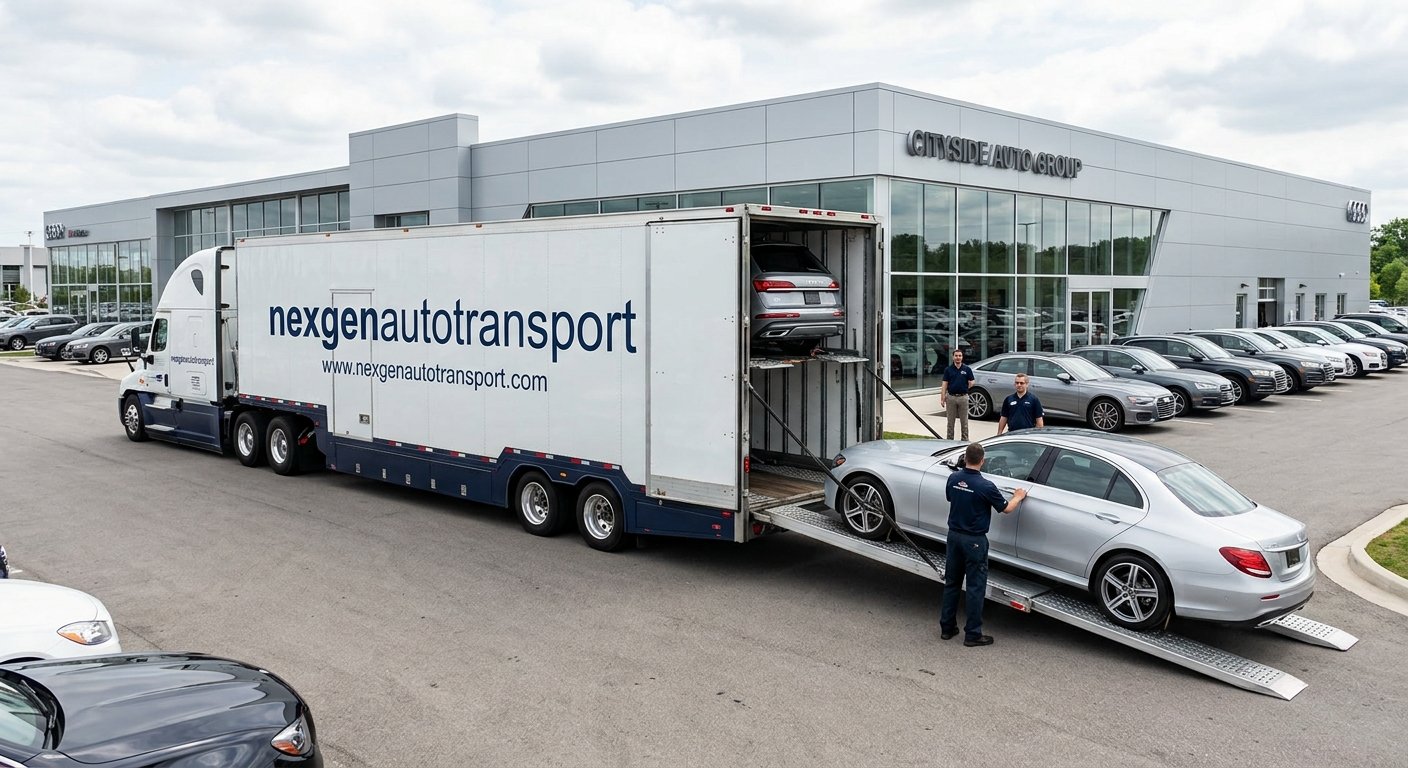
Dealer trades, auction pickups, and inventory transfers don’t leave much room for a carrier that shows up late, mishandles paperwork, or can’t scale with your volume. Dealer-to-dealer car shipping is a different service than a one-time consumer shipment, and it needs to be handled by a carrier built for that difference.
NexGen Auto Transport works with dealerships on trades, transfers, and auction logistics every day. Here’s what makes a carrier the right fit for dealer-to-dealer transport, and how our service is built around it.
What Is Dealer-to-Dealer Car Shipping?
Dealer-to-dealer shipping covers any vehicle movement between two dealership businesses rather than to an individual buyer. That includes:
- Dealer trades and swaps — exchanging inventory with another dealership to match local demand (a Florida dealer swapping a truck for a sports car with a Texas dealer, for example)
- Auction acquisitions — moving vehicles won at auction to the dealership lot for reconditioning and resale
- Lot repositioning — relocating inventory between locations within the same dealer group
- Wholesale transfers — buying and moving vehicles between dealers outside of a formal auction setting
- Reconditioning center transfers — sending vehicles to and from a detailing, inspection, or repair facility before they hit the lot
Each of these moves inventory rather than a retail delivery, which changes what you actually need from a carrier — speed, consistency, and the ability to handle volume, rather than a single white-glove delivery experience.
What Makes a Carrier the Right Fit for Dealer-to-Dealer Transport
1. Priority Dispatch
Inventory sitting idle costs money. A carrier built for dealer work prioritizes dispatch on trade and auction shipments so vehicles aren’t waiting days longer than necessary to get on a trailer — especially important when a swap or sale is time-sensitive on both ends.
2. Volume Pricing and Consolidated Billing
Dealer relationships involve repeat, ongoing shipments, not a single transaction. The right carrier prices based on your overall volume rather than treating every shipment as a brand-new quote, and offers consolidated invoicing so your accounting team isn’t processing dozens of separate payments each month.
3. A Dedicated Account Contact
Instead of submitting a new request and re-explaining your needs every time, a dealer-focused carrier assigns one point of contact who already understands your typical routes, vehicle types, and preferences.
4. Route and Auction Familiarity
Carriers who regularly run auction and wholesale routes bring fewer scheduling surprises. They already understand lot access, auction pickup procedures, and the timing constraints dealers work under — which matters more than it might seem when a vehicle needs to be on the lot before a specific sale or promotion.
5. Flexible Equipment
Dealer inventory varies — everyday sedans and SUVs alongside the occasional high-value trade-in. The right carrier offers both open and enclosed transport under the same account, so a mixed shipment doesn’t need to be split across two providers.
6. Proper Documentation and Insurance
With more vehicles moving at once, consistent condition reporting matters more, not less. A dealer-ready carrier uses a standardized inspection and bill-of-lading process for every vehicle and carries cargo insurance sufficient to cover a full multi-vehicle load, not just a single unit.
How Dealer-to-Dealer Shipping Works With NexGen
- Set up a dealer account. Share your typical shipping volume, common routes, and vehicle mix so we can build a volume pricing structure.
- Submit your shipment. Whether it’s a single trade or a multi-vehicle auction pickup, your dedicated contact handles booking directly.
- Priority dispatch. We prioritize scheduling for dealer accounts to keep inventory moving and minimize idle time.
- Pickup and documentation. Our drivers complete a standardized inspection and digital bill of lading at pickup for every vehicle.
- Delivery and sign-off. The receiving dealership inspects and signs off at delivery, with paperwork routed back to your account.
- Consolidated invoicing. Choose per-shipment or batched billing to match your accounting workflow.
Dealer-to-Dealer vs. Standard Consumer Shipping
| Factor | Dealer-to-Dealer Shipping | Standard Consumer Shipping |
|---|---|---|
| Pricing model | Volume-based, scales with shipping activity | Per-shipment quote |
| Account structure | Dedicated account manager, consolidated billing | Individual booking per shipment |
| Dispatch priority | Priority scheduling for repeat accounts | Standard scheduling queue |
| Typical shipment size | Single vehicles up to full multi-car loads | Usually a single vehicle |
| Common use case | Trades, auction pickups, lot transfers | Relocation, out-of-state purchase, snowbird moves |
What to Ask Before Choosing a Dealer-to-Dealer Carrier
Not every carrier that ships consumer vehicles is set up to handle dealer volume well. Before committing to a provider for your ongoing trades and transfers, it’s worth asking:
- Do you offer volume pricing, or is every shipment quoted individually? If pricing doesn’t improve with volume, you’re likely leaving savings on the table.
- Will I have a dedicated point of contact? Re-explaining your needs on every shipment slows things down and increases the chance of miscommunication.
- Can you handle multi-stop pickups across nearby auction lots? This matters if your sourcing isn’t concentrated at a single location.
- What’s your typical dispatch time for dealer accounts? Idle inventory has a real cost — ask how quickly a carrier typically dispatches for repeat dealer shipments versus one-off consumer orders.
- How is documentation handled? Confirm whether inspections are standardized and digital, and whether the process holds up if a damage dispute comes up later.
- Are you FMCSA registered, and can you provide your USDOT/MC number? This is a baseline check for any carrier or broker moving your inventory, dealer account or not.
Handling Trades and Swaps Between Dealerships
Dealer trades add a layer of complexity that a standard shipment doesn’t have: two dealerships, two vehicles, and often two different pickup and delivery locations happening on a coordinated timeline. A carrier experienced with dealer trades can:
- Coordinate simultaneous pickup at both dealerships when the trade needs to happen on a matched schedule
- Route both vehicles efficiently, even when the two dealerships aren’t directly on the same corridor
- Provide synchronized documentation so both dealerships receive consistent condition reports and delivery confirmation
- Flag and communicate any delay on either leg of the trade immediately, since one side arriving late affects both parties
Auction and Reconditioning Center Logistics
Auction-sourced inventory has its own timing pressure — vehicles need to move from the auction lot to the dealership (often via a reconditioning center first) quickly to minimize the time they sit unsold. A dealer-focused carrier should be able to:
- Coordinate direct pickup from major auction locations without requiring you to physically retrieve the vehicle first
- Route vehicles through a reconditioning or detailing facility as an intermediate stop when needed
- Batch multiple auction wins from the same event into a single consolidated shipment
- Provide predictable delivery windows so reconditioning and merchandising can be scheduled in advance
Common Challenges in Dealer-to-Dealer Transport (and How the Right Carrier Solves Them)
Moving inventory between dealerships comes with a specific set of friction points that don’t show up in a typical one-off consumer shipment:
Tight Lot Space and Urban Access
Dealership lots — especially in dense urban areas — can be tight to navigate for large carrier trucks. An experienced dealer carrier plans routing and truck size around lot access constraints in advance, rather than discovering the problem on pickup day.
Long-Haul Trades Across the Country
A trade between a Northeast and West Coast dealership involves a much longer transit window and more coordination than a same-region transfer. The right carrier sets realistic delivery expectations upfront for long-haul trades and communicates proactively if either leg of the trade is running behind schedule.
Inconsistent Carrier Quality
Dealerships that shop for a new carrier on every shipment often see inconsistent service — different drivers, different documentation standards, different communication styles. Working with one dealer-focused carrier on an ongoing account basis solves this by keeping the process consistent shipment after shipment.
Coordinating Simultaneous Pickups for Trades
Trades typically involve two vehicles moving in opposite directions on a matched timeline. Without careful coordination, one dealership can end up short a vehicle while waiting on the other leg to complete. A carrier with dealer trade experience builds this synchronization into the routing plan from the start.
Technology and Tracking for Dealer Shipments
Visibility matters more when you’re managing multiple vehicles in transit at once rather than tracking a single personal shipment. Look for a carrier that offers:
- Real-time status updates across all active shipments tied to your account, not just one vehicle at a time
- Digital bills of lading and inspection reports that are easy to pull up later if a dispute or warranty question comes up
- Centralized account access so anyone on your team — sales, operations, accounting — can check shipment status without routing every question through one person
- Proactive delay notifications rather than having to call and check in on a shipment’s status yourself
This kind of visibility becomes especially valuable as your shipping volume grows — a dealership moving two or three vehicles a month can manage with occasional check-ins, but one moving dozens needs a system that surfaces problems before they become a scheduling headache.
Frequently Asked Questions
What’s the difference between dealer-to-dealer shipping and shipping to a retail customer?
Dealer-to-dealer shipping moves inventory between businesses — trades, auction pickups, lot transfers — and is typically priced and managed on a volume, account basis. Retail customer delivery is a single, one-time shipment to an individual buyer, usually quoted and booked separately.
Can one carrier handle both dealer trades and auction pickups?
Yes. A carrier set up for dealer accounts typically handles both under the same account and pricing structure, since both fall under the same volume-based dealer service.
How quickly can a dealer shipment be dispatched?
Dealer accounts generally get priority dispatch over standard consumer bookings, though exact timing depends on route and vehicle availability. Ask your carrier directly about typical dispatch windows for your specific routes.
Do dealer accounts require a minimum monthly volume?
Not necessarily — many carriers, including NexGen, will work with dealerships shipping occasionally, though the deepest volume pricing and priority dispatch benefits typically apply to accounts with consistent, ongoing shipping activity.
Is enclosed transport available for high-value trade-ins?
Yes. Dealer accounts can mix open and enclosed transport within the same shipment, so a higher-value trade-in can ship enclosed while the rest of your inventory moves on standard open transport.
How is billing handled for ongoing dealer shipments?
You can choose consolidated invoicing across multiple shipments or per-shipment billing, depending on what fits your accounting process best.
What happens if a trade’s timing falls through on one side?
A carrier experienced with dealer trades will flag delays as early as possible so both dealerships can adjust — whether that means holding the other vehicle at pickup, adjusting delivery timing, or communicating directly with both parties involved. This kind of proactive communication is one of the clearest signs a carrier is actually set up for trade logistics rather than treating it as two unrelated shipments.
Can our whole team access shipment status, or just one account contact?
With NexGen, dealer accounts can have shipment visibility extended to multiple team members — sales, operations, and accounting — rather than routing every status check through a single point of contact.
Set Up Your Dealer Account With NexGen
Whether you’re managing regular trades, sourcing from auctions, or repositioning inventory across locations, NexGen Auto Transport can build a shipping structure around how your dealership actually operates. From single trade-in swaps to full multi-vehicle auction runs, the goal is the same: keep inventory moving on a predictable timeline, with pricing and support that scale as your shipping volume grows.
Request a dealer account quote from NexGen Auto Transport and get a dedicated contact, priority dispatch, and volume pricing built around your shipping needs.
