
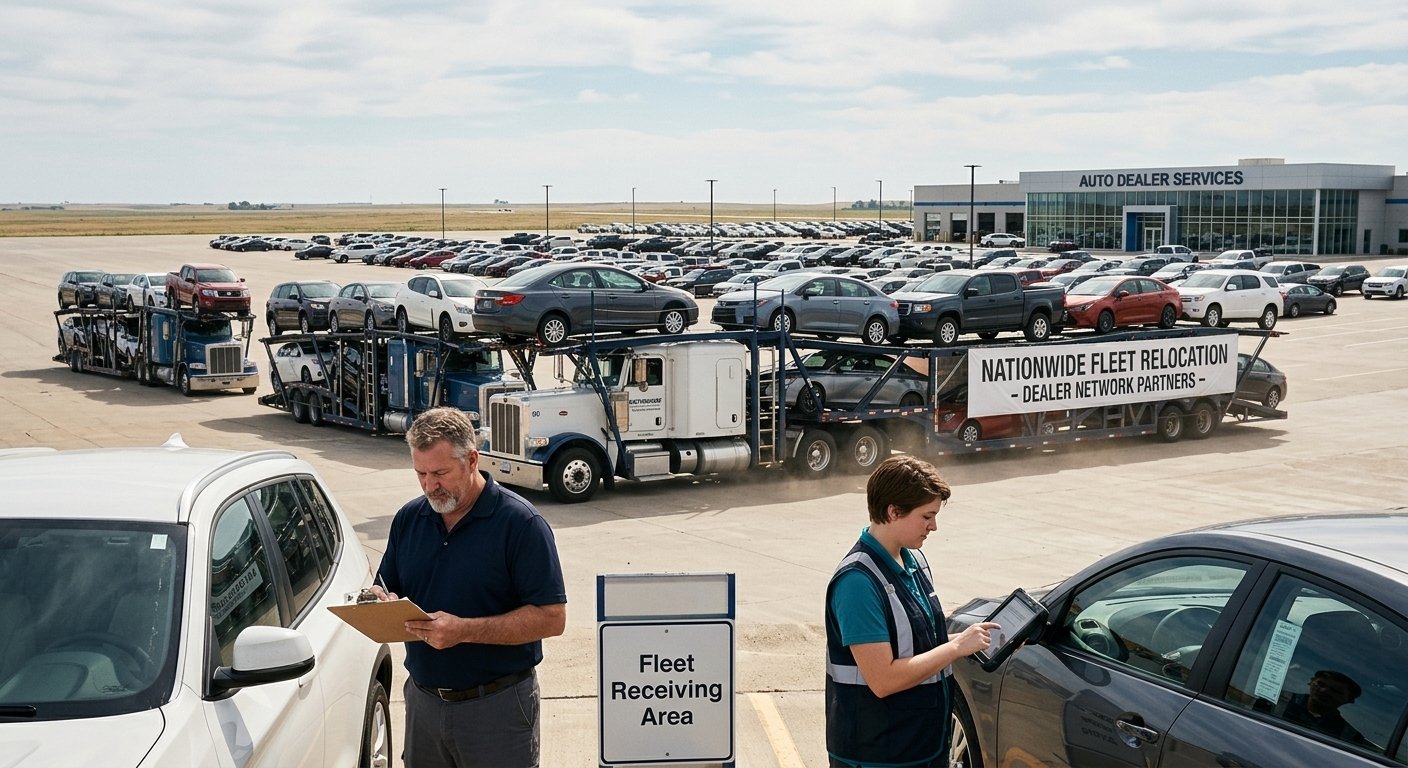
Inventory doesn’t always stay where it’s needed most. A model that’s overstocked in one region might be exactly what’s selling fast three states away. Nationwide fleet relocation for dealers is how multi-location dealer groups, franchise networks, and rental or corporate fleets keep vehicles moving to where the demand actually is — without every transfer becoming a one-off logistics project.
NexGen Auto Transport supports dealer groups relocating inventory across regions, opening new locations, and rebalancing stock between stores nationwide. Here’s how fleet relocation works and what it takes to run it well.
What Is Fleet Relocation?
Fleet relocation covers any large-scale, planned movement of vehicles between locations — as opposed to a single dealer trade or an individual shipment. Common scenarios include:
- Inter-store inventory rebalancing — moving overstocked models from one location to another within the same dealer group
- New store openings — stocking a new location’s lot with inventory pulled from existing stores or a central distribution point
- Regional demand shifts — repositioning vehicles to match seasonal or regional buying patterns (convertibles moving south for winter, trucks moving toward markets with higher demand)
- Rental and corporate fleet cycling — relocating fleet vehicles between regional hubs as usage patterns and lease cycles change
- Store closures or consolidations — moving an entire lot’s inventory to other locations within the group
This is different from a single dealer trade, which our guide on choosing a carrier for dealer-to-dealer transport covers, and different from a one-time full-truckload auction pickup, which we cover in our bulk vehicle transport guide. Fleet relocation is typically an ongoing, planned program — not a single shipment, but a recurring logistics need built around how your dealer group actually operates across multiple locations.
Why Dealer Groups Relocate Inventory Nationwide
Matching Inventory to Demand
Certain vehicles sell faster in certain regions — trucks and SUVs in areas with more rural or work-driven demand, convertibles and smaller vehicles in warmer, urban markets. Relocating slow-moving inventory to a store where it’s more likely to sell is often more cost-effective than discounting it heavily to move it locally.
Supporting New Locations
Opening a new store or acquiring an existing one usually means stocking a lot quickly, often by pulling inventory from other locations in the network rather than waiting on new deliveries alone. Coordinated relocation gets a new location to a sellable inventory level faster.
Seasonal and Market Timing
Some dealer groups relocate specific vehicle types ahead of predictable seasonal demand — convertibles and off-road vehicles moving toward warmer regions before spring, for example. Planning these moves in advance, rather than reacting to a slow sales month, tends to produce better outcomes.
Fleet and Rental Rebalancing
Rental and corporate fleets shift vehicles between hubs as usage, seasonal travel demand, and lease cycles change. Relocating vehicles proactively — rather than letting utilization imbalances build up — keeps fleet assets working instead of sitting idle in the wrong market.
How Nationwide Fleet Relocation Works
- Assess your network. Identify which locations have excess inventory and which need it, based on sales data, seasonal trends, or new-store requirements.
- Plan routes and volume. Group relocations by region and route efficiency rather than moving vehicles one at a time between mismatched locations.
- Set a relocation schedule. Whether it’s a one-time push (a new store opening) or a recurring program (quarterly rebalancing), a planned schedule lets your carrier build efficient routes in advance.
- Coordinate multi-stop or multi-location pickups. Vehicles are collected from multiple source locations and distributed to their new destinations, often across several stops on the same route.
- Track and confirm delivery. Each vehicle is inspected and documented at pickup and delivery, with visibility into where every unit is throughout the relocation.
Open vs. Enclosed Transport for Fleet Relocation
Most fleet relocation moves standard inventory via open vehicle transport, the most cost-effective option for everyday sedans, SUVs, and trucks moving between stores. If your fleet includes higher-value or specialty vehicles being relocated to a specific market, enclosed vehicle transport can be used for those units within the same coordinated relocation plan. See our guide on open vs. enclosed transport for a full comparison of when each makes sense.
Building a Relocation Program That Scales
A single relocation project is straightforward to plan around. An ongoing, nationwide relocation program — moving inventory continuously across a multi-location network — benefits from a bit more structure:
- A standing account rather than one-off quotes. Recurring relocation needs are priced and managed more efficiently under a dealer account with volume-based pricing than by requesting a new quote for every move.
- Regional route familiarity. A carrier that regularly runs the same lanes between your locations can move vehicles more predictably than one routing a truck out of its way for a one-time request.
- Centralized visibility. If relocation decisions are made at a corporate or regional level while individual stores handle receiving, a single account with shared visibility keeps everyone working from the same information.
- Forecasted volume sharing. Letting your carrier know about upcoming relocation needs — a new store opening next quarter, a seasonal push — allows better capacity planning than requesting large moves on short notice.
What to Look for in a Fleet Relocation Partner
- Nationwide carrier network capacity — enough reach to actually cover cross-country relocations, not just regional shipments
- Multi-stop and multi-location routing experience, since fleet relocation rarely involves a single pickup and single delivery point
- Dedicated account management for a program that spans multiple locations and possibly multiple regional contacts
- Consistent documentation across every vehicle and every location, so condition records stay reliable at scale
- Flexible scheduling that can support both planned, recurring relocation and occasional urgent moves (a new store opening on a tight timeline, for example)
- Verified licensing and insurance sufficient to cover the full scope of an active relocation, especially when several vehicles are in transit across different routes at once
Fleet Relocation for New Store Openings
Stocking a new location is one of the most time-sensitive relocation scenarios a dealer group faces. Rather than waiting entirely on new manufacturer deliveries, many groups pull a portion of opening-day inventory from existing stores — which means coordinating several source locations against a single hard deadline. A well-planned opening relocation typically involves:
- An inventory pull list finalized well ahead of the opening date, identifying exactly which vehicles are moving from which locations
- A staggered pickup schedule across source stores, timed so vehicles arrive in a sensible order rather than all at once or too late
- A buffer before opening day to account for any transit delays, since a new location generally can’t afford to open with an empty lot
- Clear delivery coordination with the new store’s team, who may not yet have an established process for receiving inventory
Regional Demand Shifts and Seasonal Relocation
Some dealer groups build seasonal relocation into their regular planning cycle rather than reacting to slow inventory after the fact. A few patterns that come up often:
- Convertibles and soft-top vehicles moving toward warmer regions ahead of spring and summer selling season
- Trucks and SUVs with four-wheel drive moving toward colder or more rural markets ahead of winter
- Fuel-efficient and compact vehicles shifting toward denser urban markets where they historically move faster
- Post-season repositioning — moving unsold seasonal inventory to a market where the season is just beginning, extending its selling window instead of discounting it locally
Planning these moves a season ahead, rather than after inventory has already sat too long, tends to produce noticeably better results — both in transit efficiency and in how quickly the relocated vehicles actually sell.
Common Challenges With Nationwide Fleet Relocation
Underestimating Lead Time for Cross-Country Moves
Long-haul relocations, especially coast to coast, take longer than regional transfers. Planning relocation timing around realistic transit windows — rather than assuming vehicles will arrive as quickly as a local transfer — avoids inventory gaps at the receiving location.
Uncoordinated, One-Off Requests
Treating every relocation as a separate, unrelated shipment makes it harder to get efficient routing or consistent pricing. Grouping relocations by region and planning them on a schedule, even a loose one, tends to produce better outcomes than reactive, one-at-a-time requests.
Inconsistent Communication Between Locations
When relocation decisions are made centrally but receiving happens at the store level, gaps in communication can leave a location unprepared for an incoming vehicle. Clear delivery scheduling and confirmation at each stop helps avoid this.
Frequently Asked Questions
Is fleet relocation different from a standard multi-vehicle shipment?
Yes. Fleet relocation typically involves recurring or planned movement across multiple locations, often as an ongoing program rather than a single shipment. Standard multi-vehicle shipments are usually a one-time order for a specific batch of vehicles.
Can relocation include multiple pickup and delivery locations in one plan?
Yes. Nationwide relocation commonly involves pulling inventory from several source locations and distributing it across several destination stores, coordinated as part of the same program.
How far in advance should we plan a relocation program?
For a one-time push, such as stocking a new store, 3–4 weeks of lead time is typically enough to plan efficient routing. For an ongoing relocation program, sharing your general volume and regional patterns upfront allows for better long-term capacity planning.
Can we mix open and enclosed transport within a relocation plan?
Yes. Standard inventory can move via open transport while higher-value or specialty vehicles are routed separately via enclosed transport, all coordinated under the same relocation plan.
Does relocation pricing work differently than standard shipping?
Fleet relocation is typically priced around ongoing volume and route consistency rather than a single shipment quote, which can result in more favorable standing rates for dealer groups moving inventory regularly.
Set Up a Fleet Relocation Plan With NexGen
Whether you’re rebalancing inventory across a few stores or coordinating a nationwide relocation program, NexGen Auto Transport can build a plan around how your dealer network actually operates.
Get a free quote from NexGen Auto Transport, or contact our team to discuss a relocation plan for your dealer network.
