
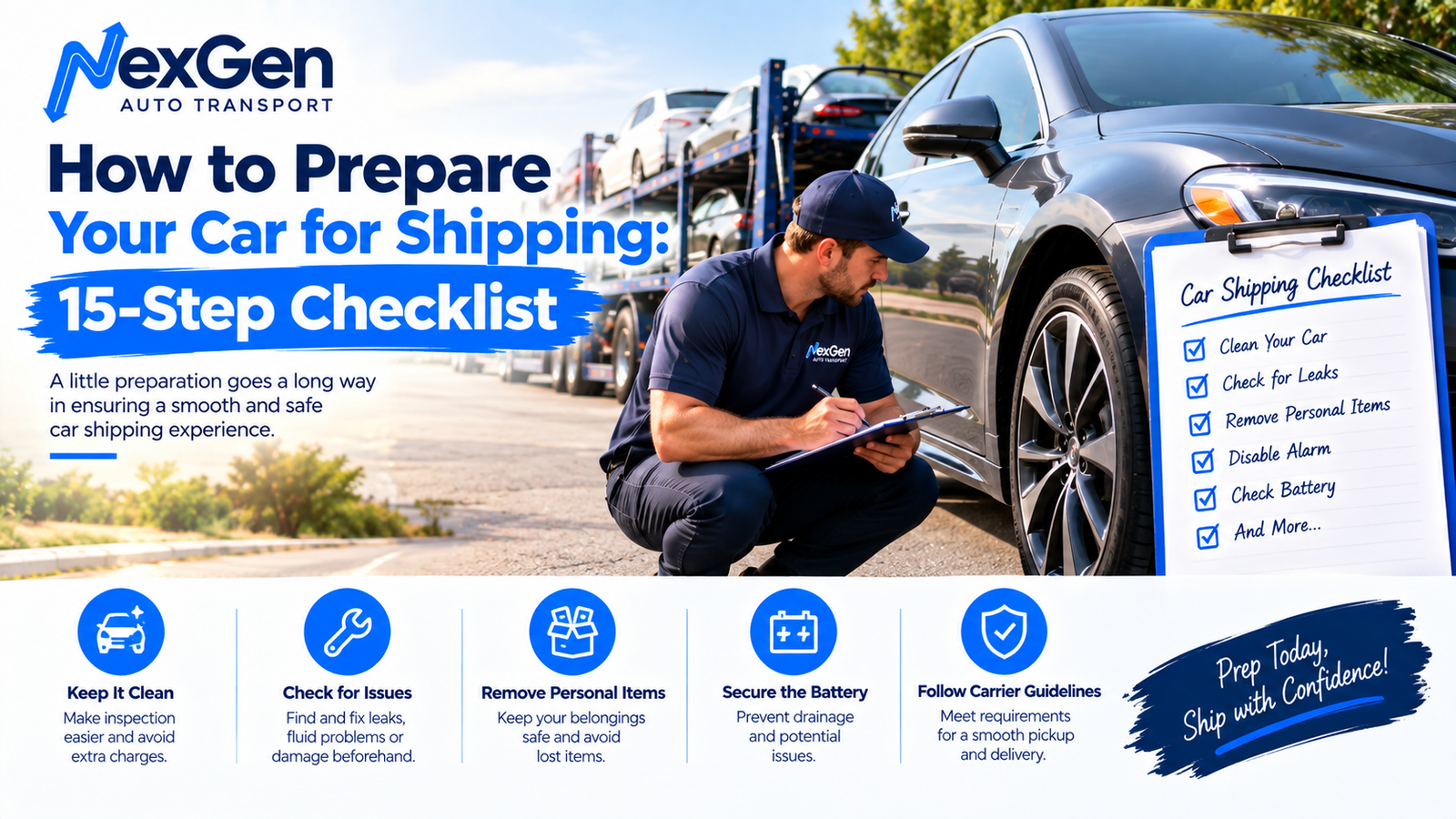
Quick answer: To prepare your car for shipping, wash it, photograph every angle, remove personal items and loose parts, keep the fuel tank about one-quarter full, check for leaks, disable the alarm and toll tags, and be ready to inspect and sign the Bill of Lading at pickup and delivery. Following these steps helps your car load without delays and protects you if you ever need to file a claim.
Last updated: October 7, 2026 | Reading time: about 8 minutes
Key Takeaways
- Photos and a clean car are your best protection if damage is ever disputed.
- Keep about a quarter tank of fuel. A full tank adds weight and an empty one causes loading problems.
- Personal items are limited and are usually not covered by cargo insurance, so remove valuables.
- A vehicle that is not ready at pickup can lead to extra fees. See our Cancellation & Refund Policy.
- Always note new damage on the Bill of Lading before you sign at delivery.
What’s in This Guide
- Why Preparing Your Car Matters
- The 15-Step Car Shipping Checklist
- Quick Reference: Do and Don’t
- What to Do at Pickup and Delivery
- Special Cases: EVs, Luxury, Non-Running and Modified Cars
- Common Mistakes to Avoid
- Choose a Shipper You Can Verify
- Frequently Asked Questions
Why Preparing Your Car for Shipping Matters
Car shipping is safe and routine, but a little preparation makes a big difference. A prepared vehicle loads faster, avoids pickup problems, and gives you clear proof of its condition. That proof is the foundation of any insurance claim, which we explain in our Claims & Damage Process guide.
Preparation also protects your wallet. If a driver travels to your pickup address and the car cannot be loaded, a dry run fee can apply. You can see exactly how fees work in our cancellation, rescheduling and refund policy.
The 15-Step Car Shipping Checklist
1. Wash your car inside and out
A clean car makes it easy to spot existing scratches, dents, and chips during the inspection. Dirt can hide damage, which leads to disagreements later. Wash the car a day or two before pickup so it is dry and clear.
2. Take dated photos and a short video
Photograph all sides of the car, the roof, the wheels, the interior, and the odometer. Take close-ups of any existing damage. Record a slow walk-around video in good light. Keep the files with the date visible on your phone. If you ever need to file a claim, this record is extremely valuable.
3. Remove personal items
Take out valuables, documents, electronics, loose change, and anything you would hate to lose. Cargo insurance protects the vehicle, and personal belongings are typically not covered. If you do need to leave something in the car, NexGen allows up to 100 lbs of securely packed items kept below window level. Ask your dispatcher first.
4. Remove or secure loose and custom parts
Take off bike racks, roof boxes, cargo carriers, and removable antennas. Secure or tell the carrier about spoilers, ground-effect kits, and other aftermarket parts, because they can be damaged by wind, tie-downs, or loading ramps.
5. Keep the fuel tank about one-quarter full
A quarter tank is enough for loading and unloading and keeps the vehicle’s weight down. A full tank adds unnecessary weight, and carriers must stay within legal weight limits.
6. Check for fluid leaks and mechanical problems
Look under the car for oil, coolant, or fuel leaks. Leaking fluids can damage vehicles stored below yours on a carrier. Tell your dispatcher about any leaks or mechanical problems before pickup so the right truck is assigned.
7. Check the battery, tires, and fluids
Make sure the battery is charged and secure, tires are properly inflated, and fluids are topped up. A car that starts, steers, and brakes normally is far easier and safer to load. You can also check for open safety recalls on the NHTSA recalls page if you have not done so recently.
8. Disable the alarm and remove toll tags
A car alarm that goes off in transit can drain the battery and frustrate drivers. Turn it off, or give the driver clear written instructions. Remove E-ZPass or other toll transponders so you are not charged for tolls the truck drives through.
9. Fold mirrors, lower the antenna, and secure convertible tops
Fold in side mirrors and lower or remove the antenna. Make sure convertible tops and sunroofs are fully closed and latched. This prevents wind damage on the road.
10. Check the charge level of an electric vehicle
For electric vehicles, ask your carrier or dispatcher what battery level they recommend. Our electric vehicle transport page covers EV-specific handling, and our Tesla car shipping page has Tesla-specific tips.
11. Prepare one set of keys
Give the driver one set of keys, and keep a spare. If you cannot hand them over in person, arrange a safe way to do it with your dispatcher. Do not leave keys hidden in or on the vehicle.
12. Gather your paperwork
Have a valid photo ID, your order confirmation, and, if requested, your vehicle registration. Some shipments may also require a bill of sale or proof of insurance, especially if the car was bought from a dealership, an auction, or a private seller.
13. Tell your dispatcher about anything unusual
Be upfront about whether the car runs, any modifications, extra height or length, and any warning lights. Non-running vehicles can be shipped on winch-equipped trucks, which usually costs more. Misreporting these details can result in a price change or a dry run fee. If your car has issues such as missing wheels, read how to move a car with no wheels.
14. Plan for truck access at your pickup address
Car carriers are large, and some residential streets are too narrow, steep, or tree-lined. If the truck cannot reach your door, you may need to meet the driver at a nearby large parking lot. Learn how this works in our guide to how door-to-door car shipping works.
15. Be there, or authorize someone you trust
You or an adult you trust (18 or older) should be present at both pickup and delivery to inspect the vehicle and sign the Bill of Lading. If you cannot be there, read our guide on how to ship a car without being present.
Ready to ship your car?
Get a free, no-obligation quote. No upfront deposit required.
Get My Free Quote or call +1 (832) 886-1321
Quick Reference: Do and Don’t
| Do | Don’t |
|---|---|
| Wash the car and take dated photos and video | Ship a dirty car that hides scratches and dents |
| Keep about a quarter tank of fuel | Fill the tank completely or let it run nearly empty |
| Remove valuables and personal items | Leave electronics, documents, or cash in the car |
| Tell your dispatcher about leaks, mods, or a non-running car | Hide problems to get a lower quote |
| Disable the alarm and remove toll tags | Leave the alarm armed or the E-ZPass attached |
| Inspect the car and note damage on the BOL before signing | Sign a clean Bill of Lading when you can see damage |
What to Do at Pickup and Delivery
At pickup
The driver will walk around your car with you and record its condition on the Bill of Lading (BOL). Review every note. Make sure existing scratches and dents are listed accurately, then sign. Keep your copy of the BOL in a safe place.
At delivery
Inspect the car in good light before you sign anything. Compare it with your photos and with the pickup report. If you see new damage, write it on the BOL and have the driver sign it. Then follow the steps in our Claims & Damage Process. Damage should be reported to NexGen Auto Transport within 24 hours of delivery. To understand what cargo insurance covers, read does car shipping insurance cover damage? and our insurance information.
Special Cases: EVs, Luxury, Non-Running and Modified Cars
- Open or enclosed transport: Enclosed trailers protect against weather and road debris, but the preparation steps are the same. Compare your options in open vs enclosed car transport.
- Luxury and classic cars: Document everything with extra photos and ask about enclosed shipping. See our luxury car transport service.
- Electric vehicles: Confirm the battery charge level and charging port access with your dispatcher. See electric vehicle transport.
- Non-running vehicles: Tell us before booking so a winch truck can be assigned.
- Motorcycles: Preparation is similar, but the shipping method differs. See motorcycle shipping and the motorcycle shipping cost.
- Moving long distance or across the country: Plan ahead with our guide to shipping a car across the country and our tips for car shipping when moving to a new state.
Common Mistakes to Avoid
- Skipping photos. Without proof of the car’s pre-shipping condition, damage claims are much harder.
- Packing the trunk. Overloaded cars add weight and can be refused. Personal items are not covered like the vehicle is.
- Forgetting to tell the dispatcher about a non-running car. This can cause a dry run or a last-minute price change.
- Signing without inspecting. Once you sign a clean BOL at delivery, it is difficult to prove the damage happened in transit.
- Choosing only on price. A very low quote can mean delays or no carrier at all. Read auto transport companies to avoid to learn the warning signs.
- Booking too late. Last-minute shipping costs more. Learn the cheapest time of year to ship a car and see typical prices in how much it costs to ship a car.
How Long Will Shipping Take After You Prepare?
Most shipments take between 1 and 7 days on the road, depending on distance, route, and weather. Short trips under 500 miles can arrive in 1 to 2 days, while coast-to-coast trips can take about 5 to 7 days. For a full timeline, see how long it takes to ship a car. In a hurry? Read about expedited auto transport and emergency car shipping.
Choose a Shipper You Can Verify
Good preparation works best with a trustworthy company. Before you book, confirm that the company is registered with the Federal Motor Carrier Safety Administration (FMCSA). You can look up any broker or carrier by USDOT or MC number in the FMCSA SAFER system, and learn more about federal motor carrier rules at FMCSA.dot.gov.
NexGen Auto Transport LLC is a licensed FMCSA property broker (USDOT 3969190, MC-1482694). Learn more about us, or read how to choose a car shipping company. Have questions? Visit our FAQs or contact us.
Frequently Asked Questions
How full should the gas tank be when shipping a car?
Keep the fuel tank about one-quarter full. This is enough to load and unload the vehicle while keeping its weight down.
Can I leave personal items in my car during shipping?
Limited items may be allowed. NexGen allows up to 100 lbs of securely packed items kept below window level. Personal belongings are typically not covered by cargo insurance, so remove valuables and confirm the rules with your dispatcher first.
Do I need to clean my car before shipping it?
Yes. A clean car makes it easier to inspect and document existing damage, which protects you in a claim.
What paperwork do I need to ship a car?
You will usually need a valid photo ID and your order details. Some shipments may also need your vehicle registration, a bill of sale, or proof of insurance.
Do I have to be present when my car is picked up or delivered?
You or an authorized adult should be there to inspect the vehicle and sign the Bill of Lading. If you cannot attend, you can authorize a trusted person. See how to ship a car without being present.
Can I ship a car that does not run?
Yes, non-running vehicles can be shipped on winch-equipped carriers. It often costs more, and you must tell your dispatcher before booking.
What should I do if my car is damaged during shipping?
Note the damage on the Bill of Lading before signing, take photos, and report it to NexGen within 24 hours of delivery. We will guide you through filing a claim. See our Claims & Damage Process.
Final Thoughts
A well-prepared car makes shipping smooth: faster pickup, fewer surprises, and strong protection if something goes wrong. Wash it, photograph it, remove valuables, keep a quarter tank of fuel, and inspect carefully at pickup and delivery.
Get Your Free Car Shipping Quote
Licensed FMCSA broker, nationwide door-to-door service, and no upfront deposit.
