
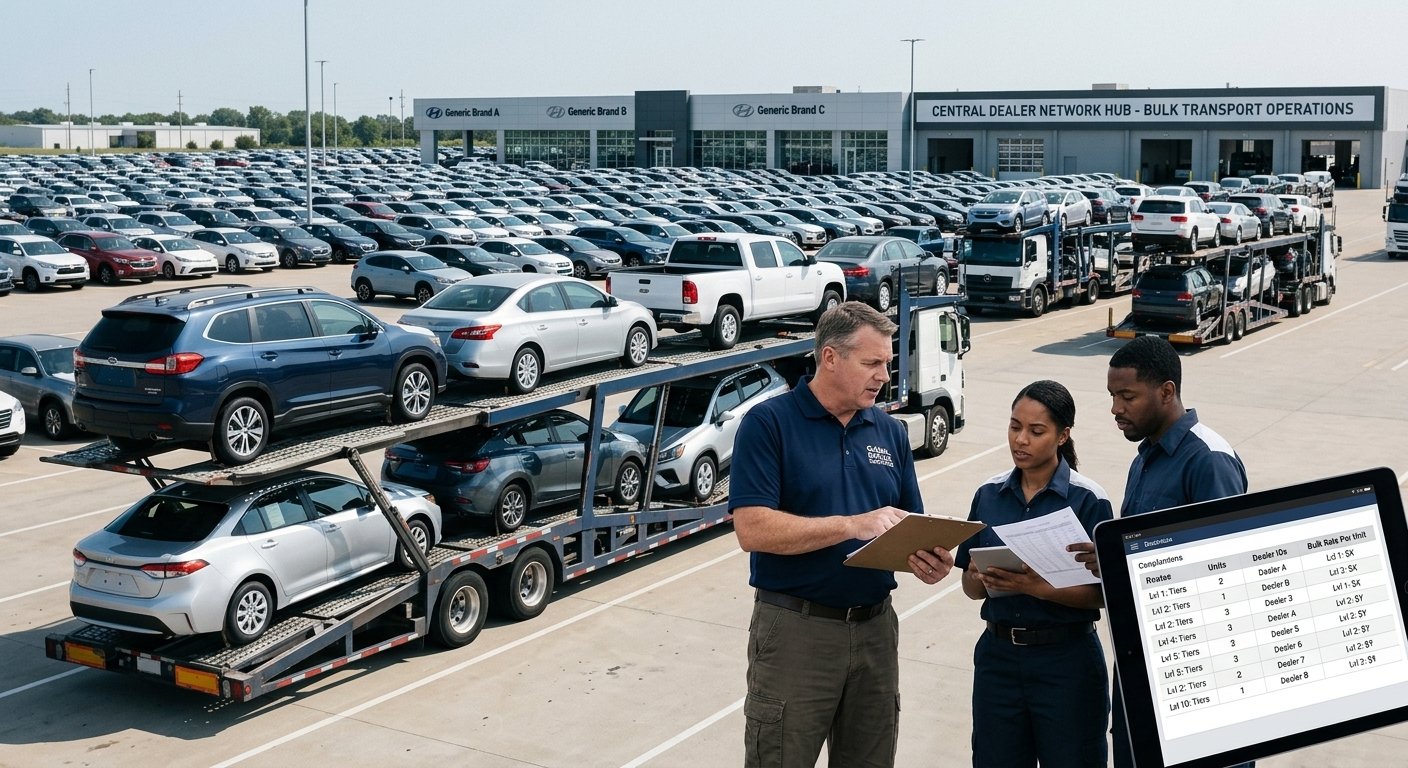
Once you’re shipping vehicles by the tier rather than one at a time, “how much does it cost” stops being a single number and becomes a rate card — a structured breakdown of what you pay per vehicle based on how much volume you bring and how far it’s traveling. Bulk car shipping rates for dealer networks work exactly that way at NexGen Auto Transport, and this guide walks through how the tiers actually break down.
If you’re looking for the reasoning behind why bulk pricing is lower per vehicle, our guide on bulk vehicle transport for dealerships covers the logistics side. This post focuses specifically on the numbers.
How Bulk Rate Cards Differ From Standard Pricing
A standard shipping quote is priced per vehicle, per shipment — you request a quote, get a number, and book. A dealer network rate card works differently:
- Pricing is tiered by volume, so your per-vehicle rate improves as your shipping activity across the network increases, rather than being quoted fresh every time.
- Rates are set against a standing agreement, not negotiated shipment by shipment, which keeps pricing predictable for budgeting and accounting purposes.
- Volume is often measured across the whole network, not per individual store, so a multi-location dealer group can combine shipping activity from several stores to reach a better tier.
Baseline Per-Vehicle Rates by Distance
Before volume discounts, standard open-transport pricing for a single vehicle generally falls in this range, depending on distance:
| Distance | Estimated Per-Vehicle Rate (Open Transport) | Approx. Per-Mile Rate |
|---|---|---|
| Under 500 miles | $500 – $750 | $1.00 – $1.50/mi |
| 500 – 1,000 miles | $650 – $950 | $0.65 – $0.95/mi |
| 1,000 – 2,000 miles | $900 – $1,400 | $0.50 – $0.70/mi |
| 2,000+ miles | $1,300 – $1,900 | $0.40 – $0.65/mi |
This is your baseline — the starting point before any dealer network volume tier is applied. For a broader look at how individual vehicle shipping is priced, see our full guide on how much it costs to ship a car.
Dealer Network Volume Rate Tiers
Once your network’s shipping volume qualifies for a tier, the baseline per-vehicle rate drops accordingly. Here’s how tiers are typically structured:
| Tier | Monthly Volume Across Network | Per-Vehicle Discount vs. Baseline |
|---|---|---|
| Tier 1 — Starter | 2–4 vehicles/month | 5–10% off |
| Tier 2 — Growth | 5–9 vehicles/month | 10–15% off |
| Tier 3 — Volume | 10–19 vehicles/month | 15–20% off |
| Tier 4 — Network | 20+ vehicles/month | 20–25%+ off, custom rate card |
Tier 4 accounts typically move to a fully custom rate card rather than a flat percentage, since volume at that level usually justifies dedicated route planning and negotiated pricing specific to your network’s actual routes and vehicle mix.
Worked Example: What a Tier Looks Like in Dollars
To make the tiers concrete, here’s what a Tier 2 dealer network (5–9 vehicles/month, roughly 10–15% off baseline) might pay shipping a mix of vehicles roughly 1,000 miles:
| Pricing Approach | Per-Vehicle Rate | Total for 7 Vehicles |
|---|---|---|
| Baseline (no tier) | ~$950 | ~$6,650 |
| Tier 2 rate (10–15% off) | ~$810 – $855 | ~$5,670 – $5,985 |
How Enclosed Transport Affects Your Rate
Enclosed transport carries its own baseline premium — typically 30–60% above open transport pricing — before any volume tier is applied. Dealer network tiers still apply to enclosed shipments, but the discount is calculated against the higher enclosed baseline rather than the open transport rate. For networks shipping a mix of standard and high-value inventory, it’s common to see most volume move via open transport with only select vehicles routed through enclosed transport, which keeps the overall network rate closer to the open transport tier pricing. See our full comparison in open vs. enclosed transport if you’re deciding how to split a mixed shipment.
What Affects Where You Land Within a Tier
Two dealer networks at the same volume tier won’t always pay the exact same rate. A few factors move you toward the better end of a tier’s range:
- Route consistency. Networks shipping regularly between the same set of locations get more favorable pricing than those with scattered, one-off routes.
- Vehicle mix uniformity. A load of similarly sized vehicles prices better than a highly mixed batch of trucks, SUVs, and low-clearance vehicles.
- Booking flexibility. Networks that can offer a few days of pickup flexibility, rather than requiring same-day dispatch, typically land toward the lower end of the rate range.
- Shipment consolidation. Bundling multiple vehicles into fewer, larger shipments — rather than requesting many small individual orders — improves effective per-vehicle pricing even within the same tier.
How to Lock In a Standing Rate Card
- Share your network’s shipping history or projected volume. Actual or estimated monthly vehicle counts across all locations determine your starting tier.
- Provide your typical routes. Common pickup and delivery regions help build a more accurate rate card than a generic quote.
- Confirm your vehicle mix. Let us know your typical split between standard inventory and any vehicles that regularly need enclosed transport.
- Review your proposed rate card. You’ll receive tiered pricing by distance band, along with the terms for moving up a tier as volume grows.
- Set up consolidated billing. Choose per-shipment or batched invoicing to match your network’s accounting process.
Rate Card by Tier and Distance
Combining the volume tiers with the distance-based baseline gives a fuller picture of what different dealer networks actually pay per vehicle. Here’s an illustrative rate card across all four tiers for a mid-distance route (roughly 500–1,000 miles):
| Tier | Monthly Volume | Estimated Per-Vehicle Rate (500–1,000 mi) |
|---|---|---|
| No tier (baseline) | 1 vehicle | $650 – $950 |
| Tier 1 — Starter | 2–4 vehicles/month | $585 – $900 |
| Tier 2 — Growth | 5–9 vehicles/month | $550 – $855 |
| Tier 3 — Volume | 10–19 vehicles/month | $520 – $810 |
| Tier 4 — Network | 20+ vehicles/month | Custom rate card, typically $487 or less |
Longer routes follow the same tiered discount pattern, just applied against a higher baseline — a Tier 3 network shipping vehicles 2,000+ miles would apply the same 15–20% range to the $1,300–$1,900 baseline for that distance band rather than the mid-distance figures shown here.
Comparing Rate Cards to a Pay-Per-Shipment Approach
Some dealer networks stick with pay-per-shipment pricing even at meaningful volume, usually because it feels simpler to manage than negotiating a standing agreement.
A rate card doesn’t require giving up flexibility — most dealer accounts can still book shipments as needed rather than committing to a fixed schedule.
Frequently Asked Questions
Is bulk rate pricing based on volume per store or across the whole network?
It can be structured either way, but most dealer networks get better pricing by combining volume across all locations into a single account tier rather than qualifying separately per store.
Do rates change automatically as our volume grows?
Typically, your account moves to the next tier once your shipping volume consistently reaches that threshold.
Can we get a custom rate card instead of a standard tier?
Yes, particularly at higher volume (Tier 4 and above), where a custom rate card built around your specific routes and vehicle mix usually performs better than a flat percentage discount.
What’s the fastest way to move to a better rate tier?
Consolidating shipments — bundling several vehicles into fewer, larger orders rather than many small individual requests — is usually the most direct way to both reach a higher volume tier and get better pricing within your current one.
Does a rate card lock us into shipping a fixed number of vehicles?
No. Most rate card agreements set pricing based on expected or historical volume, but don’t require hitting an exact monthly number. If your actual volume consistently falls short of or exceeds your tier, it’s worth revisiting the rate card so pricing reflects your real activity.
Get Your Dealer Network’s Rate Card
Share your network’s shipping volume and typical routes, and we’ll put together a tiered rate card built around how your dealer group actually ships.
Get a free quote from NexGen Auto Transport, or contact our team to request a custom rate card for your dealer network.
