
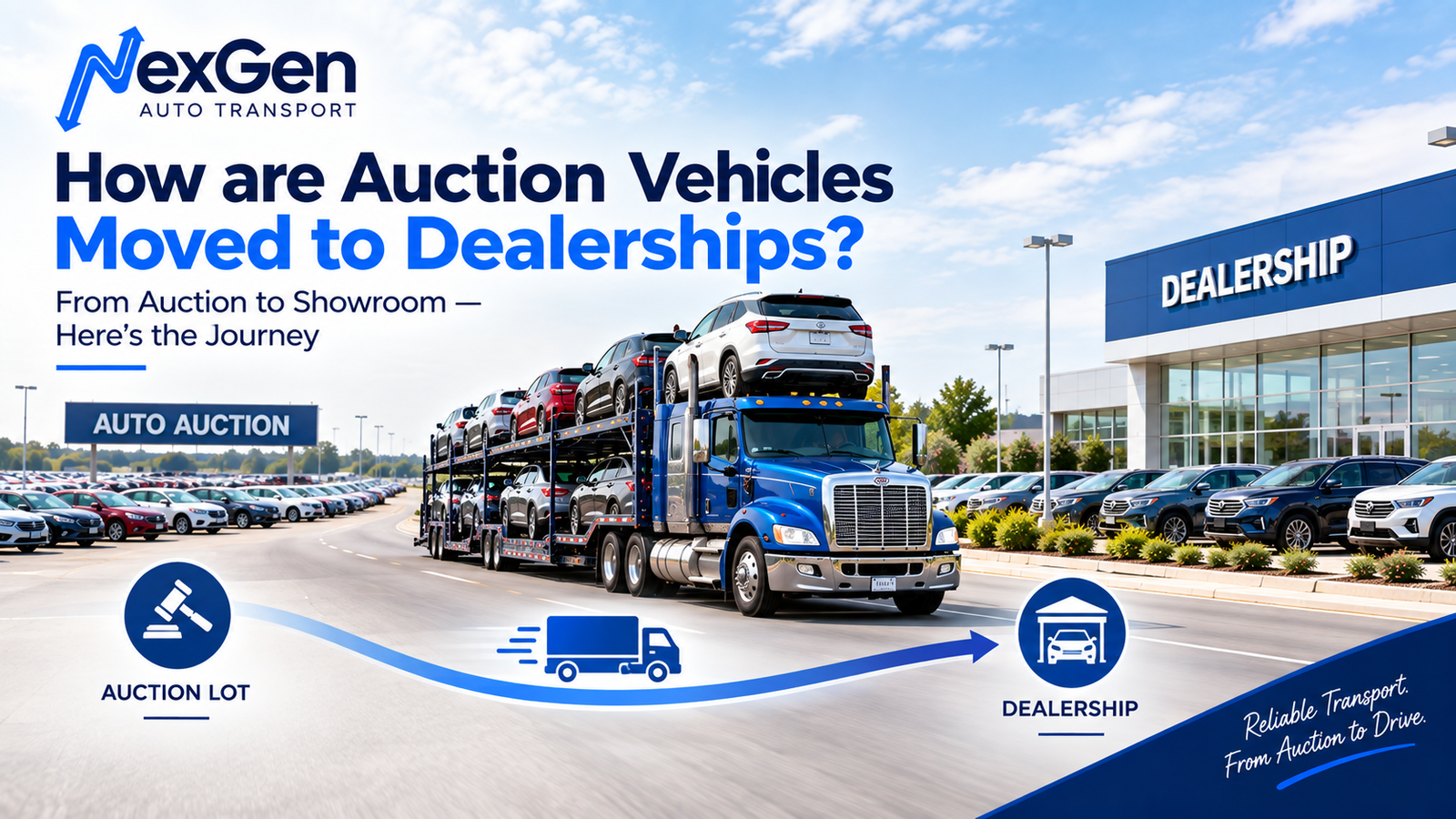
A dealer wins a vehicle at auction. Hours later, it needs to leave the lot. Days later, it needs to be on your showroom floor, ready for reconditioning. Car dealer auction transport is the logistics chain that makes this happen, and it runs on tighter timing than most other kinds of vehicle shipping. Here’s exactly how it works.
Confirm your specific location’s requirement before booking. A missing document, even a small one, can push a scheduled pickup back a full day or more.
Do you want to ship your car?
Call Now: + (832) 886-1321The Journey From Auction Block to Dealership Lot
A vehicle’s path from auction to your lot usually follows this sequence:- A buyer wins the vehicle and completes payment
- The auction issues release paperwork authorizing removal by a carrier
- A carrier picks up the vehicle from the auction lot
- The vehicle travels to its destination, sometimes a reconditioning center first
- The dealership receives, inspects, and logs the vehicle into inventory
Who Handles Auction-to-Dealership Transport
Dealers generally use one of a few approaches:- A dedicated auto transport provider. A carrier or broker coordinates pickup directly with the auction and delivers to your dealership.
- An auction’s in-house transport service. Some auction platforms offer their own logistics arm, often at a premium over independent providers.
- A dealer’s own driver network. Larger dealer groups sometimes use in-house staff for short, regional auction runs.
Step-by-Step: How Dealers Move Auction Inventory
- Confirm payment and receive release paperwork. The auction won’t release the vehicle without this.
- Contact your transport provider with pickup details. Share the auction name, lot location, buyer number, and stock number.
- Confirm a pickup appointment. Most auction lots require scheduling in advance and close on weekends.
- The carrier picks up and inspects the vehicle. This documents its condition before transport starts.
- The vehicle moves to its destination. This might be your lot directly, or a reconditioning center first.
- Your team receives and inspects the vehicle. Compare it against the pickup condition report before logging it into inventory.
Moving Multiple Vehicles From the Same Auction Event
Dealers rarely buy just one vehicle at an auction. Winning several units in a single event is common, especially at larger wholesale auctions. Consolidating those vehicles into one shipment, rather than booking each separately, cuts your per-vehicle cost and simplifies scheduling. See our guide on multi-car shipping discounts for dealers for how volume pricing works when you’re moving several vehicles at once.Do you want to ship your car?
Call Now: + (832) 886-1321Coordinating With Auction Houses
Each auction platform has its own release requirements. Copart and IAA typically ask for a buyer number and lot number. Manheim and ADESA typically require a gate pass and partial VIN. Missing paperwork is the single most common reason a scheduled pickup gets delayed. See our full breakdown of auction-specific requirements in auto auction vehicle shipping services explained.Open vs. Enclosed Transport for Auction Inventory
Most auction purchases move on open transport, the standard and most cost-effective option for everyday sedans, SUVs, and trucks. If you’ve won a specialty, classic, or high-value vehicle, enclosed transport adds protection for the trip to your lot. See our comparison guide, open vs. enclosed auto transport, if you’re deciding which to use for a mixed batch of auction wins.How Long Does Auction-to-Dealership Transport Take?
Transit time follows the same distance-based pattern as any vehicle shipment. A short regional move takes 1–3 days. A cross-country shipment takes 7–10 days. See our full guide on how long car shipping actually takes for the complete breakdown.The bigger variable for auction inventory is usually the time before transit even starts. Payment processing and release paperwork can add a day or two before your carrier can even schedule pickup. Booking transport the moment payment clears keeps this window as short as possible.How Much Does Car Dealer Auction Transport Cost?
Pricing follows the same core factors as standard vehicle shipping: distance, vehicle size, and transport method. See our detailed guide on how much it costs to ship a car for the full breakdown. A few auction-specific costs to budget for:- Storage fees if a vehicle sits past the auction’s free storage window
- Gate or release processing fees, charged by some auction platforms
- Inoperable vehicle fees, typically $150–$300, for vehicles that don’t roll, steer, or brake
- Volume discounts when consolidating several vehicles from the same event into one shipment
Auction Transport Requirements by Platform
Every auction platform handles release slightly differently. Knowing this ahead of time saves a wasted trip for your carrier.| Auction Platform | Typical Release Requirement | Scheduling Notes |
|---|---|---|
| Copart | Buyer number and lot number | Closed weekends. Free storage typically runs about 3 days. |
| IAA | Buyer number and stock number | Closed weekends. Wait times can extend during peak periods. |
| Manheim | Gate pass and last 6 digits of the VIN | Large wholesale network. Appointment-based pickup. |
| ADESA | Gate release and buyer credentials | Similar wholesale process to Manheim. |
Routing Auction Vehicles Through a Reconditioning Center
Many dealers don’t send auction vehicles straight to the sales lot. Instead, the vehicle first goes to a reconditioning or detailing facility. This adds a step to the transport chain:- Carrier picks up from the auction lot
- Vehicle is delivered to the reconditioning center
- Reconditioning work is completed (detailing, minor repairs, inspection)
- A second transport leg moves the vehicle from the reconditioning center to your lot
Tracking and Visibility Across Multiple Shipments
Dealers moving several vehicles at once benefit from clear visibility into where every unit stands. A few things worth asking your provider about:- Real-time status updates across every active shipment tied to your account, not just one vehicle at a time
- Digital inspection reports you can pull up quickly if a condition question comes up later
- Shared account access so your team isn’t routing every status check through a single person
- Proactive delay notifications, rather than needing to call and check on progress yourself
Common Challenges Dealers Face With Auction Transport
Missing or Delayed Release Paperwork
This is the most frequent cause of delay. Confirm exact requirements with each auction house before your carrier arrives.Multiple Vehicles, Scattered Pickup Locations
Buying from several auction lots in the same event complicates routing. A carrier experienced with multi-stop pickups handles this more efficiently than booking each vehicle as a separate order.Inoperable Vehicles Without Advance Notice
A salvage or non-running vehicle needs a winch-equipped carrier. Flag this before booking so the right equipment shows up on pickup day.Inconsistent Transport Providers
Switching providers for every auction event makes it harder to build a predictable, efficient process. A standing relationship with one dealer-focused provider tends to produce more consistent results over time.Seasonal Patterns in Auction Sourcing and Transport
Auction volume and vehicle types shift throughout the year, which affects transport demand too. A few patterns worth planning around:- Spring and summer bring higher auction volume, as more vehicles come off lease and more buyers compete for inventory. Carrier availability tightens during these months.
- Certain vehicle types cycle seasonally, with more convertibles and soft-tops available in spring, and more trucks and SUVs available heading into winter.
- End-of-quarter and end-of-year auction events often see spikes in dealer buying activity, which can mean longer wait times for carrier dispatch if you’re not booked in advance.
What to Look for in an Auction Transport Provider
- Direct experience with your specific auction sources. Ask whether they regularly coordinate pickups at the locations you buy from most.
- Multi-stop routing capability. This matters if you’re sourcing from several lots in the same region.
- Consistent, per-vehicle documentation, even when several vehicles move as part of one larger shipment.
- Verified FMCSA licensing and adequate insurance for the full value of a multi-vehicle load, not just a single unit.
- A dedicated account contact who understands your typical routes and buying patterns, rather than a new representative on every call.
Building a Reliable Auction Transport Process
Dealers who source from auction regularly benefit from treating transport as a standing process, not a one-off task for every purchase:- Set up a dealer account rather than requesting a new quote for every shipment.
- Share your regular auction sources with your provider, so they understand the release requirements at each location.
- Book transport the moment payment clears, rather than waiting on every piece of paperwork first.
- Consolidate purchases from the same event into one shipment whenever possible.
- Track your recurring routes so your provider can plan efficient, predictable pickups instead of reacting to each request individually.
