
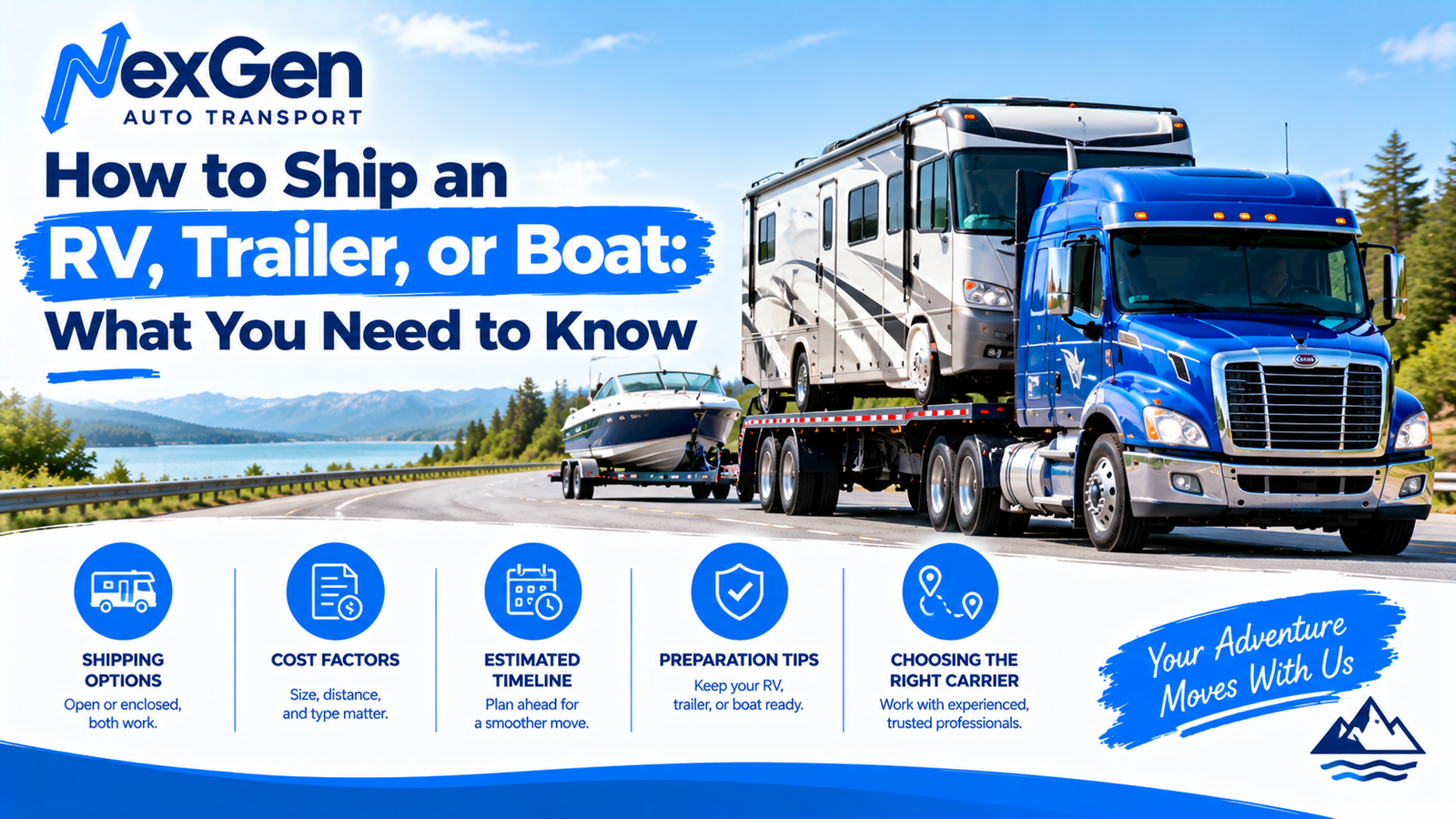
Short answer: You can ship an RV, trailer, or boat by drive-away (a professional driver drives your RV), tow-away (a truck tows your trailer or RV), or flatbed or lowboy hauling (a truck carries it on a trailer). Costs usually run about $1 to $4 or more per mile for RVs and trailers, and about $1.50 to $4 per mile for boats, with higher rates for oversize loads that need permits and escort vehicles. Size is the biggest factor: anything wider than 8 feet 6 inches or taller than about 13 feet 6 inches usually becomes an oversize load. Get a quote that clearly includes permits, escorts, and insurance.
Last updated: October 23, 2026 | Reading time: about 10 minutes
Key Takeaways
- It is not the same as car shipping. RVs, trailers, and boats need different equipment, permits, and insurance.
- Pick the right method: drive-away is often cheapest for driveable RVs, tow-away suits many trailers, and flatbed or lowboy suits large, non-driveable, or oversize loads.
- Know your dimensions. Length, width, height, and weight decide the equipment, route, and price.
- Check the quote for permits, pilot (escort) cars, and fuel. A quote far below the rest on an oversize load often leaves these out.
- Confirm insurance. Your own RV or boat policy may exclude commercial transport, and the carrier’s cargo insurance must cover your unit’s value.
What’s in This Guide
- What You Can Ship
- Transport Methods Compared
- How Much Does It Cost?
- Size Limits, Permits, and Escorts
- Insurance and Liability
- How to Prepare an RV or Trailer
- How to Prepare a Boat
- Timing and Booking
- How to Choose a Transporter
- How NexGen Can Help
- Frequently Asked Questions
What You Can Ship
| Category | Examples | Common Methods |
|---|---|---|
| Motorhomes | Class A, Class B, Class C | Drive-away, or flatbed or lowboy if not driveable |
| Towable RVs | Travel trailers, fifth wheels, toy haulers, pop-ups, teardrops | Tow-away, or flatbed for some units |
| Utility and specialty trailers | Cargo trailers, car haulers, horse trailers, tiny homes | Tow-away, or flatbed or lowboy |
| Boats | Jet skis, bass boats, pontoons, center consoles, sailboats, cruisers | On its own trailer, or on the hauler’s trailer |
| Vans and work vehicles | Cargo vans, delivery vans, heavy equipment | Specialized hauling. See cargo van transport and heavy equipment transport |
See our service pages for RV transport and boat transport. Shipping a motorcycle instead? See motorcycle shipping and the motorcycle shipping cost.
Transport Methods Compared
| Method | How It Works | Pros | Cons |
|---|---|---|---|
| Drive-away | A professional driver drives your driveable RV to the destination | Usually the cheapest for driveable RVs | Adds miles and wear to your RV, and you must trust the driver with the whole unit |
| Tow-away | A truck tows your travel trailer, fifth wheel, or small RV | A good fit for towable units, with moderate cost | Needs a working hitch, lights, tires, and brakes. Wear and weather exposure on the road |
| Flatbed or lowboy | Your unit is loaded and strapped onto a trailer and hauled | No wear on your RV, and works for non-driveable or oversize units | Highest cost, and may need permits and escorts |
| Enclosed | Smaller or high-end units are hauled in an enclosed trailer | Maximum protection | Expensive and limited to smaller units |
| Boat on trailer | Your boat travels on its own trailer, or the hauler lifts it onto theirs | The common method for trailerable boats | Needs a roadworthy trailer or lift equipment at both ends |
Unlike a standard car, an RV or boat does not ride on a normal car carrier. That is why this is a different job from car shipping and needs a transporter with the right equipment. For the basics on how brokers and carriers divide the work, see auto transport broker vs. carrier.
How Much Does It Cost to Ship an RV, Trailer, or Boat?
Published 2026 estimates vary a lot, so treat any price as a starting point until you have a quote that matches your exact unit and route.
Estimated RV and trailer costs (per mile)
| Type / Method | Typical Range |
|---|---|
| Drive-away (driveable motorhome) | About $1 to $2 per mile |
| Tow-away (travel trailer) | About $1.50 to $3.50 per mile |
| Fifth-wheel trailer | About $2 to $3 per mile |
| Flatbed or lowboy (large or non-driveable) | About $2 to $4 or more per mile |
| Large Class A motorhome (specialized hauling) | Often $4 or more per mile |
Estimated boat costs
| Type | Typical Range |
|---|---|
| Small boats within legal width (about 8 feet 6 inches or less) | About $1.50 to $3 per mile |
| Mid-size boats (about 9 to 11 feet wide) | About $2 to $3.25 per mile |
| Wide boats (12 feet or more) | About $2.75 to $4 or more per mile |
| Permits (oversize) | Often about $30 to $250 per state |
| Pilot (escort) car, when required | Often about $1.50 or more per mile |
Example trips (illustrations, not quotes)
| Example | Rough Total |
|---|---|
| 24-foot travel trailer, 1,500 miles, tow-away at about $1.50 to $2.50 per mile | About $2,250 to $3,750 |
| Driveable Class C motorhome, 1,500 miles, drive-away at about $1 to $2 per mile | About $1,500 to $3,000, plus fuel and fees |
| 25-foot boat on a legal-width trailer, 1,000 miles, at about $2 to $3 per mile | About $2,000 to $3,000 |
| Oversize boat (12 feet wide), 1,000 miles, at about $3 to $4 per mile, plus permits and escorts | About $3,000 to $4,000 or more |
What affects the price?
- Size and weight (length, width, height). Bigger means more cost.
- Distance. Longer routes cost less per mile, but more in total. See is shipping cheaper short or long distance?
- Method. Drive-away is usually cheaper than flatbed.
- Permits, escorts, and route. Oversize loads add real costs.
- Direct trip vs. backhaul. A hauler returning with an empty truck may charge less than one making a dedicated one-way trip.
- Season and fuel. See why shipping costs more in 2026 and the cheapest time of year to ship.
- Pickup and delivery access. A tight campsite, marina, or storage yard can add time.
For ideas to lower your price, see the cheapest way to ship a car, which applies to RVs and boats too: book early, stay flexible, and compare complete quotes. Also read car shipping cost factors.
Get a quote for your RV, trailer, or boat
Send your dimensions, route, and dates. No upfront deposit.
Get My Free Quote or call +1 (832) 886-1321
Size Limits, Permits, and Escorts
This is where RV and boat shipping differs most from car shipping. In most of the U.S., the legal limits for a load on public roads are roughly:
- Width: 8 feet 6 inches (102 inches).
- Height: about 13 feet 6 inches in most states (a few allow slightly more).
- Weight and length: limits vary by state and by axle configuration.
A load that goes over these limits is oversize. It generally needs:
- Permits from each state it crosses, with rules and fees that differ by state.
- Route planning to avoid low bridges and restricted roads.
- Pilot (escort) cars for wider or longer loads in many states.
- Travel restrictions, such as daylight-only driving, and limits on weekends, holidays, or bad weather.
Height matters as much as width. For a boat, the height of the boat plus the trailer deck must clear every bridge on the route, and towers, arches, radar masts, and antennas often push a load over the limit. Removing them before transport can keep it legal. Learn more from the Federal Highway Administration’s size and weight pages.
Permits and escorts should be in your quote. A price far below others on an oversize load often leaves them out, and you may be surprised later. See why a quote can go up after booking.
Insurance and Liability
- Your own policy may not cover it. Many RV and boat insurance policies exclude commercial transport. Call your insurer and ask.
- Ask for the carrier’s cargo insurance certificate. Check that coverage matches your RV or boat’s value, and ask about the deductible and exclusions.
- Contents are usually not covered. Remove personal belongings, electronics, and valuables.
- Document the condition. Photograph or video the inside and outside, and inspect the unit with the driver at pickup and delivery. Note any new damage on the Bill of Lading before you sign.
- Report damage quickly. With NexGen, damage must be reported within 24 hours of delivery.
Read our Claims & Damage Process, does car shipping insurance cover damage?, and insurance information.
How to Prepare an RV or Trailer for Transport
- Measure and weigh it. Know the exact length, width, height, and loaded weight, including roof items such as air conditioners and satellite dishes.
- Empty the water tanks. Drain the fresh, gray, and black tanks and the water heater. Water adds weight and can shift or freeze.
- Turn off propane and disconnect the tanks if the transporter requires it.
- Secure the interior. Latch cabinets and drawers, lock the refrigerator, and remove or pack loose items.
- Retract slides, awnings, and steps, and lock them. Remove or secure antennas.
- Check tires, lights, brakes, and the hitch on a towable unit. Make sure the safety chains and breakaway system work.
- Remove valuables and personal items. They are usually not covered.
- Take photos and video of every side, the roof, the interior, and the odometer.
- Prepare paperwork: registration, title, ID, and insurance details.
- Plan pickup access. Make sure the truck can reach and turn around, and clear the area. If you cannot be there, a trusted adult should handle it. See how to ship a car without being present.
If your unit does not run or has tire or battery issues, read can you ship a car that doesn’t run? and how to ship a car with a dead battery or flat tires. For general prep, see our car shipping preparation checklist. For more on RV safety and ownership, visit the Recreation Vehicle Industry Association.
How to Prepare a Boat for Transport
- Measure the boat on its trailer: length, beam (width), height, and weight.
- Remove or lower tall items, such as the bimini top, outriggers, radar, antennas, and canvas.
- Remove electronics and loose gear. Take the cushions, fishing gear, and valuables off the boat.
- Drain water and keep fuel low. Empty the livewell, bilge, and freshwater tanks, and drain extra fuel as the hauler advises.
- Secure everything. Lock hatches and lockers, tie down covers, or consider shrink wrap for protection on long trips.
- Inspect the trailer. Check tires, bearings, brakes, lights, and registration if the boat travels on its own trailer.
- Check the hull and supports. Make sure the boat sits on proper bunks, cradles, or stands.
- Take photos and video of the hull, deck, interior, and any existing damage.
- Plan the lift or launch. Confirm how the boat will be loaded and unloaded at both ends, such as a ramp, crane, or marina lift.
For tips on boat towing and handling, the BoatUS website is a helpful resource.
Timing and Booking
- Book 3 to 6 weeks ahead if you can. Specialized haulers and oversize permits take more lead time than a car shipment. See how far in advance to book shipping.
- Expect longer, less predictable transit. Oversize loads often travel only in daylight and may have day-of-week limits. Cross-country trips can take one to two weeks or more.
- Plan around the seasons. RV demand peaks in spring and summer, and with snowbird moves in fall and spring. See snowbird car shipping. Boats peak before and after the boating season. Winter weather can slow northern routes. See shipping a car in winter.
- Be flexible. A wider pickup window helps your transporter find a truck and keeps the price down. See expedited transport if you are on a deadline.
- Moving? See car shipping when moving to a new state and how to ship a car across the country. Military members can see military car shipping.
How to Choose a Transporter
- Verify registration. Look up the USDOT and MC numbers in the FMCSA SAFER system.
- Confirm experience with your specific type of unit, such as fifth wheels, Class A motorhomes, or large boats.
- Ask who will actually haul it. A broker arranges the move and a carrier does the hauling. See auto transport broker vs. carrier and how load boards work.
- Get everything in writing: price, method, permits, escorts, insurance, pickup window, and fees.
- Compare complete quotes, not just the lowest price. See how to choose a car shipping company.
- Check reviews on the Better Business Bureau and other sites.
How NexGen Can Help
NexGen Auto Transport LLC is a licensed FMCSA property broker (USDOT 3969190, MC-1482694). Visit our RV transport and boat transport pages, or contact us with your unit’s dimensions, route, and dates so we can match you with a suitable carrier. We do not charge an upfront deposit. We keep a valid card on file to secure your reservation, and the balance is paid as stated in your order confirmation. Fees for rescheduling, a dry run, or cancellation apply only in specific situations, as described in our Cancellation & Refund Policy and Terms & Conditions. Learn more about us, browse the FAQs and our state pages, or learn about our dispatch service.
Frequently Asked Questions
How do you ship an RV?
You can ship an RV by drive-away (a professional driver drives it), tow-away (a truck tows it), or flatbed or lowboy hauling. The best method depends on whether the RV is driveable or towable, its size, and your budget.
How much does it cost to ship an RV?
Costs commonly range from about $1 to $4 or more per mile. Drive-away is often the cheapest at about $1 to $2 per mile, tow-away for travel trailers is about $1.50 to $3.50 per mile, and flatbed or oversize hauling costs more. Distance, size, and permits change the final price.
What is the cheapest way to ship an RV?
Drive-away service is usually the most affordable for a driveable motorhome. Booking early and staying flexible on dates also helps lower the price.
How much does it cost to ship a boat?
Overland boat transport typically costs about $1.50 to $4 per mile. Wider boats and oversize loads cost more, and permits and escort cars add to the total.
Do I need a permit to ship a boat or RV?
If the load is wider than about 8 feet 6 inches, taller than about 13 feet 6 inches, or over the weight limits, it generally needs oversize permits for each state it crosses. Your transporter should handle them. Make sure they are included in the quote.
Is my RV or boat insured while it is being shipped?
The carrier’s cargo insurance should cover the unit, but your own policy may exclude commercial transport. Ask for the carrier’s insurance certificate, check the coverage amount, and remove personal items, which are usually not covered.
Can I ship a travel trailer without a truck?
Yes. A tow-away service uses its own truck to tow your trailer, or a flatbed can haul it. You do not need your own tow vehicle.
How far in advance should I book RV or boat transport?
Book about 3 to 6 weeks ahead if possible. Specialized equipment and oversize permits need more lead time than standard car shipping.
Final Thoughts
Shipping an RV, trailer, or boat is different from shipping a car, but it is straightforward when you know your dimensions, pick the right method, and get a complete quote that includes permits, escorts, and insurance. Prepare your unit carefully, verify the transporter, and document everything at pickup and delivery.
Ready to ship your RV, trailer, or boat?
Licensed FMCSA broker and no upfront deposit.
