
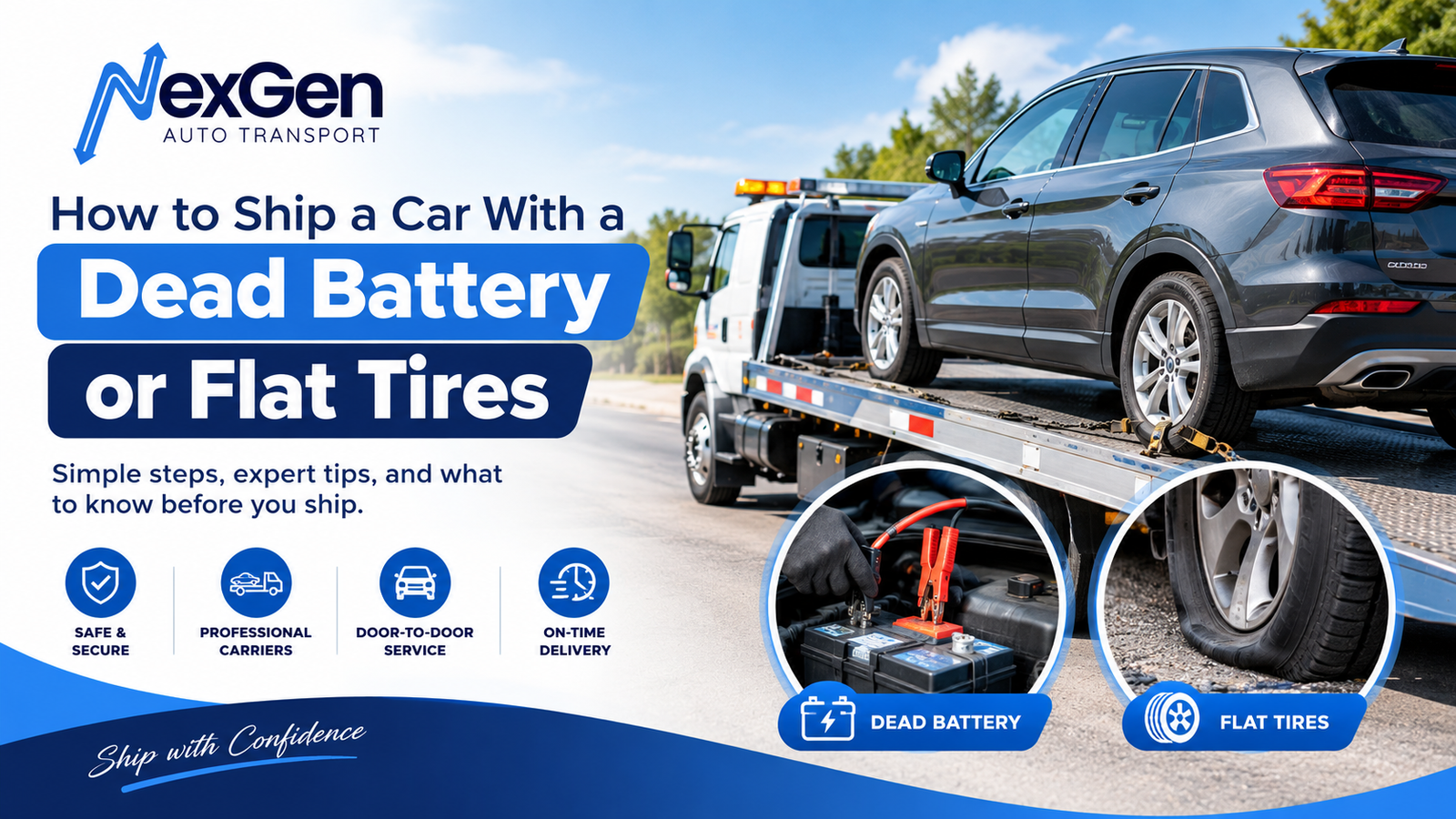
Short answer: Yes, you can ship a car with a dead battery or flat tires, but tell your shipper first. A car that won’t start is usually treated as non-running (inoperable) and needs a winch-equipped truck, which adds a fee of about $150 to $350. If your tires will not hold air, or a wheel is missing, loading can need a forklift or special equipment and costs more. The cheapest fix is often to jump-start or replace the battery and re-inflate the tires before pickup, so the car counts as running.
Last updated: October 21, 2026 | Reading time: about 8 minutes
Key Takeaways
- Dead battery: shippable, usually with a winch and an inoperable fee. A quick jump start or new battery can avoid the fee.
- Flat tires: inflate or repair them before pickup. Tires that cannot hold air may need a forklift.
- Modern cars: a dead battery can lock the car in Park, or leave an electronic parking brake engaged, so it will not roll. Tell your shipper.
- Always disclose the problem when you book. A surprise at pickup can cause extra fees or a failed pickup.
- Bring a jump pack to delivery too, in case the battery drains again in transit.
What’s in This Guide
- Quick Guide: Will a Carrier Take My Car?
- Shipping a Car With a Dead Battery
- Shipping a Car With Flat Tires
- Costs: Fix It or Pay the Fee?
- Preparation Checklist
- Special Cases: EVs, Winter, Auctions, and Stored Cars
- Insurance and the Bill of Lading
- How NexGen Handles These Shipments
- Frequently Asked Questions
Quick Guide: Will a Carrier Take My Car?
| Problem | Can It Ship? | Likely Extra Cost | Best Fix |
|---|---|---|---|
| Dead battery, car rolls and steers | Yes, with a winch truck | About $150 to $350 | Jump start or replace the battery |
| Dead battery, car stuck in Park or parking brake won’t release | Yes, but needs special handling | About $300 to $500 or more | Jump the car so it can shift to Neutral and release the brake |
| One or more soft tires that hold air | Yes | Usually none if inflated | Inflate to the recommended pressure |
| Flat tire that will not hold air | Yes, but harder to load | Possible winch fee, or higher if a forklift is needed | Plug, patch, or replace the tire, or fit the spare |
| Several flat tires, or a damaged wheel | Yes, with special equipment | Often $300 to $500 or more | Repair or replace the tires or wheel |
| Missing wheels or tires | Yes, with a forklift or dollies | Quoted case by case | See how to move a car with no wheels |
For the full picture on non-running cars, see can you ship a car that doesn’t run?
Shipping a Car With a Dead Battery
Why a dead battery matters
Shippers treat a car that cannot start and run under its own power as inoperable. That means the driver cannot simply drive it onto the trailer, and a winch must pull it up the ramps. The driver steers through the window, so the wheels must turn freely and the steering must work.
Modern cars add a catch. Many have an electronic parking brake or an electronic shifter that needs power. With a dead battery, the car can be stuck in Park or have the brake engaged, so it will not roll. This turns a simple winch job into a harder one. It is one more reason to get the car powered up before pickup.
How to fix a dead battery before pickup
- Jump-start it. A portable jump starter is a cheap tool that can save you the inoperable fee. Roadside services such as AAA can also help.
- Run the engine for a while after the jump so the battery gets some charge, or use a battery charger overnight.
- Replace the battery if it is old, swollen, or will not hold a charge. A mobile mechanic can often do this at your home.
- Check for a drain. If the battery keeps dying, something is draining it, such as an accessory or an electrical fault. Tell your shipper if you cannot fix it.
- Be honest about the result. If the car starts only sometimes, do not call it running. Describe exactly what happens.
What if the car starts, but the battery dies again in transit?
This is common with weak batteries, especially in cold weather. The car may start at pickup and not start at delivery after days on the trailer. To plan for it:
- Tell the driver the battery is weak.
- Keep a charged portable jump starter at your delivery address.
- Be ready for a winch unload, which can mean a fee, if the car will not start.
- Avoid leaving lights, chargers, or accessories on, and turn off any alarm. Ask your shipper before disconnecting the battery, because that can leave electronic locks and brakes unable to release.
Shipping a Car With Flat Tires
Why tires matter
Wheels that roll freely let the winch pull the car up the ramp without dragging it. A flat tire can damage the wheel rim, make the car harder to load, and in some cases make the car impossible to winch. Cars with flat or missing tires may need a forklift or dollies, which are rarer and more costly.
How to fix flat or low tires
- Inflate to the right pressure. Use the placard on the driver’s door jamb, not the number on the tire sidewall. See the NHTSA tire safety guide.
- Check whether it holds air. Recheck after a few hours. A slow leak that holds for a day or two may still be fine for pickup, but tell your shipper.
- Plug, patch, or replace the tire. A repair shop or mobile tire service can usually do this quickly.
- Use the spare if you have one and the car is otherwise fine.
- Avoid sealants as a long-term fix. A can of emergency sealant is only a temporary patch.
- Check low-profile tires, run-flats, and air suspension. Tell your shipper if your car sits low or has air suspension, so the right ramps and equipment are used.
Costs: Fix It or Pay the Fee?
Shippers charge an inoperable fee, usually about $150 to $350 for a standard winch load, with complex loads at about $300 to $500 or more. Compare that with fixing the problem yourself. These are rough estimates and vary by car and location.
| Fix | Rough Cost | Compared With the Inop Fee |
|---|---|---|
| Portable jump starter (one-time purchase) or roadside jump | Low | Often much cheaper |
| New battery, installed | Often about $100 to $300 | Similar to or cheaper than the fee, and fixes the problem for good |
| Inflate tires | Free to low | Much cheaper |
| Tire plug or patch | Often about $20 to $50 | Much cheaper |
| New tire | Often about $100 to $250 each | Comparable, and you keep the tire |
The bottom line: for a dead battery or flat tire, fixing it before pickup is often as cheap as the inoperable fee, or cheaper, and it avoids a delay. If the repair is large, shipping the car as non-running may be the better choice. For total price, see how much it costs to ship a car, car shipping cost factors, and the cheapest way to ship a car.
Not sure how to describe your car?
Tell us what’s wrong and get a quote with the right truck. No upfront deposit.
Get My Free Quote or call +1 (832) 886-1321
Preparation Checklist
When you book
- Tell your broker exactly what is wrong: dead battery, flat tire, stuck in Park, will not roll, or slow leak.
- Ask whether the assigned carrier has a winch, and get the inoperable fee in writing.
- Book 2 to 3 weeks ahead, since winch trucks are fewer. See how far in advance to book car shipping.
2 to 3 days before pickup
- Jump-start or replace the battery, and test whether the car starts several times.
- Inflate all tires to the recommended pressure, and recheck them the day before.
- Make sure the car can shift into Neutral and the parking brake releases.
- Wash the car, and take photos and video of every side, the wheels, and the dashboard.
- Remove personal items and follow our car shipping preparation checklist.
Pickup day
- Be there, or have a responsible adult there. See how to ship a car without being present.
- Have the key or fob ready, and tell the driver about any quirks, such as a weak battery.
- Clear the area so the truck and ramps have room.
- Inspect the car with the driver and review the condition on the Bill of Lading before signing.
Delivery day
- Keep a charged jump starter and a tire inflator nearby.
- Inspect the car, including the tires and wheels, before signing. Note any new damage on the Bill of Lading.
- Pay the balance to the driver as stated in your order confirmation.
Special Cases: EVs, Winter, Auctions, and Stored Cars
- Electric vehicles. An EV has a small 12-volt battery as well as its main battery. If either is dead, the car may not power on, unlock, or enter transport mode. See how to ship an electric vehicle.
- Winter. Cold weather weakens batteries and lowers tire pressure, roughly 1 psi for every 10 degrees Fahrenheit of temperature drop. See shipping a car in winter.
- Auction cars. Cars that sat in a yard often have dead batteries and soft tires. Book a winch-equipped carrier as soon as you win. See ship a car from auction, Copart transport, IAAI transport, and Manheim shipping.
- Stored, project, and classic cars. Long storage drains batteries and flat-spots tires. For valuable cars, consider enclosed transport. See luxury car transport and enclosed vehicle transport.
- Shops and dealers. See transport for auto repair shops, transport for auto body shops, and dealership transport.
- Short moves. For a short local move, a tow may be an option. See how to tow a car and can you tow a car without putting it in neutral.
Insurance and the Bill of Lading
The carrier’s cargo insurance covers damage the carrier causes in transit. It generally does not cover problems that existed before pickup, such as a dead battery, worn tires, or mechanical faults. The Bill of Lading (BOL) is your record. At pickup, make sure the driver notes the car’s condition accurately. At delivery, check the car, including the wheels and tires, and note any new damage on the BOL before you sign. With NexGen, damage must be reported within 24 hours of delivery. See our Claims & Damage Process, does car shipping insurance cover damage?, and insurance information.
How NexGen Handles These Shipments
NexGen Auto Transport LLC is a licensed FMCSA property broker (USDOT 3969190, MC-1482694). Tell us about your car’s battery and tire condition, and we will arrange a suitable carrier. Our Terms & Conditions explain that the final price can change if vehicle details are inaccurate, and our Cancellation & Refund Policy explains that a dry run fee applies if a driver travels to your pickup and the vehicle cannot be loaded, including when its details were significantly misrepresented. We do not charge an upfront deposit. We keep a valid card on file to secure your reservation, and the balance is paid to the driver at delivery. Read why a quote can go up after booking, how to choose a car shipping company, and the difference between a broker and a carrier. Verify us in the FMCSA SAFER system, check reviews on the Better Business Bureau, browse our state pages, read the FAQs, learn about us, or contact us.
Frequently Asked Questions
Can you ship a car with a dead battery?
Yes. A car with a dead battery is usually treated as non-running and loaded with a winch, which adds an inoperable fee of about $150 to $350. If you jump-start or replace the battery so the car runs, you can often avoid the fee.
Can you ship a car with a flat tire?
Yes, but inflate or repair the tire first if you can. A tire that holds air is easy to load. A tire that will not hold air, or a missing wheel, may need a forklift or special equipment, which costs more.
Will the driver jump-start my car?
Some drivers carry a jump pack, but you should not count on it. Fix the battery before pickup, and tell your shipper in advance if the car may not start.
Is a car with a dead battery considered inoperable?
Yes, if it cannot start and run under its own power at pickup. If you jump it and it runs and drives onto the trailer, it may be treated as running. Ask your shipper how they define it.
How much extra does it cost to ship a car with a dead battery?
Typically about $150 to $350 for a standard winch load. If the car is stuck in Park or needs special equipment, it can be about $300 to $500 or more.
Should I replace the battery before shipping?
If the battery is old, swollen, or will not hold a charge, yes. A new battery often costs about the same as the inoperable fee and fixes the problem for good.
What if my car will not start at delivery?
Keep a charged jump starter at your delivery address, and tell the driver beforehand if your battery is weak. If the car cannot start, it may need a winch to unload, which can add a fee.
Does NexGen charge a deposit?
No. NexGen Auto Transport does not charge an upfront deposit. We keep a valid card on file to secure your reservation, unless you choose to pay in advance.
Final Thoughts
A dead battery or flat tires will not stop your car from being shipped, but they change how it is loaded and what it costs. The simplest path is to be honest about the problem, fix what you cheaply can before pickup, and keep a jump starter and tire inflator handy for delivery. Choose a verified company, note the condition on the Bill of Lading, and your car will get where it needs to go.
Ready to ship your car?
Licensed FMCSA broker, winch-equipped carriers, and no upfront deposit.
