
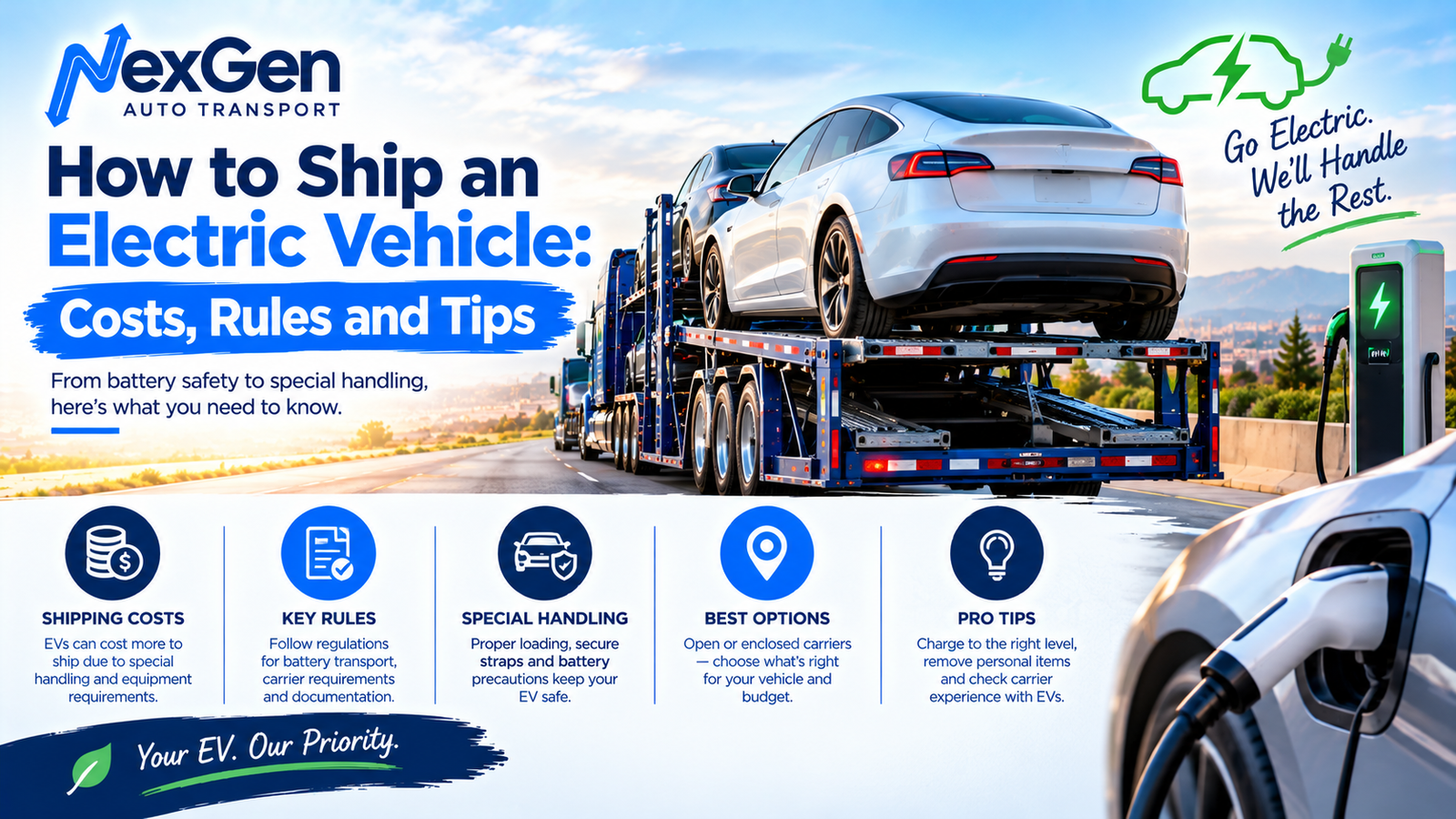
Short answer: You can ship an electric vehicle (EV) the same way you ship a gas car, using an open or enclosed carrier, but a few details are different. Charge the battery to a moderate level, usually about 30% to 50%, enable your car’s transport or tow mode if it has one, remove the charging cable, and tell your shipper it’s an EV when you book so an experienced carrier is assigned. Expect the cost to be similar to a comparable gas vehicle, with a modest premium for heavier EVs.
Last updated: October 12, 2026 | Reading time: about 9 minutes
Key Takeaways
- Charge level: aim for about 30% to 50% unless your carrier or owner’s manual says otherwise. Not full, not nearly empty.
- Tell your shipper it’s an EV. Weight, ground clearance, and battery handling matter when assigning a truck.
- Carriers do not charge your EV in transit, so what you send is roughly what arrives.
- Cost: EVs often cost somewhat more to ship than comparable gas cars because they are heavier, and enclosed transport costs more again.
- A dead EV is treated as a non-running vehicle and usually needs a winch, which adds cost.
- The carrier’s cargo insurance applies to the vehicle, so check coverage limits for high-value EVs.
What’s in This Guide
- How EV Shipping Differs from Shipping a Gas Car
- How Much Does It Cost to Ship an Electric Vehicle?
- What Battery Charge Level Should You Ship At?
- Rules and Safety: What Carriers and Regulations Expect
- EV Shipping Preparation Checklist
- Open or Enclosed Transport for an EV?
- Insurance and Damage Protection
- What to Expect When Your EV Arrives
- How to Choose a Shipper for Your EV
- Frequently Asked Questions
How EV Shipping Differs from Shipping a Gas Car
Electric vehicles ride on the same types of car haulers as gas cars. Most EVs do not need special trailers. But three differences matter:
| Factor | Gas Car | Electric Vehicle |
|---|---|---|
| Weight | Lighter on average | Heavier because of the battery pack, which can reduce how many cars a truck can carry |
| Fuel or charge | Keep about a quarter tank | Keep a moderate charge, usually 30% to 50% |
| Special settings | Disable alarm | Enable tow or transport mode, turn off features such as sentry mode, disable alarm |
| If it won’t start | Jump start or winch | Treated as non-running if the battery is too low to roll, steer, or brake. Usually needs a winch |
| Ground clearance | Varies | Many EVs sit low, and some have adjustable air suspension that should be set correctly for loading |
| Carrier experience | Any qualified carrier | Better with a driver who has hauled EVs before |
For general service details, see our electric vehicle transport page.
How Much Does It Cost to Ship an Electric Vehicle?
Shipping an EV usually costs a bit more than shipping a similar gas vehicle. The main reasons are higher weight and, for many EVs, a higher vehicle value. Some industry sources put the weight-related premium at roughly 10% to 20%, but it varies by model and route.
Estimated cost to ship a standard electric car (open carrier)
| Distance | Estimated Price Range |
|---|---|
| Short (under 500 miles) | About $600 to $1,000 |
| Medium (500 to 1,500 miles) | About $900 to $1,500 |
| Long or cross-country (1,500+ miles) | About $1,300 to $2,000 |
| Enclosed transport | Often 30% to 60% more than open |
| Heavy EV (large SUV, truck, or luxury model) | Additional premium for weight |
| Non-running (dead battery) | Additional winch fee |
These are estimates, not guaranteed prices. Final pricing depends on your route, dates, vehicle, and carrier availability.
What affects EV shipping cost?
- Vehicle weight and size. Large EV SUVs and trucks take more weight capacity.
- Distance and route. See how to ship a car across the country and our route guide for Los Angeles to Houston.
- Open vs. enclosed. See open vs. enclosed car transport.
- Season and demand. See the cheapest time of year to ship a car.
- Fuel costs for the carrier. See why car shipping is so expensive in 2026.
- Speed. See expedited auto transport.
For a full breakdown, read car shipping cost factors and how much it costs to ship a car.
Get a quote for your electric vehicle
Free quote, no upfront deposit, licensed FMCSA broker.
Get My Free Quote or call +1 (832) 886-1321
What Battery Charge Level Should You Ship an EV At?
Most carriers and industry guides recommend a moderate charge. A working range of about 30% to 50% is common, and some sources suggest 20% to 50%. Follow your carrier’s instructions and your owner’s manual first.
| Charge Level | Why It Matters |
|---|---|
| Under about 20% | Risk of running out before delivery. A very low battery can leave the car unable to roll, steer, or brake, so it is treated as non-running. |
| About 30% to 50% | Enough to load and unload and to cover small drains in transit, without storing a full charge. |
| Near 100% | Not needed. A high state of charge adds battery stress, especially if the vehicle sits in hot sun for days. |
Important: carriers do not plug in or charge your EV during transport. Your car may lose a small amount of charge from handling, onboard systems, and temperature changes. Plan to have enough range to reach a charger after delivery. You can find chargers near your destination with the U.S. Department of Energy’s Alternative Fuels Data Center station locator.
Rules and Safety: What Carriers and Regulations Expect
There is no special federal “EV shipping license” for consumers. The usual rules for car transport apply, and carriers follow their own EV policies. Here is what to expect:
- The battery stays in the vehicle. Shipping a whole EV on a car hauler is different from shipping loose lithium battery packs, which are regulated much more strictly. For questions about the federal rules, see the Pipeline and Hazardous Materials Safety Administration (PHMSA).
- Carrier policies vary. Some carriers ask for a specific charge level, require you to disclose the model, or decline certain vehicles, such as an EV with a damaged battery or an open safety recall.
- Check for recalls. Search your VIN on the NHTSA recalls page. A vehicle with a battery or fire-related recall may be refused or need special handling.
- Weight limits apply. A truck has a total weight limit, so a heavy EV can reduce how many cars fit on a load. This is a main reason EVs can cost more.
- Be honest about condition. Tell your dispatcher about warning lights, a damaged battery, a non-running car, or aftermarket modifications. Misreporting these details can lead to a price change or a dry run fee.
- Documentation. Take photos of the vehicle, including the dashboard showing the charge level and the odometer.
EV Shipping Preparation Checklist
- Tell your shipper it is an EV when you request your quote, and give the exact make and model.
- Set the charge to about 30% to 50%, or the level your carrier requests.
- Enable tow or transport mode if your vehicle has one. Check your owner’s manual.
- Turn off energy-draining features such as sentry mode, cabin preconditioning, and app-based scheduled charging or climate.
- Remove the charging cable from the charge port, and store it in the car or with you.
- Set air suspension correctly if your car has it, following the manual. This helps avoid scraping on loading ramps.
- Disable the alarm and remove toll tags.
- Remove personal items. Follow our general car shipping preparation checklist.
- Wash the car and take photos and video of every side, including close-ups of any existing damage.
- Give the driver your key fob or key card and explain how to start, shift, and put the car in neutral. Share any manufacturer instructions in writing.
- Inspect and sign the Bill of Lading at pickup and delivery, noting any new damage before you sign.
Open or Enclosed Transport for an EV?
Most EVs ship safely on open carriers, the same way most cars do. It is the more affordable choice. Consider enclosed transport if your EV is expensive, rare, or new, or if you want protection from weather, road debris, and dust. Luxury models such as high-end sedans and performance EVs are a common fit. See our luxury car transport service, our guide to Tesla car shipping, and the full comparison in open vs. enclosed car transport.
Insurance and Damage Protection
The carrier’s cargo insurance covers the vehicle while it is in transit. Because many EVs are high-value, check the carrier’s coverage limits and exclusions before you book, and ask for the insurance certificate. Also check whether your own auto policy gives extra protection.
- Inspect the car at pickup and delivery with the driver, and note any new damage on the Bill of Lading before signing.
- With NexGen, damage must be reported within 24 hours of delivery.
- Take photos of the dashboard, including the charge level and any warning messages.
Read more in our Claims & Damage Process, does car shipping insurance cover damage?, and insurance information.
What to Expect When Your EV Arrives
- The charge may be a little lower. Small losses from handling and onboard systems are normal.
- Range can look lower in cold weather. Cold batteries show less range and may charge more slowly at first. This is normal and usually improves as the battery warms.
- Plan your first charge. Know where the nearest charger is before delivery day.
- Inspect before signing. Check the body, wheels, charge port, and underbody area, and compare it with your pickup photos.
- Turn off tow or transport mode after delivery, following your manual.
Timing questions? See how long it takes to ship a car. Can’t be there? Read how to ship a car without being present.
How to Choose a Shipper for Your EV
- Ask about EV experience. A good broker flags EV shipments and matches them with drivers who have hauled EVs before.
- Verify registration. Look up the USDOT and MC numbers in the FMCSA SAFER system. NexGen Auto Transport LLC is a licensed FMCSA property broker (USDOT 3969190, MC-1482694).
- Get the charge-level requirement in writing. Ask what the carrier wants and what happens if the battery is too low.
- Check insurance limits. Confirm the cargo coverage is enough for your vehicle’s value.
- Be wary of very low quotes. See how to choose a car shipping company and auto transport broker vs. carrier.
Buying an EV from afar? See our guides to shipping a car from a dealership, a private seller, or an auction. Moving states? Read car shipping when moving to a new state. If your plans change, see our Cancellation & Refund Policy, or contact us with questions.
Frequently Asked Questions
Can you ship an electric vehicle on a car carrier?
Yes. EVs ship on the same open and enclosed car carriers as gas vehicles. Tell your shipper it is an EV when you book so the right carrier is assigned.
How much does it cost to ship an electric vehicle?
It usually costs somewhat more than a comparable gas car because of the extra weight. As an estimate, a standard electric car on an open carrier may cost about $600 to $1,000 for short trips and about $1,300 to $2,000 for cross-country trips. Enclosed transport costs more.
What charge should an EV have when shipped?
A moderate charge of about 30% to 50% is common, but follow your carrier’s and manufacturer’s instructions. Do not ship it nearly full or nearly empty.
Should I ship my EV with a full battery?
No. A full charge is not needed and adds battery stress, especially if the vehicle sits in hot sun. A moderate charge is enough to load, unload, and reach a charger.
Do car carriers charge electric vehicles during transport?
No. Carriers do not plug in or charge your EV in transit, so plan for a moderate starting charge and a first charge after delivery.
What happens if my EV battery is dead?
A dead or critically low EV that cannot roll, steer, or brake is treated as non-running and usually needs a winch, which adds cost. Tell your dispatcher before booking if the battery is very low.
Is it safe to ship an electric vehicle?
Yes, when the carrier follows normal car transport practices and you prepare the vehicle properly. Choose a verified company, ask about EV experience, and check the carrier’s insurance coverage.
Can I ship a Tesla or other EV in an enclosed carrier?
Yes. Enclosed transport is a popular choice for high-value or new EVs because it protects against weather and road debris. It costs more than open transport.
Final Thoughts
Shipping an electric vehicle is straightforward when you prepare for the few differences: a moderate charge, the right vehicle settings, honest details, and a carrier with EV experience. Choose open transport for value or enclosed for extra protection, and inspect carefully at pickup and delivery.
Ready to ship your EV?
Licensed FMCSA broker, nationwide door-to-door service, and no upfront deposit.
