
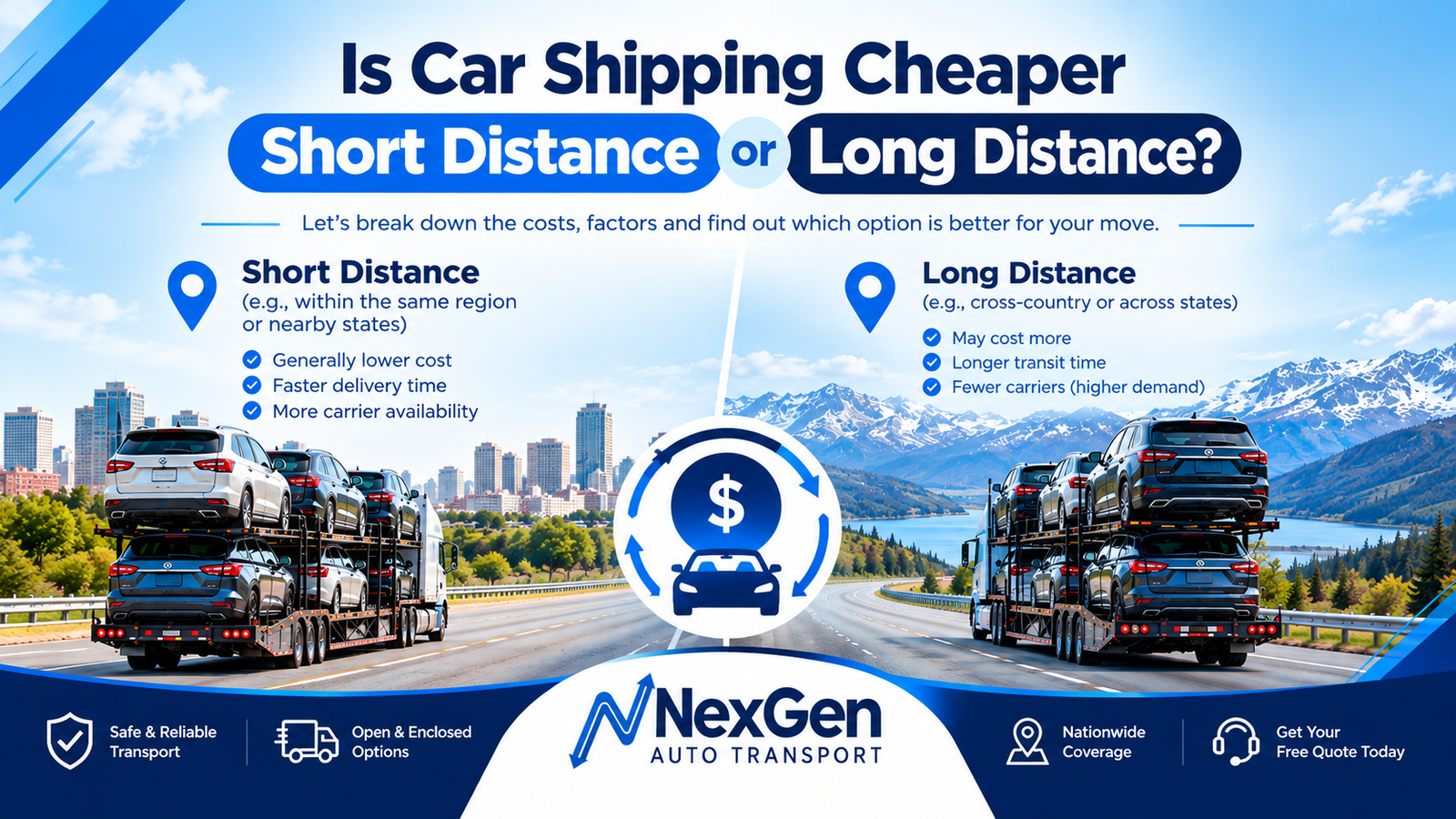
Short answer: Short-distance car shipping costs less in total, but long-distance shipping costs less per mile. A 300-mile trip might cost around $450 to $750 overall, which works out to $1.50 or more per mile, while a 2,500-mile cross-country trip might cost $1,500 to $2,500 overall, which is closer to $0.60 to $1.00 per mile. So if you are comparing quotes, compare the total price for your route, not the per-mile rate.
Last updated: October 12, 2026 | Reading time: about 8 minutes
Key Takeaways
- Total cost: goes up with distance. Short trips are cheaper in dollars.
- Cost per mile: goes down with distance. Long trips are cheaper per mile.
- Why: loading, unloading, city driving, and minimum fees get spread over more miles on longer trips.
- The best value is often a mid-to-long trip on a popular route between major cities.
- On very short trips (under about 200 miles), driving or towing can be cheaper than shipping.
- Route, season, fuel costs, and flexibility can matter as much as distance.
What’s in This Guide
- Why Total Cost and Cost Per Mile Move in Opposite Directions
- Car Shipping Price by Distance (2026 Estimates)
- Quick Estimate Calculator
- Why Short Trips Cost More Per Mile
- Why Long Trips Cost Less Per Mile
- Route Matters as Much as Distance
- Short Distance: Ship, Drive, or Tow?
- How to Get the Best Price at Any Distance
- Frequently Asked Questions
Why Total Cost and Cost Per Mile Move in Opposite Directions
Every car shipment has two kinds of cost. Fixed costs happen on every job no matter how far the truck goes: finding a carrier, scheduling, loading and unloading, driving through city streets at both ends, inspection paperwork, and dispatching. Distance costs grow with every mile: fuel, driver time, wear on the truck, and tolls.
On a short trip, the fixed costs are a large share of the price, so each mile looks expensive. On a long trip, the same fixed costs are spread across many more miles, so the per-mile rate falls, even though the total bill is higher. This is why the same carrier might charge about $1.80 per mile for a 300-mile trip and under $0.80 per mile for a 2,500-mile trip.
Car Shipping Price by Distance (2026 Estimates)
These are typical ranges for a standard running sedan on an open carrier. Real prices vary by route, season, fuel costs, and vehicle.
| Distance | Typical Price Per Mile | Typical Total Price | Typical Transit Time |
|---|---|---|---|
| Short: under 500 miles | About $1.25 to $2.50 | About $450 to $900 | 1 to 3 days |
| Medium: 500 to 1,500 miles | About $0.85 to $1.30 | About $800 to $1,500 | 3 to 6 days |
| Long: 1,500 to 2,500 miles | About $0.65 to $1.05 | About $1,200 to $2,200 | 5 to 8 days |
| Cross-country: 2,500+ miles | About $0.60 to $1.00 | About $1,500 to $2,800 | 7 to 10 days |
Estimates only. Enclosed transport, SUVs and trucks, non-running vehicles, and expedited service cost more. See our guide to how much it costs to ship a car.
The same car at three distances
| Example Trip | Miles | Example Rate | Example Total |
|---|---|---|---|
| Regional move | 300 | $1.90 per mile | About $570 |
| Los Angeles to Houston | 1,550 | $0.80 per mile | About $1,240 |
| Coast to coast | 2,800 | $0.75 per mile | About $2,100 |
The cross-country trip costs about four times as much in total as the regional move, but it covers more than nine times the distance. That is the per-mile discount in action. See our route guides for real examples: Los Angeles to Houston, New York to California, Michigan to California, and Florida to Massachusetts.
Quick Estimate Calculator
Enter your trip distance for a rough price range for a standard sedan on an open carrier. This is only an estimate. For an exact price, get a free quote.
Enter a distance and click Estimate.
Why Short Trips Cost More Per Mile
- Fixed costs dominate. Loading, unloading, inspections, and dispatching cost about the same whether the truck drives 200 miles or 2,000.
- Minimum fees. Carriers have a minimum price below which a job is not worth taking.
- City driving. A larger share of a short trip is slow, stop-and-go driving at both ends, instead of efficient highway miles.
- Empty or partly empty trucks. Carriers try to fill a trailer. Short hauls give them less time and fewer chances to fill the truck.
- Fewer carriers. Many car haulers prefer long routes. Local runs can have less carrier availability.
Why Long Trips Cost Less Per Mile
- Fixed costs are spread out. The same loading and paperwork cost is divided over many more miles.
- Efficient highway driving. Most of the trip is steady interstate miles, which are cheaper to run.
- Better truck utilization. Carriers can fill all the spots on a trailer along a long route and make several pickups and drop-offs.
- High competition on major lanes. More carriers run big corridors, which keeps prices competitive.
Long trips do have limits. Federal driving-hour rules cap how far a truck can go each day, so transit takes longer. See the FMCSA hours-of-service rules and our guide to how long it takes to ship a car.
Get an exact price for your route
Free quote, no upfront deposit, licensed FMCSA broker.
Get My Free Quote or call +1 (832) 886-1321
Route Matters as Much as Distance
Distance is only one piece. Two trips of the same length can have very different prices.
- Popular vs. rural routes. A 1,500-mile trip between two big cities on a busy corridor can cost less than a 700-mile trip to a remote town, because carriers want to run busy lanes.
- Direction of demand. Prices can differ in each direction depending on where trucks are heading. Seasonal flows such as snowbird car shipping push up some lanes.
- Season. Summer is usually the most expensive. See the cheapest time of year to ship a car.
- Fuel prices. Diesel costs affect every mile. Check the EIA diesel price page, and read why car shipping is so expensive in 2026.
- Pickup and delivery addresses. Locations near major highways are cheaper to serve. Learn how door-to-door car shipping works.
- Vehicle and service. Trucks, SUVs, enclosed transport, and rush delivery all add cost. See open vs. enclosed car transport and expedited auto transport.
You can browse more routes on our states and cities pages, or see how a state-to-state move works in car shipping when moving to a new state and shipping a car across the country.
Short Distance: Ship, Drive, or Tow?
For long trips, shipping often competes well with driving once you add fuel, hotels, meals, time off work, and wear on your car. For short trips, the math can go the other way.
Example: driving 300 miles in a car that gets 28 miles per gallon, at $4.00 per gallon, uses about 11 gallons, or about $43 in fuel, plus about 5 hours of your time. Shipping the same trip might cost $450 or more. You can also check typical driving costs per mile on AAA’s Your Driving Costs page.
| Situation | Usually Best Choice |
|---|---|
| Under about 200 miles, car runs, you have time | Drive it yourself |
| Short trip but the car does not run | Ship or tow. See how to tow a car |
| Short trip, just bought out of state, no time | Ship it |
| 500 to 1,500 miles | Compare shipping vs. driving. Shipping often wins on time and total cost |
| 1,500+ miles or a household move | Shipping is usually the better value |
Thinking about towing a long way instead? Read our guide to the cheapest way to tow a car long distance. Short moves for students and service members are covered in student car shipping and military car shipping.
How to Get the Best Price at Any Distance
- Compare total prices, not per-mile rates. Per-mile numbers make short trips look expensive and long trips look cheap.
- Pick major cities or highway locations for pickup and delivery when you can.
- Be flexible on dates. A pickup window of several days gives carriers room to fit you in.
- Book 1 to 2 weeks ahead. Last-minute shipping costs more.
- Choose open transport unless your car needs extra protection.
- Make sure the car runs and is ready on pickup day. Follow our car shipping checklist.
- Avoid peak season if your schedule allows.
- Watch out for lowball quotes. A price far below the rest can mean delays or a later increase. See why a car shipping quote can go up after booking and cheap car shipping.
- Verify the company. Look up the USDOT and MC numbers in the FMCSA SAFER system, and read auto transport broker vs. carrier and how to choose a car shipping company.
NexGen Auto Transport LLC is a licensed FMCSA property broker (USDOT 3969190, MC-1482694). We do not charge an upfront deposit, and you can see our fee rules in the Cancellation & Refund Policy. Learn more about us, browse the FAQs, or contact our team.
Frequently Asked Questions
Is car shipping cheaper for short or long distances?
Short trips cost less in total dollars, but long trips cost less per mile. Fixed costs like loading and paperwork are spread over more miles on longer routes.
Why is shipping a car a short distance so expensive?
Short trips carry the same fixed costs as long ones, such as loading, inspection, dispatching, and city driving. Carriers also have minimum prices, so the cost per mile looks high on short routes.
How much does it cost to ship a car 500 miles?
A standard sedan on an open carrier typically costs about $575 to $900 for 500 miles, depending on the route, season, and fuel costs. Get a quote for your exact route and dates.
How much does it cost to ship a car per mile?
In 2026, prices commonly range from about $1.25 to $2.50 per mile on short trips, $0.85 to $1.30 per mile on medium trips, and $0.60 to $1.00 per mile on long and cross-country trips.
Is it cheaper to ship a car or drive it?
For very short trips, driving is often cheaper. For long trips, shipping can compete once you count fuel, hotels, meals, time, and wear on your car.
What is the cheapest distance to ship a car?
The cheapest per mile is usually a long trip on a busy route between major cities. The cheapest overall is a short trip, although very short trips may be cheaper to drive.
Does the route matter more than the distance?
It can. A trip between major cities on a busy corridor can cost less than a shorter trip to a remote area, because more carriers run popular lanes.
How can I lower the cost of shipping my car?
Be flexible with dates, book one to two weeks ahead, choose open transport, use accessible pickup and delivery locations, and compare total prices from verified companies.
Final Thoughts
Distance changes both the price and the value you get. A short trip is cheaper in total but pricier per mile, and a long trip costs more overall but gives you the best rate per mile. Compare the total price for your exact route, check that the company is registered, and give yourself flexibility on dates to get the best deal.
Get your car shipping quote
Short trips or cross-country. Clear pricing, vetted carriers, and no upfront deposit.
