
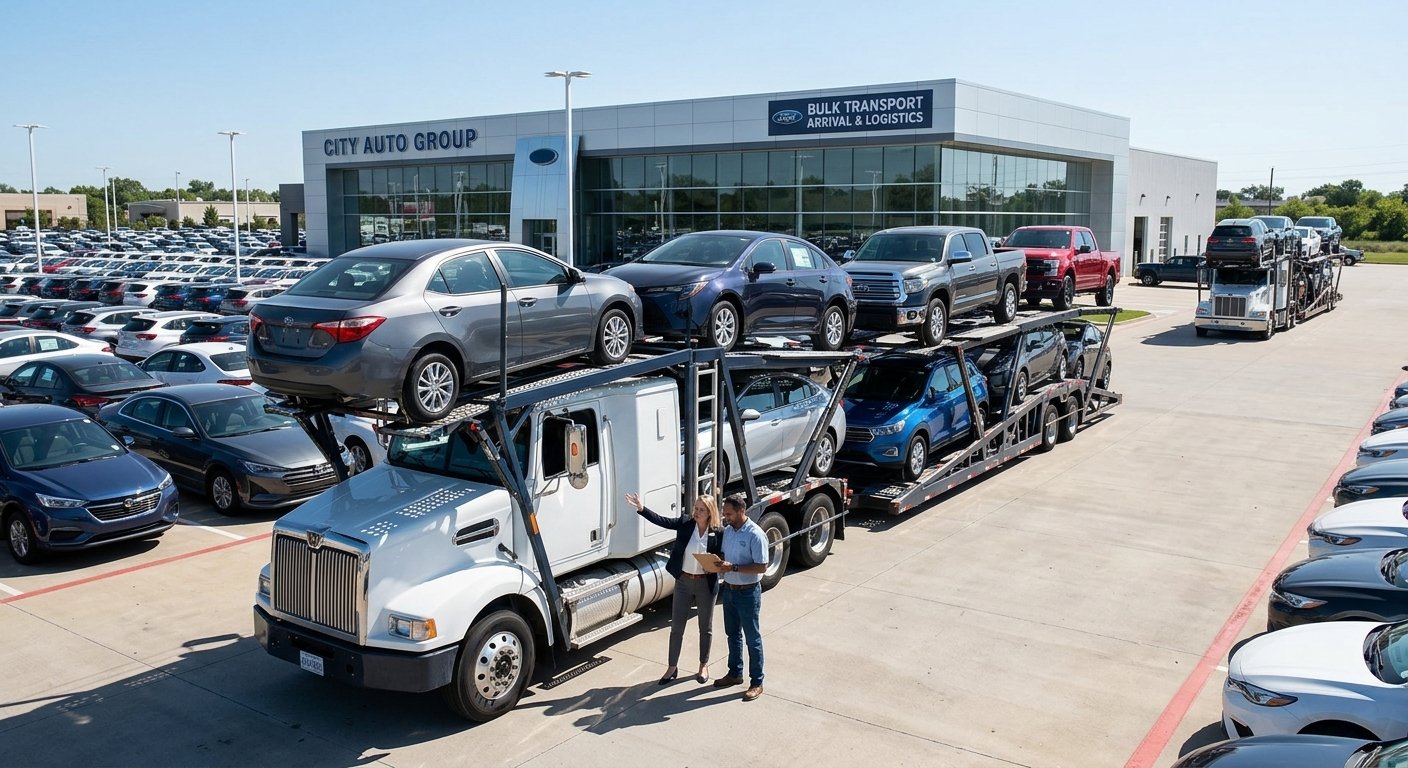
When you’re moving inventory by the truckload instead of one vehicle at a time, the logistics get more complicated — not just pricing, but staging, scheduling, multi-location coordination, and making sure a full trailer’s worth of vehicles arrives on a timeline you can actually plan around. Bulk vehicle transport for dealerships is built to handle exactly that.
NexGen Auto Transport works with dealership groups, auction buyers, and wholesalers moving inventory in volume — from a handful of vehicles at once to full truckload shipments across multiple pickup and delivery points. Here’s how bulk transport actually works, and what it takes to run it efficiently.
What Counts as Bulk Vehicle Transport?
Bulk transport generally means moving enough vehicles at once that they fill — or nearly fill — a full carrier trailer, typically 7 or more vehicles depending on size and trailer type. Common scenarios include:
- Full truckload auction runs — consolidating everything won at a single auction event into one or more full trailers
- Multi-location inventory redistribution — moving vehicles across several stores within the same dealer group to balance stock
- New inventory restocking — bringing in a large batch of vehicles from a regional distribution point or port
- Liquidation or fleet disposal — moving a large block of vehicles off a lot or out of a fleet all at once
- Seasonal inventory pushes — building up stock ahead of a known high-demand period
This is different from the kind of multi-car shipment we cover in our guide on dealer auto transport discounts, which focuses on volume pricing for smaller batches of 2–6 vehicles. Bulk transport picks up where that leaves off — full trailer loads and coordinated multi-shipment logistics for dealerships moving inventory at scale.
How Bulk Transport Pricing Works
Full truckload shipments are priced differently than individual vehicle orders. Instead of a per-vehicle rate built around a single pickup and delivery point, bulk pricing accounts for:
- Trailer utilization — how efficiently the vehicles fill the trailer’s available space and weight capacity
- Number of stops — whether all vehicles share one pickup and delivery point, or the load involves multiple stops along the route
- Vehicle mix — a load of similarly sized sedans loads more efficiently than a mixed batch of trucks, SUVs, and low-clearance vehicles
- Route and lane — bulk loads on high-density lanes (major metro to major metro) typically price more favorably than routes with less regular carrier traffic
Because a full truckload shipment maximizes what a single carrier and trailer can move in one trip, the effective per-vehicle cost is almost always lower than booking the same vehicles as separate orders — often significantly more than the discount available on smaller multi-vehicle shipments. For a general sense of how per-vehicle pricing scales with distance and vehicle type outside of bulk orders, see our guide on how much it costs to ship a car.
Full Truckload vs. Partial Load: Which Fits Your Shipment?
| Factor | Full Truckload | Partial / Consolidated Load |
|---|---|---|
| Best for | 7+ vehicles moving together on one route | Smaller batches that can share trailer space with other shippers’ vehicles |
| Per-vehicle cost | Lowest available, since the whole trailer is dedicated to your inventory | Lower than single-vehicle rates, but higher than a full truckload |
| Scheduling control | Highest — the route is built around your shipment | Shared with other pickups/deliveries on the same trailer |
| Typical use case | Auction liquidations, large restocks, fleet disposal | Ongoing smaller dealer trades and transfers |
Many dealerships use both models depending on the shipment — a full truckload for a big auction haul, and smaller consolidated orders for day-to-day trades. If your typical order size is closer to a handful of vehicles rather than a full trailer, our guide on choosing a carrier for dealer-to-dealer transport covers what to look for at that scale.
Coordinating Multi-Location and Multi-Stop Bulk Shipments
Bulk transport rarely means one pickup point and one delivery point. Dealer groups often need vehicles collected from several nearby auction lots and distributed across multiple stores. A carrier built for bulk logistics handles this by:
- Mapping efficient multi-stop routes that minimize total transit time across several pickup or delivery points in the same region
- Sequencing deliveries so stores receive inventory in a planned order rather than whichever vehicle happens to load last
- Coordinating with each location’s receiving team so someone is prepared to inspect and sign off at every stop, not just the final one
- Splitting loads across multiple trailers when volume exceeds what a single truck can carry, while keeping the shipments coordinated under one account
Staging and Scheduling a Bulk Shipment
Moving a full trailer’s worth of inventory takes more upfront planning than a single-vehicle order. A typical bulk shipment timeline looks like this:
- Volume and route planning. Share your expected vehicle count, pickup locations, and delivery destinations so a route and trailer plan can be built around the shipment.
- Staging confirmation. Confirm which vehicles are ready and where they’re physically located — auction lot, reconditioning center, or dealership — before a pickup date is finalized.
- Carrier and trailer assignment. A carrier (or coordinated set of carriers, for larger loads) is assigned based on trailer capacity and route.
- Pickup and documentation. Each vehicle is inspected and documented individually, even though they’re moving as part of one larger shipment.
- Delivery and sign-off. Vehicles are delivered to their assigned destination(s), with condition reports matched back to the original pickup documentation.
Giving your carrier a realistic staging window — rather than expecting every vehicle to be pickup-ready on a single fixed day — usually results in a faster, more efficient load. Vehicles still being reconditioned or awaiting title paperwork can hold up an entire truckload if they’re not accounted for in the schedule ahead of time.
Open vs. Enclosed Transport Within a Bulk Shipment
Bulk inventory isn’t always uniform. A large restock might include everyday sedans and SUVs alongside a few higher-value trade-ins or specialty vehicles. Most bulk shipments run primarily on open vehicle transport, the most cost-effective option for standard inventory, while any vehicles that warrant extra protection can be routed separately via enclosed vehicle transport — without splitting the shipment into two completely separate orders or accounts.
What to Look for in a Bulk Transport Partner
- Enough carrier network capacity to actually fill full truckload orders on your timeline, not just occasional multi-car shipments
- Multi-stop routing experience, since bulk shipments rarely involve a single pickup and single delivery point
- Consistent per-vehicle documentation even at scale — every vehicle in a bulk load still needs its own inspection and bill of lading
- Dedicated account management so a large, multi-stop shipment has one point of contact coordinating the whole load, not several disconnected bookings
- Flexible scheduling that can accommodate staggered vehicle readiness without holding up the entire shipment
- Proper licensing and insurance sufficient to cover a full trailer’s value, not just a single vehicle — confirm FMCSA registration and coverage limits before committing a large shipment to any carrier
Common Challenges With Bulk Vehicle Transport
Underestimating Staging Time
The most common delay in a bulk shipment isn’t the carrier — it’s vehicles that aren’t actually ready to load on the planned pickup date. Building a realistic staging buffer into your schedule avoids holding up an entire truckload over one or two vehicles.
Uneven Vehicle Mix
A trailer loaded with a wide range of vehicle sizes — compact sedans next to full-size trucks — doesn’t always use space as efficiently as a more uniform load. Sharing your expected vehicle mix upfront helps your carrier plan trailer capacity accurately and avoid last-minute adjustments.
Multiple Delivery Points Without a Clear Sequence
When inventory is heading to several stores, an unplanned delivery order can mean some locations wait longer than necessary. Confirming a delivery sequence in advance — based on priority, staffing availability, or lot capacity — keeps the whole shipment moving efficiently.
Inconsistent Documentation at Scale
It’s easier for a single missed inspection photo or incomplete condition report to slip through when a dozen or more vehicles are moving at once. A carrier with a standardized process for every vehicle, regardless of shipment size, protects you if a damage dispute comes up later.
Bulk Transport for Auction and Wholesale Buyers
Auction and wholesale buyers moving large batches face a specific version of this challenge: vehicles are often scattered across several lots or auction houses in the same region, purchased over the course of a single event. Bulk transport built for this use case can:
- Consolidate vehicles from multiple auction locations into a single coordinated shipment
- Route through a reconditioning or inspection facility before final delivery, if needed
- Batch title and paperwork handling alongside the physical transport process
- Provide a single consolidated invoice for the entire event’s worth of purchases, rather than dozens of individual charges
Insurance and Liability at Bulk Volume
A full trailer of vehicles represents significantly more value in transit than a single shipment, which makes insurance coverage worth confirming carefully before committing a large load to any carrier. A few things worth clarifying upfront:
- Total coverage per trailer, not per vehicle. Confirm the carrier’s cargo insurance limit covers the full combined value of the load, not just what would be sufficient for one vehicle.
- How claims are handled at scale. If damage affects more than one vehicle in a shipment, ask how the carrier processes multiple claims from the same load.
- Whether coverage differs between open and enclosed segments of a mixed shipment, since these sometimes carry different default limits.
- Documentation retention. With more vehicles moving at once, having easy access to each vehicle’s individual inspection report matters more if a dispute comes up weeks after delivery.
Scaling Bulk Transport as Your Dealership Grows
What counts as a “bulk” shipment for a single-location dealership looks different from a multi-store dealer group moving dozens of vehicles a week. As your shipping volume grows, it’s worth revisiting a few things periodically:
- Route consistency. If you’re regularly sourcing from the same auction hubs or distributing to the same set of stores, a carrier familiar with those specific lanes can often move vehicles more efficiently over time.
- Account structure. A dealer group with several locations may benefit from a single master account with location-level visibility, rather than each store managing shipments independently.
- Forecasted volume sharing. Giving your carrier visibility into upcoming volume — an expected auction haul next month, a seasonal restock — allows better route and capacity planning than requesting bulk shipments on short notice each time.
Frequently Asked Questions
How many vehicles count as a bulk shipment?
Generally, a shipment of 7 or more vehicles is considered bulk or full truckload, since that’s roughly what a standard open carrier trailer can hold. Smaller batches of 2–6 vehicles typically fall under standard multi-car dealer pricing rather than full truckload logistics.
Is bulk transport cheaper per vehicle than booking individually?
Yes, typically. Full truckload shipments make the most efficient use of a carrier’s trailer capacity. Usually results in a lower per-vehicle cost than booking the same vehicles as separate orders.
Can a bulk shipment include multiple pickup and delivery locations?
Yes. Multi-stop routing is common for bulk shipments, especially for dealer groups moving inventory across several stores. Buyers collecting from multiple auction lots in the same region.
What happens if not all vehicles are ready on the planned pickup date?
It’s best to communicate this in advance so your carrier can plan around a realistic staging window. Vehicles that aren’t ready can sometimes be added to a follow-up shipment rather than delaying the entire truckload.
Can I mix open and enclosed transport in one bulk order?
Yes. Standard inventory can move via open transport while higher-value vehicles in the same shipment. Routed via enclosed transport, all coordinated under a single account.
Do bulk shipments still get individual documentation for each vehicle?
Yes. Even though vehicles move together as part of one larger shipment. Each one should still receive its own inspection and bill of lading to protect both the dealership and the carrier.
Get a Bulk Transport Quote for Your Dealership
Whether you’re moving a full truckload from a single auction event or coordinating inventory across multiple stores. NexGen Auto Transport can build a bulk shipping plan around your actual volume and timeline.
Get a free quote from NexGen Auto Transport, or contact our team directly to discuss volume pricing and scheduling for your next bulk shipment.
