
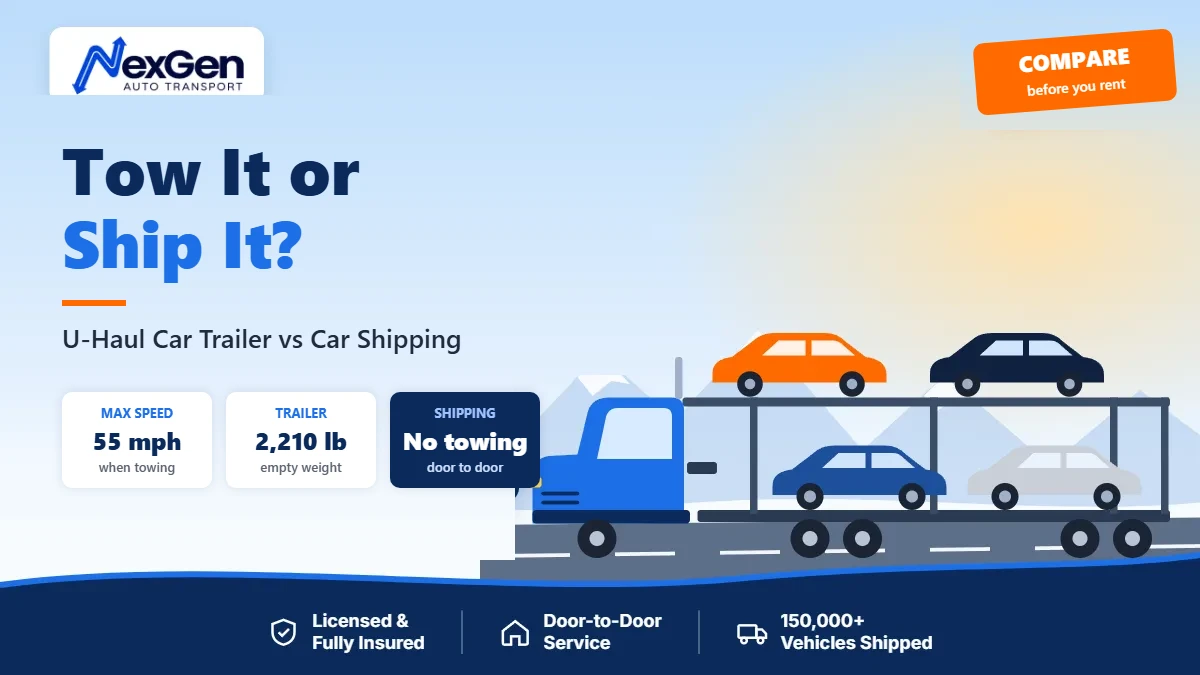
By NexGen Auto Transport Team · Reviewed by our Operations Team · Updated November 10, 2026
Short answer: A U-Haul auto transport trailer can be the cheaper option if you already own a strong enough tow vehicle and you are driving the same route anyway. For most long moves, though, professional car shipping costs about the same once you add fuel, hotels and time, and it saves you from towing at 55 mph for days. Shipping a sedan about 1,500 miles usually runs around $950 to $1,500 on an open carrier. Get your exact price here.
Calculate Your Car Shipping Cost
If you are moving across the country, you have probably asked yourself whether to rent a car trailer and tow your second vehicle behind a moving truck or SUV, or to pay a company to ship it. Both options work. The right choice depends on what you are towing with, how far you are going and how much your time is worth. This guide compares a U-Haul auto transport trailer with professional car shipping, using U-Haul’s own published specifications, so you can decide with real numbers instead of guesses.
Quick Comparison: U-Haul Trailer vs Car Shipping
| U-Haul auto transport trailer | Professional car shipping | |
|---|---|---|
| Who drives | You tow the car yourself | A licensed carrier hauls it |
| Top speed | 55 mph maximum recommended by U-Haul | Normal highway speed for the truck |
| Tow vehicle needed | Yes, with a proper hitch and enough weight | No |
| Typical 1,500-mile cost | Trailer rental + fuel + hotels + meals | About $950 to $1,500 for a sedan (open carrier) |
| Your time | 3 to 4 days of driving at towing speed | A few minutes at pickup and delivery |
| Best for | Short or medium moves when you already drive a heavy truck or SUV | Long moves, flights, winter trips, newer or valuable cars |
What Is a U-Haul Auto Transport Trailer?
An auto transport trailer is a two-axle trailer that carries all four wheels of your car off the ground. You drive the car up the ramps, strap the front tires down and tow it behind your truck. Because the whole car rides on the deck, it works for front-wheel, rear-wheel, all-wheel and four-wheel drive cars, unlike a tow dolly. U-Haul lists these specifications on its auto transport rental page:
| Specification | U-Haul auto transport |
|---|---|
| Empty weight | 2,210 lbs |
| Maximum load | 5,290 lbs |
| Gross weight (trailer + car) | 7,500 lbs |
| Maximum recommended speed | 55 mph |
| Maximum outside tire width of the towed car | 6 ft 4 in |
| Hitch ball | 2-inch ball rated for at least 2,000 lbs |
Specifications from U-Haul’s website. U-Haul notes that measurements are approximate and equipment can vary, so confirm the details for your rental.
The weight rule most people miss
U-Haul states that the curb weight of your tow vehicle must be more than the weight of the loaded trailer. The empty trailer alone weighs 2,210 lbs. Put a 3,300-lb midsize sedan on it and the loaded trailer weighs about 5,500 lbs, so your tow vehicle has to weigh more than that. That usually means a full-size pickup, a large SUV or a U-Haul moving truck. Most midsize SUVs and crossovers are not heavy enough, even if their towing capacity looks high on paper.
U-Haul also requires mirrors on both sides of the tow vehicle, working lights, a proper hitch, and a hard top on SUVs and some Jeeps. The rental counter checks these before you leave.
Not sure your truck can tow it? Get a shipping price instead
What Does a U-Haul Car Trailer Really Cost?
U-Haul does not publish a flat price for its auto transport trailer. The rate depends on your pickup city, drop-off city and date, and one-way rentals usually cost more than local ones. Check your exact route on U-Haul’s site before you compare. The rental fee is only part of the cost, though. Here is everything a long tow adds up to:
- Trailer rental: the one-way rate U-Haul quotes for your route and dates, plus any damage coverage you add.
- Extra fuel: pulling a loaded car trailer, often 5,000 lbs or more, lowers your fuel economy a lot, so you will buy noticeably more fuel than for the same trip without a trailer.
- Extra hotel nights: at 55 mph, a 1,500-mile trip is more than 27 hours of driving, which is three or four days for most people.
- Meals and time off work: every extra day on the road adds food costs and often unpaid leave.
- Hitch work: if your vehicle has no hitch or wiring, installation is an extra cost before you can rent.
A worked example: Houston to Los Angeles
Here is how the numbers can look for a 1,550-mile move. The fuel figures are an example only, so plug in your own vehicle’s numbers.
| Cost | Towing it yourself | Shipping it |
|---|---|---|
| Equipment | One-way trailer rental (get a U-Haul quote) | Included |
| Fuel | About 110 gallons if your truck gets 14 mpg while towing; about $385 at $3.50 a gallon | None |
| Hotels | Two or three extra nights | None |
| Driving time | About 28 hours at 55 mph | None |
| Shipping price | None | About $950 to $1,500 (see Houston to Los Angeles car shipping) |
If you are driving a moving truck on that route anyway, adding a trailer can save money. If you would otherwise fly, or your vehicle cannot legally tow the load, shipping is usually the better deal. For more on what drives shipping prices, see car shipping cost factors and whether shipping is cheaper for short or long distances.
When a U-Haul Trailer Makes Sense
- You are already driving a heavy pickup or a U-Haul truck on the same route.
- The trip is a few hundred miles, so one day of towing gets you there.
- Your car is an older daily driver and you are comfortable loading and strapping it yourself.
- You need the car to arrive the same day you do, and you are willing to drive slowly to make that happen.
When Professional Car Shipping Is the Better Choice
- You are flying to your new home, or two people would otherwise have to drive two vehicles.
- Your tow vehicle does not outweigh the loaded trailer, which rules most crossovers and midsize SUVs out.
- The move is long, such as coast to coast, where towing at 55 mph adds days.
- You are moving in winter and do not want to tow through snow, ice or mountain passes.
- The car is new, valuable or classic, and you want it in an enclosed carrier instead of exposed behind your truck.
- You are moving more than one car. Multi-car shipments can save up to 20% with NexGen.
Safety: What Towing a Car Trailer Is Really Like
Towing a loaded car trailer is not like normal driving. The combination is long and heavy, stopping distances are longer, and crosswinds and passing trucks push the trailer around. Backing up takes practice, and many gas stations and hotel parking lots are hard to get in and out of. U-Haul’s 55 mph limit also means traffic is constantly passing you on the interstate.
None of this is a reason not to tow if you are experienced. But if you have never towed before, a cross-country trip is a tough place to learn. If towing is your plan, read our guide on how to tow a car first.
How Car Shipping Works With NexGen
- Get a quote with your pickup and delivery addresses, vehicle and dates on our car shipping cost page.
- We assign a vetted, insured carrier on your route. There is no upfront payment.
- The driver inspects the car with you at pickup and notes its condition on the Bill of Lading.
- Your car travels on an open carrier or an enclosed one, usually door to door.
- You inspect the car at delivery and pay the balance to the driver.
Most long-distance shipments arrive in about 3 to 9 days after pickup, depending on distance. See how long it takes to ship a car for details, and how far in advance to book so your car arrives when you do.
Related guides: Also compare car dolly vs car trailer vs car shipping, and find out whether your moving company can ship your car.
Why Book With NexGen Auto Transport?
NexGen Auto Transport LLC is a licensed auto transport broker (FMCSA MC 1482694, USDOT 3969190) based in Stafford, Texas. We match your car with a vetted carrier, there is no upfront payment and no cancellation fee, and the carrier’s cargo insurance covers your car while it is on the truck. Students and military members can save up to 20%. See military car shipping and student car shipping.
Frequently Asked Questions
Is it cheaper to rent a U-Haul car trailer or ship my car?
For short trips where you already drive a heavy truck, the trailer is often cheaper. For long moves, shipping usually costs about the same once you add fuel, hotels and extra days on the road, and it saves you the work of towing.
What can tow a U-Haul auto transport trailer?
U-Haul requires that your tow vehicle’s curb weight be more than the loaded trailer, which weighs 2,210 lbs empty plus the weight of your car. In practice, that usually means a full-size pickup, a large SUV or a U-Haul truck.
How fast can you drive with a U-Haul car trailer?
U-Haul’s maximum recommended speed for its auto transport trailer is 55 mph.
How much weight can a U-Haul auto transport carry?
U-Haul lists a maximum load of 5,290 lbs, with a gross weight of 7,500 lbs for the trailer and car together.
Can I put belongings in the car on a U-Haul trailer?
U-Haul’s towing instructions say not to load extra cargo into a towed vehicle. If you ship with a carrier instead, most also limit personal items in the car, so ask before you pack.
How much does it cost to ship a car instead?
Most long-distance shipments of a sedan cost about $800 to $1,500 on an open carrier, depending on distance, season and vehicle. Get an exact price on our quote page.
Skip the towing. Get your car shipping quote
About the authors
This guide was written and reviewed by the NexGen Auto Transport team in Stafford, Texas. Since 2021 we have arranged transport for more than 150,000 vehicles nationwide (FMCSA MC 1482694, USDOT 3969190). Prices and transit times reflect our current rates. Read our editorial policy.
