
By the NexGen Auto Transport team
You request a quote, and suddenly you’re reading about “dispatch,” “deadhead miles,” and a “bill of lading.” Nobody warned you there’d be vocabulary.
This glossary explains the terms you’ll actually run into when you ship a car, in plain English. Skim it now, or bookmark it and come back when a term pops up in your paperwork.
Quick Answer: The Terms That Matter Most
If you only learn five, make it these:
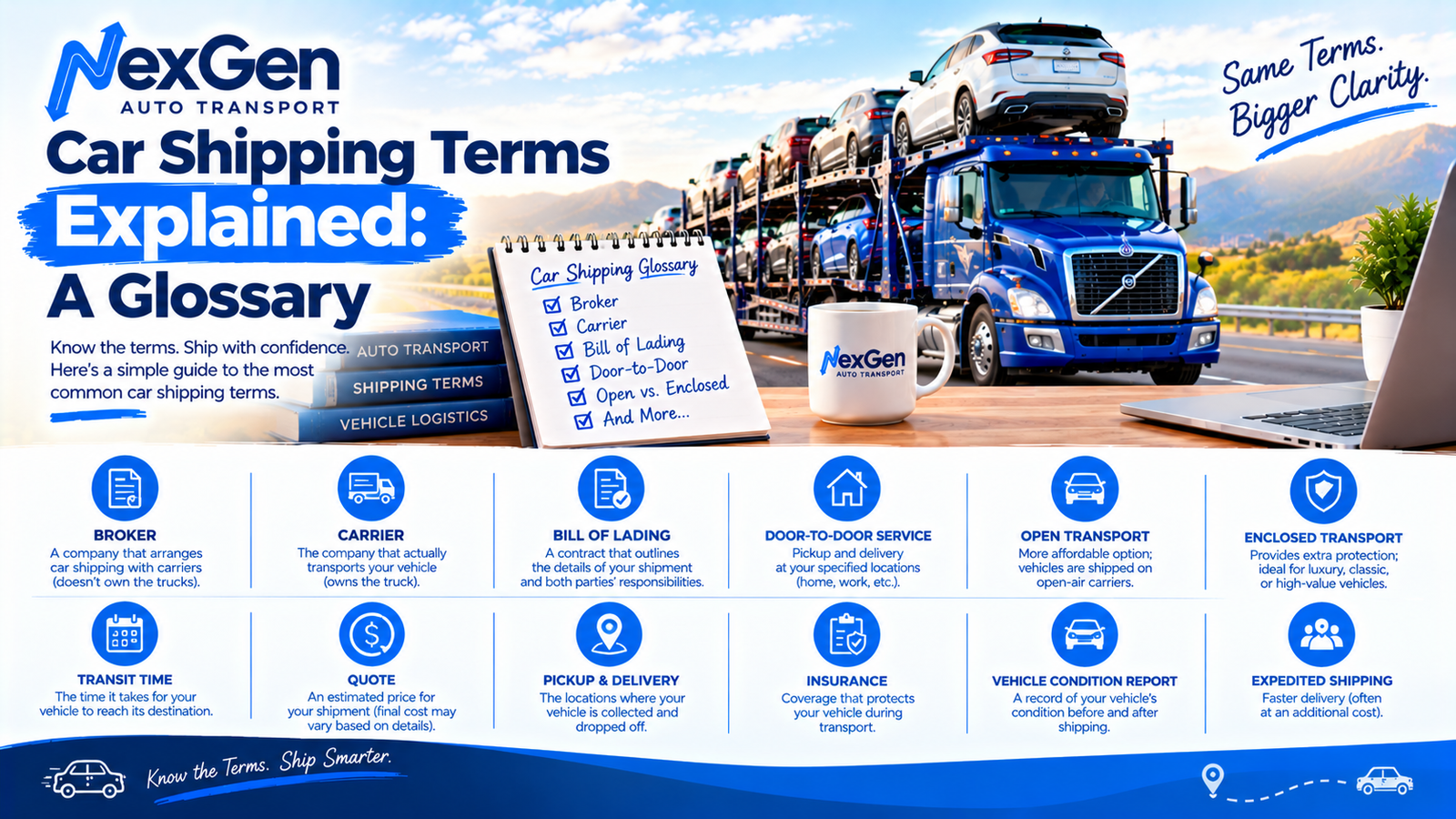
- Broker: the company that arranges your shipment and matches you with a carrier.
- Carrier: the trucking company and driver who physically move your car.
- Bill of Lading (BOL): the inspection report and receipt you sign at pickup and delivery.
- Pickup window: the range of days your car may be collected, not a single fixed time.
- Open vs. enclosed transport: the two main trailer types, which affect both protection and price.
Everything else below builds on those.
Want to know what your shipment will cost?
Get a free, no-obligation quote for your route in seconds.
The People and Companies Involved
Broker
A broker is the middle layer between you and the truck. They take your request, price the job, and find a carrier who has space on the route you need. Most customers book through a broker because it’s far easier than calling dozens of trucking companies yourself.
A good broker is also your point of contact if anything changes along the way.
Carrier
The carrier is the company that owns the truck and employs the driver. Your car rides on their trailer. Brokers work with a network of carriers, so a larger network usually means more trucks on more routes and faster pickups. NexGen works with more than 16,000 carrier partners.
Driver
The person behind the wheel of the truck. They do the inspection at pickup, load your car, and hand it over at delivery. If you need to coordinate a meeting spot or time, the driver (or the dispatcher) is who you’ll talk to.
Dispatcher
The dispatcher assigns jobs to drivers and manages schedules. When people say “your order has been dispatched,” it means a specific carrier has accepted your shipment and is now responsible for it.
Shipper
That’s you. In the industry, the person sending the vehicle is called the shipper, even if you’re just moving a Honda Civic to college.
Types of Transport
Open Carrier (Open Transport)
An open carrier is the double-decker trailer you’ve seen on the highway, with cars loaded in the open air. It’s the most common method and usually the cheapest, because the trailer holds up to 8–10 vehicles and the cost is split among them.
Your car is exposed to weather and road debris, the same as if you drove it yourself. For most everyday vehicles, that’s a perfectly reasonable trade. See our open vehicle transport page for how it works.
Enclosed Carrier (Enclosed Transport)
An enclosed carrier has walls and a roof. Your car is shielded from rain, hail, dust, and prying eyes. Because these trailers carry fewer cars, the price is higher.
People choose enclosed for classic cars, exotics, luxury vehicles, and anything with high sentimental or collector value. Learn more about enclosed vehicle transport.
Door-to-Door Shipping
The driver picks up as close to your address as a big truck can legally and safely get, and delivers the same way. It’s the standard service for most shipments.
The key phrase is as close as possible. A 75-foot rig can’t always fit down a narrow street or a tight cul-de-sac, so you may be asked to meet the driver at a nearby parking lot. Details are on our door-to-door auto shipping page.
Terminal-to-Terminal Shipping
Instead of meeting at your address, you drop the car off at a storage terminal and collect it from another one at the destination. It can be cheaper, but it’s less convenient, and some terminals charge storage fees if you’re slow to pick up.
Expedited Shipping
This is the fast lane. You pay a premium so your car gets priority placement on a truck and goes out sooner. It’s useful when you have a hard deadline, like a military move or a job start date. See expedited auto shipping.
Auction Transport
Shipping a vehicle to or from an auction house such as Manheim, Copart, or IAAI. These jobs often come with their own rules about pickup hours, gate passes, and release paperwork. We cover this in more detail on our auction car transport page.
Snowbird Shipping
Snowbirds are people who spend winter in a warm state and summer back north. Their cars make the same trip twice a year, so demand spikes on routes like the Northeast to Florida every fall and spring. Booking early during these seasons usually helps. Details at snowbird car shipping.
Not sure whether open or enclosed is right for your car?
Talk to a real person who can recommend the best option for your vehicle and route.
Scheduling Terms
Pickup Window
A pickup window is the range of days when your car can be collected, often one to five days. It exists because truck schedules shift: traffic, weather, and earlier stops all affect timing.
A wider window generally gives your broker more options, which can mean a better price and an easier match.
Delivery Window
The estimated range of days your car should arrive. Cross-country trips typically take longer than regional ones, and the estimate depends on distance, route, weather, and how many other stops the truck has.
First Available Date
The earliest day you’re okay with your car being picked up. You’ll see this on most quote forms. Being flexible here is one of the easiest ways to keep costs down.
Dispatch
The moment a carrier is officially assigned to your shipment. Before dispatch, your order is waiting for a truck. After dispatch, a driver has agreed to pick up your car.
Transit Time
The actual time your car spends on the truck, from pickup to drop-off. Not the same as the pickup window, which is the wait before the trip starts.
Deadhead Miles
Miles a truck drives empty, with no cars on board, to get to a pickup. Drivers try to minimize these, which is why routes between major cities are often cheaper and quicker than rural ones.
Paperwork and Payment
Bill of Lading (BOL)
The single most important document in the whole process. The BOL is both a receipt and a condition report. At pickup, the driver inspects your car and notes any existing scratches, dents, or damage. At delivery, you compare the car against that report.
Do this: walk around the car with the driver, take your own dated photos, and don’t sign until the notes match what you see. If something is wrong at delivery, note it on the BOL before you sign and before the driver leaves.
Quote
An estimate of what it will cost to ship your car. Prices depend on distance, vehicle size and weight, trailer type, season, fuel costs, and whether the car runs. A real quote should be clear about what’s included. Our car shipping cost page walks through the factors.
Deposit
A partial payment taken when you book, often to cover the broker’s fee. The remaining balance is typically paid to the driver at delivery.
COD (Cash on Delivery) or COP (Cash on Pickup)
Paying the driver directly, either when they collect the car or when they drop it off. Many carriers expect certified funds, cash, or another specific payment method, so confirm what’s accepted before delivery day.
Surcharge
An extra fee added to the base price. Common examples include fuel adjustments, oversize or lifted vehicle fees, and inoperable vehicle fees. Ask up front whether your quote is all-in. NexGen’s policy is that the quote you get is the price you pay, with no fuel surcharges added after booking.
Tired of surprise fees?
At NexGen, the quote you get is the price you pay. See what goes into the cost of shipping a car.
Insurance and Compliance
Cargo Insurance
Coverage carried by the carrier that protects your vehicle while it’s on the truck. It’s required by federal law for licensed carriers, but coverage limits differ from carrier to carrier. Ask to see the certificate and check what it covers and what the deductible is.
Your Personal Auto Insurance
Your own policy may or may not cover your car during shipping. Call your insurer and ask. It’s a two-minute conversation that can save you a headache.
FMCSA
The Federal Motor Carrier Safety Administration, the U.S. agency that regulates interstate trucking. Brokers and carriers that move vehicles across state lines need to be registered with it.
MC Number and USDOT Number
These are the registration numbers that identify a broker or carrier with the FMCSA. You can look either one up on the FMCSA’s public website to confirm a company is licensed and active. For reference, NexGen’s are MC# 1482694 and USDOT# 3969190.
Checking these numbers before you book is the fastest way to filter out unlicensed operators.
Bonded
A broker that’s bonded has a financial guarantee on file. If they fail to meet certain obligations, there’s money set aside to cover claims.
Vehicle Condition Terms
Operable vs. Inoperable
An operable vehicle starts, steers, and brakes, so it can roll on and off the truck under its own power. An inoperable vehicle doesn’t. It needs a winch and sometimes extra equipment, and that usually adds to the price.
Be upfront about this when you request a quote. Showing up with a car that doesn’t run, after you said it did, can delay or cancel your pickup.
Winch
A motorized cable on the truck used to pull non-running vehicles onto the trailer.
Ground Clearance
How high the underside of your car sits off the ground. Low sports cars and heavily lowered vehicles may not clear the trailer ramps without special equipment, which is another reason people choose enclosed transport with a liftgate.
Liftgate
A hydraulic platform that raises and lowers a vehicle onto the trailer, instead of driving it up a ramp. It’s common on enclosed trailers and helps with low-clearance cars.
Top Load / Bottom Load
Open trailers have two levels. Top-load spots are generally less exposed to leaks and road grime from above, so some customers request them, though they may carry an added cost and aren’t always guaranteed. Bottom-load is the lower deck.
Other Terms You Might Hear
Hotshot
A smaller rig, usually a pickup truck pulling a short trailer, that carries one to three vehicles. Hotshots can be quicker for short or specialized jobs, but they aren’t ideal for long-haul routes.
Storage Fee
A charge for keeping a car at a terminal or lot longer than the free period. It’s one of the most common surprise bills in terminal-to-terminal shipping.
Lien or Hold
A legal claim or restriction that can stop a vehicle from being released. If your car has one, sort it out before booking.
Personal Items
Most carriers don’t allow you to pack your car with belongings, and they aren’t covered by cargo insurance. Some will allow a small amount, but always confirm in writing first.
Have a question the glossary didn’t answer?
Our team is happy to walk you through the process, step by step.
Frequently Asked Questions
What does “broker” mean in car shipping?
A broker arranges your shipment. They don’t usually own trucks. They match you with a licensed carrier that has space on your route and handle the coordination between you and the driver.
What is a bill of lading?
It’s the document that serves as your shipping receipt and your vehicle’s condition report. Check it carefully at both pickup and delivery, and keep your copy.
What’s the difference between open and enclosed car shipping?
Open carriers transport cars on an uncovered trailer and cost less. Enclosed carriers protect cars inside a covered trailer and cost more. Both are insured, and the right choice depends on your vehicle’s value and how much exposure you’re comfortable with.
What is a pickup window?
It’s the span of days in which your car may be picked up. Carriers use a window instead of a set time because truck routes change with traffic, weather, and other stops.
How do I know a car shipping company is legit?
Look up its MC and USDOT numbers on the FMCSA website, confirm that they’re active, and check recent reviews. Be cautious of quotes far below everyone else’s.
Ready to Ship?
Now that the jargon makes sense, the process is a lot less intimidating. If you’d like a price for your route, you can get a free quote online or call NexGen Auto Transport at (832) 886-1321 and talk to a real person who can walk you through it. You can also browse all of our car shipping services.
Ready to ship your car?
FMCSA licensed, bonded, and insured. BBB accredited with an A+ rating.
