
By NexGen Auto Transport Team · Reviewed by our Operations Team · Updated November 21, 2026
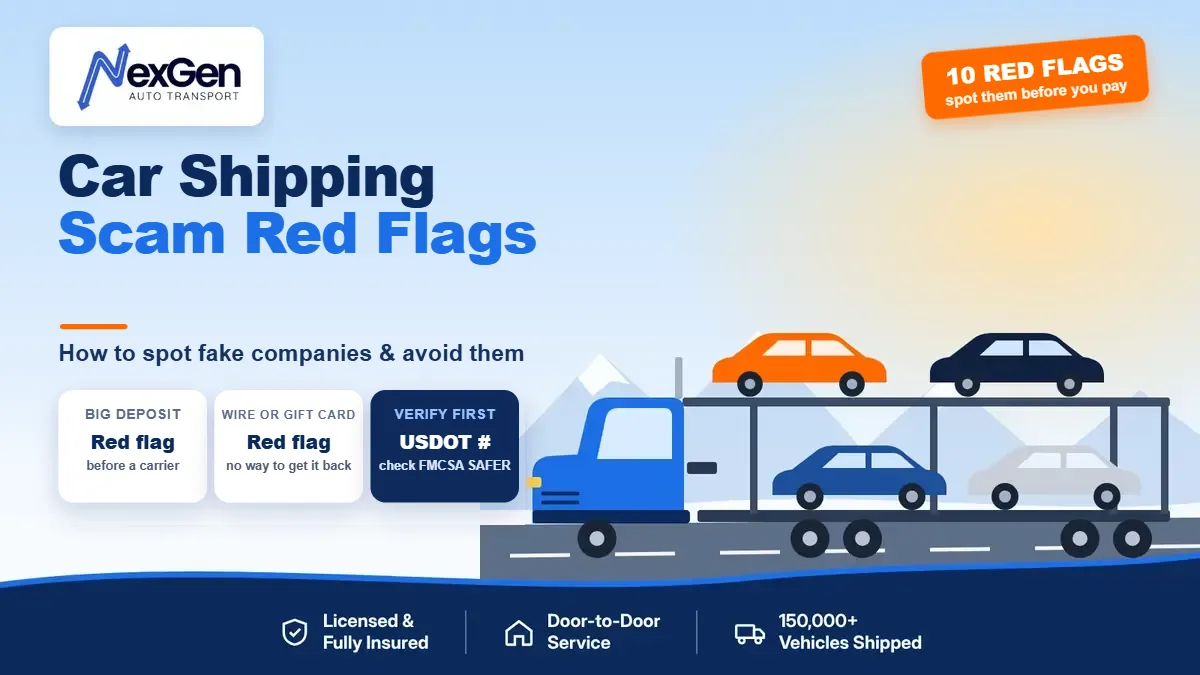
Quick answer: The biggest car shipping scam red flags are a quote far below everyone else’s, a demand for a large deposit before a carrier is assigned, and a request to pay by wire, gift card, crypto or a cash app to a person. Before you pay anything, look up the company’s USDOT number on the FMCSA SAFER system or the new Motus public search, check that the legal name matches the website, and get every price and fee in writing. A legitimate company will pass all three checks in about five minutes.
Last updated: November 21, 2026.
Most car shipping companies are honest. But because customers book online, often in a hurry and with a car on the line, the industry attracts scammers. The Better Business Bureau has repeatedly warned about fake vehicle transport websites that take a deposit and vanish, and about “shippers” that move the car and then demand more money before releasing it. This guide is about spotting those schemes. For choosing between legitimate companies, see how to choose a car shipping company.
10 Car Shipping Scam Red Flags
1. A quote far below every other quote
If four companies quote $1,100–$1,300 and one quotes $750, the cheap one is the warning sign, not the deal. Lowball quotes are used to win your booking; the price then goes up once you’re committed (“bait and switch”), or no driver ever accepts the load. Treat any quote more than about 20% under the others as suspect. See why a quote can go up after booking.
2. A big deposit before a carrier is assigned
Many legitimate brokers charge nothing until a carrier is assigned, and some charge nothing upfront at all. A company that wants several hundred dollars, or full payment, the moment you book has little reason to work for you afterward. NexGen charges no upfront deposit; see how car shipping payment works.
3. Payment by wire, gift card, crypto or a cash app to a person
These methods are hard or impossible to reverse. A request to send money by Western Union, gift card, cryptocurrency, or Zelle or Cash App to an individual’s name instead of the business is one of the clearest signs of fraud. A credit card gives you the strongest dispute rights.
4. No USDOT number, or one that doesn’t check out
Every interstate broker and carrier must be registered with the Federal Motor Carrier Safety Administration (FMCSA). Look the number up on SAFER or with the public search in FMCSA’s Motus registration system, which launched in May 2026. Walk away if the authority is inactive or revoked, or if the number belongs to a different company.
5. A name, address or website that doesn’t match the registration
Scammers copy real companies’ names, logos and even USDOT numbers onto look-alike websites. Check that the legal name and address on SAFER match the website and your contract. A brand-new website, a phone number that only texts, or a Gmail address for “the office” are all warnings.
6. A guaranteed exact pickup date at a bargain price
Legitimate companies give pickup windows, because carriers schedule loads around routes, traffic and weather. A promise of a fixed date and a very low price is usually a promise that can’t be kept. Guaranteed dates do exist, but they cost more and come in writing.
7. No written contract or clear cancellation terms
Before you pay, you should have a written order showing the price, pickup window, transport type, insurance, payment terms and every possible fee. If the company won’t put it in writing, assume the terms will change.
8. Pressure to book right now
“This price expires in 10 minutes” or “only one spot left on the truck today” is a sales tactic, not a logistics fact. Take the time to verify the company first.
9. No proof of insurance, or no carrier details
Once a carrier is assigned, you should be able to get its company name, USDOT number and cargo insurance certificate. A company that refuses, or sends a certificate that doesn’t match the carrier’s name, is hiding something. See is it safe to ship a car.
10. A driver who demands more money or a blank signature
At pickup, never sign a blank or “clean” bill of lading. At delivery, a driver who demands far more than your written balance, or refuses to unload until you pay extra, is in breach of your agreement. Call the broker before paying anything beyond what your order states.
The five-minute check: (1) Look up the USDOT number on SAFER or Motus. (2) Match the legal name and address to the website and contract. (3) Read recent reviews on Google and the BBB. (4) Call the phone number on the FMCSA record, not just the one on the website. (5) Get the full price, fees and payment terms in writing.
Common Car Shipping Scams and How They Work
| Scam | How it works | How to avoid it |
|---|---|---|
| Fake company or cloned website | A professional-looking site takes a deposit, then stops answering | Verify the USDOT number and legal name; pay by credit card |
| Bait and switch | A low quote wins the booking; the price rises before pickup | Compare several quotes; be wary of the lowest by far |
| Hostage load | The car is picked up, then held until you pay extra | Written price and balance; verified carrier; call the broker immediately |
| Double brokering | Your load is passed to an unknown, unvetted carrier | Ask for the assigned carrier’s name and USDOT number before pickup |
| Fake car buyer or seller “shipper” | A seller or buyer insists you use their shipper and pay upfront | Choose and verify the shipping company yourself |
Ship with a company you can verify: USDOT# 3969190
Call Now: + (832) 886-1321 Get a Free Instant QuoteHow to Verify NexGen in Two Minutes
We’d rather you check us than trust us. NexGen Auto Transport LLC is an FMCSA-licensed broker, MC-1482694, USDOT# 3969190, at 3945 Greenbriar Dr Ste B1, Stafford, TX 77477. Look us up on SAFER, call us at +1 (832) 886-1321, and read our cancellation and refund policy before you book. We don’t charge an upfront deposit.
What to Do If You’ve Been Scammed
- Stop further payments and call your bank or card issuer to dispute the charge right away.
- Save everything: quotes, emails, texts, receipts, the website address and screenshots.
- Report the company to the FMCSA through its National Consumer Complaint Database.
- Report the fraud to the FTC at ReportFraud.ftc.gov and, for online fraud, the FBI at IC3.gov. You can also file with BBB Scam Tracker and your state attorney general.
- If your car is being held, contact local police where the vehicle is, and give them your title and contract.
Frequently Asked Questions
How do I know if a car shipping company is a scam?
Check whether its USDOT number is active on the FMCSA SAFER system or Motus search, whether the legal name matches its website, and whether it gives you a written price and terms. Big upfront deposits, untraceable payment methods and quotes far below the market are the most common warning signs.
Is it normal to pay a deposit for car shipping?
Some legitimate brokers charge a deposit once a carrier is assigned, and some charge nothing upfront. A large deposit demanded before any carrier is assigned, especially by wire or a cash app, is a red flag.
What is the safest way to pay for car shipping?
A credit card is the safest, because you can dispute the charge if the service isn’t provided. Avoid wire transfers, gift cards, cryptocurrency and cash-app payments to individuals.
What is a bait-and-switch car shipping quote?
It’s a low quote used to win your booking, followed by a higher price once you’re committed or close to your pickup date. Comparing several quotes and getting the price in writing helps you avoid it.
Where do I report a car shipping scam?
Report it to the FMCSA National Consumer Complaint Database, the FTC at ReportFraud.ftc.gov, the FBI’s IC3.gov for online fraud, BBB Scam Tracker and your state attorney general. Also contact your bank or card issuer.
Are car shipping brokers scams?
No. Licensed brokers are legal and arrange most car shipments in the U.S. Like carriers, they must be registered with the FMCSA, and brokers must also keep a $75,000 bond. Verify the registration before you book.
Related Guides
- How to choose a car shipping company
- How to compare car shipping quotes fairly
- Auto transport broker vs carrier
- How car shipping payment works
About the authors
This guide was written and reviewed by the NexGen Auto Transport team in Stafford, Texas. Since 2021 we have arranged transport for more than 150,000 vehicles nationwide (FMCSA MC 1482694, USDOT 3969190). Prices and transit times reflect our current rates. Read our editorial policy.
