
By NexGen Auto Transport Team · Reviewed by our Operations Team · Updated November 21, 2026
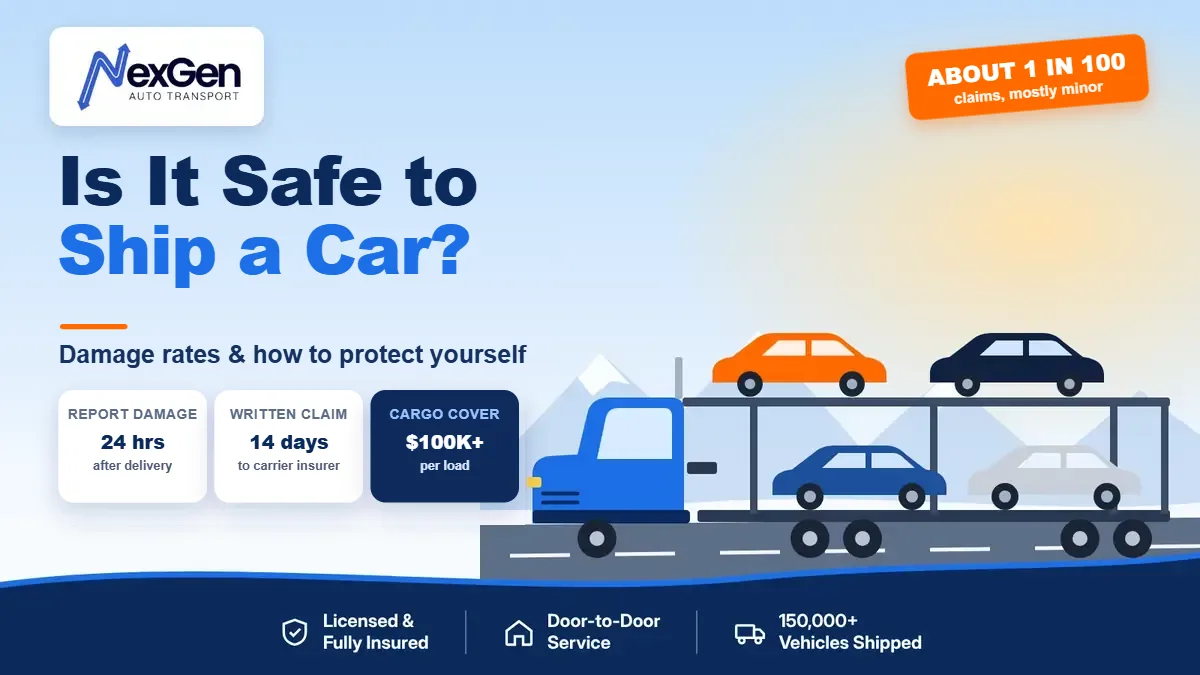
Quick answer: Yes. Shipping a car is very safe, and most cars arrive exactly as they left. There’s no official government damage statistic, but brokers that publish their numbers report damage claims on roughly 1 in 100 shipments, and most are minor, such as a rock chip or a small scratch. To protect yourself, choose an FMCSA-licensed company, confirm the carrier’s cargo insurance in writing, photograph the car at pickup, and note any new damage on the bill of lading before you sign at delivery.
Last updated: November 21, 2026. Insurance rules below are from the Federal Motor Carrier Safety Administration (FMCSA) and NexGen’s published claims policy.
Handing your car keys to a stranger with a 75-foot truck is a big ask. It’s normal to wonder how often things go wrong, what’s covered if they do, and how to make sure you’re not the unlucky one. This guide gives you straight answers, including the parts other companies leave out.
How Often Are Cars Damaged During Shipping?
Not often. Here’s what the evidence shows, and what it doesn’t:
- There is no official number. Neither the FMCSA nor any other government agency publishes a damage rate for car shipping. Any exact percentage you see comes from a company’s own records.
- Published broker figures cluster around 1%. Brokers that share their data generally report damage claims on about 1 in 100 shipments, with estimates ranging from under 1% to about 3%.
- Most damage is cosmetic. Rock chips, light scratches and scuffs from loading are far more common than dents or mechanical problems. Serious damage, such as a truck accident, is rare.
- Enclosed transport has fewer claims. Cars inside a closed trailer are shielded from road debris and weather, which removes the most common cause of minor damage.
The Most Common Types of Shipping Damage
| Damage type | Usual cause | How to reduce the risk |
|---|---|---|
| Rock chips and paint nicks | Road debris on open carriers | Choose enclosed transport or a top-deck spot for valuable cars |
| Scratches and scuffs | Loading, unloading and straps | Remove loose parts, fold mirrors, point out low bumpers |
| Undercarriage scrapes | Low cars on steep ramps | Tell the company the car is lowered so the carrier brings longer ramps |
| Fluid drips from cars above | A leaking car on the upper deck of an open carrier | Enclosed transport or a top-deck request |
| Broken accessories | Antennas, spoilers, bike racks or loose trim | Remove or secure them before pickup |
| Dead battery on arrival | Alarms or accessories left on | Turn off the alarm and unplug dash cams and chargers |
Is My Car Insured During Shipping?
Yes, but it’s worth knowing exactly how, because this is where people get surprised.
- Liability insurance is required by law. The FMCSA requires interstate for-hire carriers with trucks over 10,000 lb to carry at least $750,000 in liability coverage. That protects other people on the road, not your car.
- Cargo insurance is not federally required for car haulers. The FMCSA dropped the cargo-insurance filing requirement for most property carriers in 2011, except household goods movers. Coverage for your car comes from the carrier’s own cargo policy, so you should confirm it.
- On NexGen shipments, every load moves under the assigned carrier’s cargo insurance, with policy limits of $100,000 to $250,000 on open carriers and higher limits on many enclosed carriers. We send you the carrier’s insurance details.
- Brokers must be bonded. Every licensed auto transport broker must keep a $75,000 surety bond or trust fund with the FMCSA. NexGen Auto Transport is an FMCSA-licensed broker (MC# 1482694, USDOT# 3969190).
- Your own policy may help. Some personal auto policies cover a car in transit. Call your insurer and ask before pickup.
Sources: FMCSA insurance filing requirements; FMCSA broker bond FAQ. For what’s covered and excluded, read does car shipping insurance cover damage.
What insurance won’t cover: personal items left in the car, mechanical problems not caused by shipping, damage that wasn’t written on the bill of lading at delivery, and damage from poor preparation, such as a loose spoiler. Read our insurance page for the full list.
How to Protect Your Car: A 10-Step Checklist
Before you book
- Look up the company. Search its MC or USDOT number on the FMCSA SAFER system. Its authority should be active.
- Ask for the carrier’s insurance certificate. Check that cargo coverage is active and that the limit is higher than your car’s value.
- Be wary of the lowest quote. A price far below the others may never attract a driver, or may go up later. See auto transport companies to avoid.
- Choose enclosed transport for valuable cars. It costs about 30–50% more but removes road debris and weather from the equation. Compare open vs enclosed.
Before pickup
- Wash the car so existing scratches and dents are easy to see and record.
- Take dated photos and a video of every side, the roof, the wheels, the interior and the odometer.
- Prepare the car. Remove personal items and loose accessories, fold the mirrors, turn off the alarm and leave about a quarter tank of fuel. Use our 15-step preparation checklist.
At pickup and delivery
- Walk around the car with the driver at pickup and make sure every existing mark is on the bill of lading (BOL) before you sign.
- Inspect again at delivery in good light, before the driver leaves. If it’s dark, use a flashlight.
- Write any new damage on the BOL and have the driver sign it. If damage isn’t written on the BOL at delivery, it usually can’t be claimed.
What to Do If Your Car Is Damaged
NexGen’s claims and damage process (last updated October 7, 2026) sets these deadlines:
| Step | Deadline | What to do |
|---|---|---|
| Note the damage | At delivery, before the driver leaves | Write it on the BOL. Both you and the driver sign. |
| Document it | At delivery | Take photos and video from several angles, along with the BOL. |
| Pay the balance | At delivery | The remaining balance must be paid before the carrier’s insurer processes the claim. You can still claim after paying. |
| Report to NexGen | Within 24 hours of delivery | Call or email with your order number and photos. |
| File the written claim | Within 14 days of delivery | Submit it to the carrier’s insurer. We send you the insurance packet and help you file. |
Open vs Enclosed: Which Is Safer?
| Factor | Open carrier | Enclosed carrier |
|---|---|---|
| Exposure to road debris and weather | Yes | No |
| Typical cost | Lower (the standard choice) | About 30–50% more |
| Typical cargo insurance limits | $100,000–$250,000 per load | Often higher |
| Best for | Everyday cars, SUVs and trucks | Luxury, classic, exotic and new cars |
Dealers ship millions of new cars a year on open carriers, so open transport is safe for most vehicles. Enclosed is about extra protection, not basic safety.
Red Flags That Make Shipping Less Safe
- No MC or USDOT number, or one that shows as inactive on SAFER.
- A large upfront payment before a carrier is assigned. NexGen charges no upfront deposit; see our cancellation and refund policy.
- A driver who won’t do a walk-around inspection or asks you to sign a blank or “clean” BOL.
- Pressure to pay in cash only, or to a different company name than the one you booked with.
- No written proof of cargo insurance.
Frequently Asked Questions
Is it safe to ship a car?
Yes. Most cars arrive in the same condition they left in. Published broker figures put damage claims at roughly 1 in 100 shipments, and most claims are for minor cosmetic damage such as rock chips or light scratches.
How often do cars get damaged during shipping?
There’s no official government statistic. Brokers that publish their own data report damage claims on roughly 1% of shipments, with estimates from under 1% to about 3%. Serious damage is rare.
Who pays if my car is damaged during shipping?
The carrier’s cargo insurance pays for damage caused in transit, as long as the damage is written on the bill of lading at delivery and the claim is filed on time. With NexGen, report damage within 24 hours and file the written claim within 14 days of delivery.
Do car carriers have to carry insurance?
Interstate carriers must carry at least $750,000 in liability insurance under FMCSA rules. Cargo insurance for the cars themselves isn’t federally required for most carriers, so ask for the carrier’s cargo insurance certificate before pickup.
Is open car transport safe?
Yes. Open carriers are the standard way dealers and manufacturers move new cars. The main risk is minor road debris. For high-value or classic cars, enclosed transport removes that risk.
Should I add my own insurance when shipping a car?
Call your auto insurer and ask whether your policy covers the car in transit. Keep your own coverage active during shipping, because it may cover gaps the carrier’s policy excludes.
What should I do if I find damage after the driver leaves?
Photograph it right away and contact the shipping company within 24 hours. Damage not noted on the bill of lading is much harder to claim, which is why a careful inspection before signing matters.
Related Guides
- Does car shipping insurance cover damage?
- How to choose a car shipping company
- Is car shipping worth it?
- Enclosed vehicle transport
About the authors
This guide was written and reviewed by the NexGen Auto Transport team in Stafford, Texas. Since 2021 we have arranged transport for more than 150,000 vehicles nationwide (FMCSA MC 1482694, USDOT 3969190). Prices and transit times reflect our current rates. Read our editorial policy.
