
By NexGen Auto Transport Team · Reviewed by our Operations Team · Updated November 5, 2026
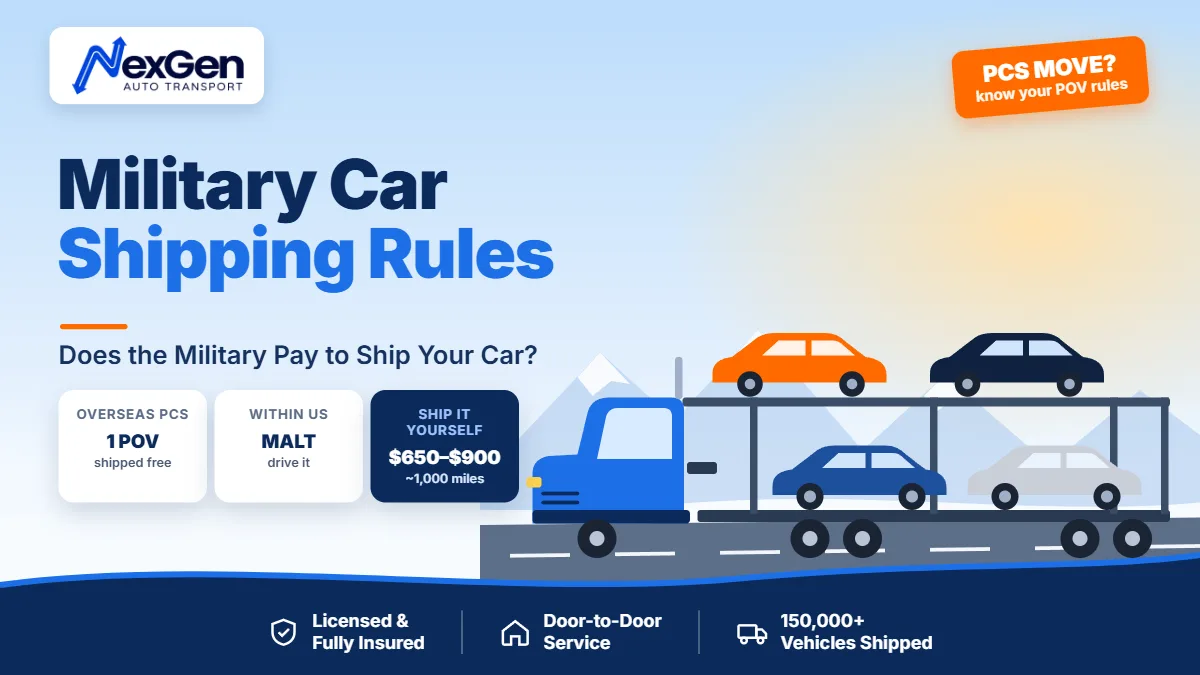
Quick answer: The military pays to ship your car mainly on an overseas (OCONUS) PCS move. In that case the government ships one privately owned vehicle (POV) for you through its contractor at no cost, and Alaska and Hawaii count as overseas for this. On a move within the lower 48 (CONUS), you’re normally expected to drive your car and claim the mileage allowance (MALT) and per diem. The exceptions are a ship changing homeport, too little travel time to drive (documented by your commanding officer) or a medical condition certified by a doctor. If none of those apply, you can still ship your car yourself.
PCS orders bring a long to-do list, and the car is often the last thing people sort out. This guide explains exactly when the government ships your vehicle, what the rules look like at the vehicle processing center, and what to do when you have to move a car within the United States on your own.
NexGen Auto Transport is based in Stafford, Texas, near several large military communities, and has shipped more than 150,000 vehicles since 2021. Service members are some of our most frequent customers, especially in peak PCS season from May to August.
Moving on PCS orders? Get a free car shipping quote
Call Now: + (832) 886-1321 Get a Free Instant QuoteWhen Does the Military Pay to Ship Your Car?
It comes down to where you’re going. Here is how the rules work for the most common PCS situations.
| Your move | Does the government ship your car? | What you usually get |
|---|---|---|
| Overseas PCS (OCONUS), including Alaska and Hawaii | Yes, one POV you own or lease | Shipment through the government contractor at no cost |
| PCS within the lower 48 (CONUS) | Normally no | MALT (a per-mile allowance) plus per diem for driving |
| CONUS move with a ship changing homeport | It can be authorized | Government-arranged shipment |
| CONUS move with not enough time to drive | It can be authorized, in writing by your commanding officer | Government-arranged shipment |
| CONUS move with a certified medical condition | It can be authorized, with a doctor’s written certification | Government-arranged shipment |
| A second car on any move | Usually no | You arrange and pay for it yourself |
The rules come from the Joint Travel Regulations (JTR), Chapter 5. They change from time to time, so always confirm your own entitlement with your installation’s transportation or personal property office before you book anything.
Overseas PCS: How Government POV Shipping Works
For most overseas moves, the government ships one vehicle for you through its official contractor, International Auto Logistics (IAL). You drop the car at a vehicle processing center (VPC) and pick it up at a VPC near your new duty station. According to the Defense Personal Property Program, these are the main rules:
- Appointments only. Turn-in and pickup are booked through PCSmyPOV.com, where you can also find VPC locations and the list of required documents.
- Time left on tour. You generally need at least 12 months remaining at the overseas duty station when the car reaches the port.
- Car condition. The vehicle must be clean, with no significant fluid leaks, working brakes, a windshield without major cracks and tires in good condition.
- Fuel. Turn it in with a quarter tank or less.
- Nothing extra inside. The car can’t be used as a moving box. Only items needed to operate it or keep passengers safe can stay, such as a spare tire, jack, jumper cables, first-aid kit and child seats.
- Some vehicles are restricted. Certain countries limit vehicle types or modifications, so your counselor will check before you ship.
Documents to bring to the VPC
- Your PCS orders with all amendments.
- Government-issued ID.
- Proof of ownership: current registration, a copy of the title, or a bill of sale for a car bought in the last 90 days.
- A letter from your lender or leasing company approving the export if the car is financed or leased.
- A power of attorney if someone else is dropping off or picking up the car, or if another person is on the title.
Storage instead of shipping
If you can’t take your car overseas, or you’d rather not, you may be authorized to store it at government expense for the length of your tour. Ask your transportation office for the authorization letter before you turn the car in.
PCS Within the Lower 48: You’re Usually Expected to Drive
On a CONUS move the default is that you drive. You’re paid MALT, a per-mile allowance for the official distance between your old and new duty stations, plus per diem for the travel days. One MALT payment covers everyone in the car. MALT rates are set by the Defense Travel Management Office and change periodically, so check the current rate on the Defense Travel site.
The government can authorize shipping your car within CONUS in a few situations:
- You’re assigned to a ship that is changing its homeport.
- You don’t have enough travel time to drive from the old duty station to the new one, documented in writing by your commanding officer.
- You have a medical condition that prevents the drive, certified in writing by a doctor.
If you think one of these applies, talk to a personal property counselor early. Authorization has to be in place before the car moves, not after.
What If You Have Two Cars?
Most military families have more than one vehicle, but the entitlement covers one. On a CONUS move, the most common plan is to drive one car and ship the other. On an OCONUS move, the second car is usually sold, stored privately or shipped to family at your own expense.
Shipping the second car also means one driver isn’t stuck making a long solo trip with kids or pets, and nobody has to fly back to collect a car later.
Shipping Your Car Yourself: Cost and Timing
When the government doesn’t ship your car, you can hire a car shipping company directly. These are typical 2026 prices for a standard sedan on an open carrier:
| Distance | Typical open-carrier price | Transit after pickup |
|---|---|---|
| About 500 miles | $450–$650 | 1–3 days |
| About 1,000 miles | $650–$900 | 2–4 days |
| About 2,000 miles | $1,050–$1,450 | 4–7 days |
SUVs and pickups cost a little more, and enclosed transport runs about 1.4 to 1.5 times these figures. See our car shipping cost page for an instant estimate on your exact route.
Keep your receipts. Even when the government doesn’t ship your car, your PCS travel allowances still apply to your own trip. Ask your finance office how shipping a car instead of driving affects your claim before you book, so there are no surprises on your travel voucher.
A Simple PCS Car Shipping Timeline
- As soon as you have orders: confirm your POV entitlement with the transportation office.
- 3–4 weeks before you leave: get quotes and book. Summer is peak PCS season, so earlier is better from May to August.
- 1 week before pickup: wash the car, take photos of every side, remove personal items and toll tags, and leave about a quarter tank of fuel. Our car preparation checklist has the full list.
- Pickup day: you, your spouse or anyone you trust can hand over the car and sign the inspection report. You don’t have to be there yourself. Here’s how to ship a car without being present.
- Delivery: inspect the car against the pickup report, note any new damage and pay the balance.
How NexGen Helps Military Families
- No large upfront payment. A card or electronic reservation hold secures your spot, and the balance is due on delivery.
- Free cancellation before a carrier is assigned, so a change to your orders doesn’t cost you.
- Insurance up to $250,000 on open carriers and $500,000 enclosed. MC 1482694, USDOT 3969190.
- Flexible handoffs to a spouse, relative or friend with a power of attorney.
Learn more on our military car shipping page, including how to ask for our military discount.
Frequently Asked Questions
Does the military pay to ship your car within the US?
Usually not. On a PCS move within the lower 48, you’re expected to drive and you receive MALT and per diem. Shipping can be authorized if your ship is changing homeports, you lack the travel time to drive, or a doctor certifies a medical condition.
How many cars will the military ship overseas?
One privately owned vehicle that you own or lease, on most overseas PCS moves. A second car is your own expense or can be stored privately.
Does Hawaii or Alaska count as overseas for POV shipping?
Yes. Moves to or from Alaska and Hawaii are treated as OCONUS, so one POV is normally shipped by the government contractor.
Can I leave things in my car when the military ships it?
No. For government POV shipments, only items needed to operate the car or keep passengers safe can stay inside, such as a spare tire, jack and child seats.
Can my spouse drop off or pick up the car?
Yes, with a power of attorney or letter of authorization. The same goes for a private car shipment with NexGen, where any adult you trust can sign at pickup and delivery.
Related Guides
About the authors
This guide was written and reviewed by the NexGen Auto Transport team in Stafford, Texas. Since 2021 we have arranged transport for more than 150,000 vehicles nationwide (FMCSA MC 1482694, USDOT 3969190). Prices and transit times reflect our current rates. Read our editorial policy.
