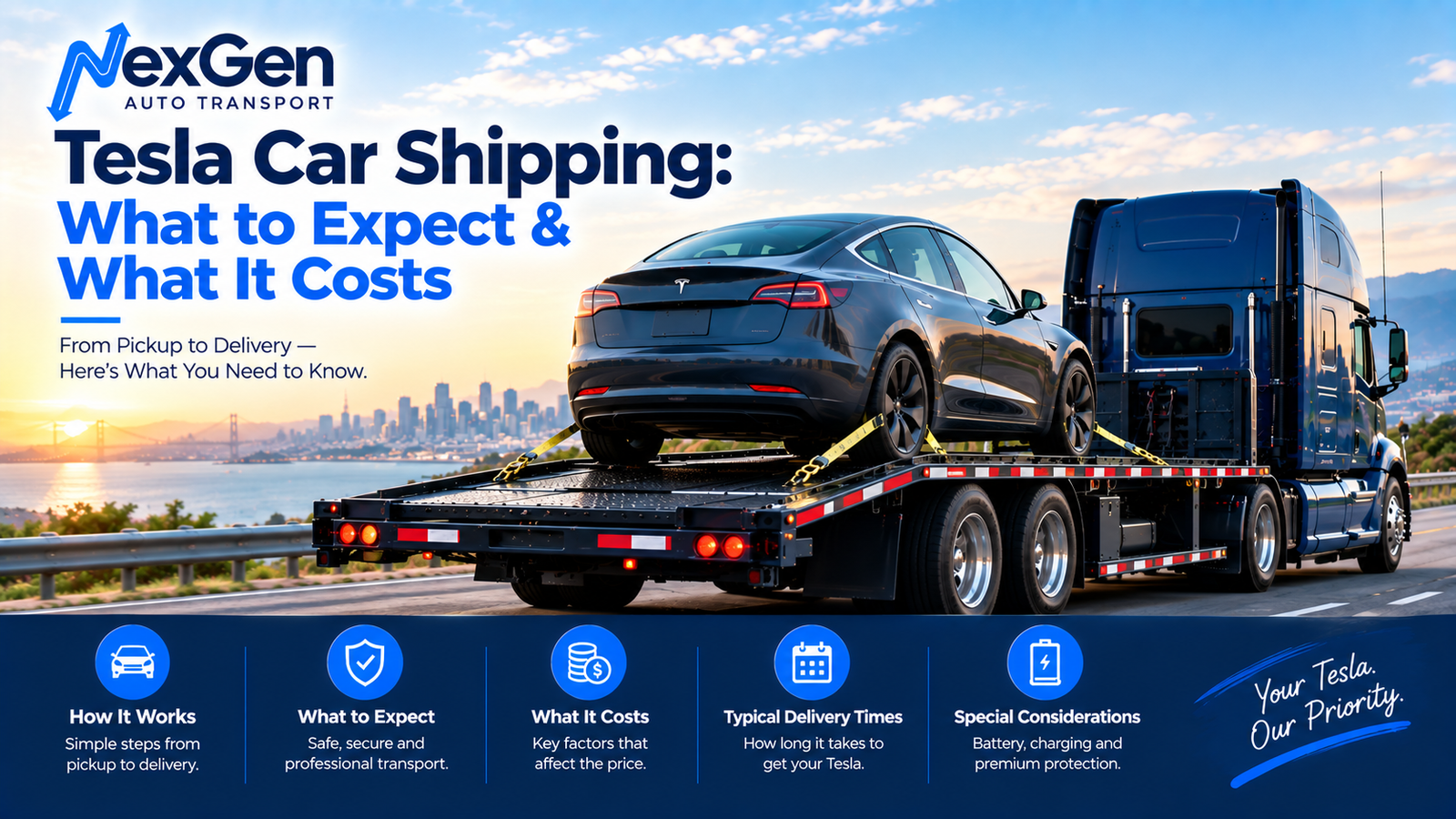
A Tesla ships differently than a typical gas-powered sedan. Some models sit lower to the ground. Sensors sit close to the body. The battery doesn’t need to run during transport, but a few settings still matter before pickup.
Tesla car shipping is simple once you know the details. Here’s the full breakdown, model by model.
How Much Does It Cost to Ship a Tesla?
Tesla shipping cost typically runs $300 to $2,200 or more. Distance, model, and transport method all affect the final price.
| Distance | Open Transport | Enclosed Transport |
|---|
| Under 500 miles | $350 – $700 | $500 – $950 |
| 500 – 1,000 miles | $650 – $1,050 | $900 – $1,450 |
| 1,000 – 2,000 miles | $950 – $1,500 | $1,300 – $1,950 |
| 2,000+ miles (cross-country) | $1,300 – $1,900 | $1,700 – $2,200+ |
These ranges cover a Model 3 or Model Y on the low end. A heavier Model S, Model X, or Cybertruck sits at the high end. Check our general guide on
how much it costs to ship a car for more on distance and transport-method pricing.
Tesla Shipping Cost by Model
Model 3 and Model Y
These are the most common Teslas on the road. They ship at the most affordable rates, since their size and weight are close to a standard sedan or compact SUV. Both models sit low at the front. This matters more for loading than for price. Standard open carrier ramps work fine. A driver experienced with low-clearance vehicles reduces the risk of scraping the front air dam.
Model S and Model X
These are larger and heavier than the Model 3 and Model Y. They cost a modest premium to ship — typically 10–20% more than a Model 3 on the same route. The added weight and trailer space explain the difference.
Cybertruck
The Cybertruck is the heaviest and widest Tesla by a clear margin. Its weight runs roughly 6,600–6,900 lbs, depending on configuration. Its unusual dimensions take up more trailer capacity than a standard truck. Confirm your carrier’s equipment can handle its width and weight before you book. Not every trailer configuration fits a Cybertruck the way it fits a standard pickup.
Should I Use Open or Enclosed Transport for a Tesla?
Most Teslas ship safely on open transport. It’s the same method carriers use to move new Teslas from the factory to delivery centers nationwide. Enclosed transport earns its added cost in a few specific cases:
- You’re shipping a Performance, Plaid, or higher-trim model, where paint condition affects resale value more
- Your route crosses severe weather — heavy snow, hail-prone regions, or extended road salt exposure
- You want to protect the sensor housings and cameras from road debris, since they sit close to the body
- You simply want extra peace of mind, regardless of trim level
See our full comparison in
open vs. enclosed auto transport. For higher-value vehicles generally, see our guide on
luxury and high-value vehicle transport.
How to Prepare Your Tesla for Shipping
- Charge the battery to around 50%. A partial charge powers onboard systems during loading. It also avoids carrying unnecessary weight. Check your Tesla app or owner’s manual for current guidance before you ship.
- Turn off Sentry Mode. Left on, it can drain the battery over a multi-day shipment. It can also trigger false alerts from normal transport vibration.
- Turn off Dog Mode and Camp Mode. Neither is needed during transport, and both draw power you don’t need to spend.
- Close and secure the charge port door. This keeps it from catching on anything during loading.
- Fold in the mirrors if your carrier recommends it, especially for tighter trailer spacing.
- Take detailed photos from every angle before pickup. Get close-ups of the wheels, sensor housings, and any existing marks.
- Clear out the frunk and trunk. Remove personal items and loose accessories, just as you would for any vehicle shipment.
- Tell your carrier the exact model and trim ahead of time. This matters most for a Cybertruck or Plaid variant, so they plan the right equipment for pickup.
Ground Clearance and Loading Considerations
The Model 3 and Model Y sit lower than many traditional sedans and SUVs. This is the most common Tesla-specific concern during loading. An experienced driver approaches the ramp at an angle or uses extended ramps. This avoids scraping the front air dam or lip. Ask directly when booking whether your carrier has real Tesla loading experience, not just general shipping volume.
Does a Tesla Need to Be Fully Charged for Shipping?
No. A full charge isn’t recommended. A partial charge — generally the range manufacturers suggest for extended storage or transport — powers onboard systems during loading without leaving the battery high for several days in transit. Check your specific model’s current guidance, since Tesla updates these recommendations over time.
Is Open Transport Safe for a Tesla?
Yes. Open transport works safely for the vast majority of Tesla shipments. Carriers use this same method to move new Teslas from Gigafactories and delivery centers to customers nationwide. The real question isn’t safety — it’s whether you want the extra weather and debris protection of enclosed transport for a higher-trim or higher-value model. That choice comes down to personal preference and risk tolerance.
How Long Does Tesla Shipping Take?
| Distance | Typical Transit Time |
|---|
| Under 500 miles | 1 – 3 days |
| 500 – 1,000 miles | 3 – 6 days |
| 1,000 – 2,000 miles | 5 – 8 days |
| 2,000+ miles | 7 – 10 days |
See our full guide on
how long car shipping actually takes for what affects timing across any vehicle.
Insurance Considerations for Shipping a Tesla
Tesla’s price point sits above many standard vehicles. Confirm your coverage directly rather than assuming a standard policy is enough. Ask your carrier:
- What the total cargo insurance limit is, and whether it covers your specific model and trim
- Whether coverage differs between open and enclosed transport
- What documentation you’ll need to file a claim, if you ever need one
NexGen Auto Transport includes cargo insurance at no extra cost. Coverage runs up to $250K for open transport and up to $500K for enclosed and door-to-door shipments.
Shipping a Tesla Cross-Country
Cross-country Tesla shipments follow the same distance-based pricing and timing as any long-haul shipment. Expect a range of $1,300–$2,200 or more, depending on model and transport method. A few things matter more on longer routes:
- Book further ahead. Give cross-country routes 1–3 weeks of lead time for better carrier availability and pricing.
- Plan your charge level for a longer window. A multi-day shipment means your Tesla sits longer before its next charge. A moderate charge level gives more buffer than a low one.
- Ask about weather exposure on your route. If severe weather is likely during your shipping window, consider enclosed transport.
See our dedicated guide on
cross-country car shipping for more on longer routes generally.
Common Questions From First-Time Tesla Shippers
Will the carrier need my Tesla’s key card or key fob?
Yes. Whoever hands off the vehicle at pickup needs to provide a key card, key fob, or phone-as-key access. The driver needs this to move the vehicle during loading and unloading. Arrange this before your scheduled pickup window.
Does Autopilot or Full Self-Driving need to be disabled during shipping?
No. The vehicle doesn’t drive itself during transport, so these features stay inactive the whole time. You don’t need to change these settings for shipping.
Can I track my Tesla’s location during shipping the way I would with the Tesla app?
The app can still show your vehicle’s location if it has connectivity and enough charge. Treat your carrier’s own tracking or communication as your primary source for shipment status. The Tesla app wasn’t built as a shipping tool.
What if my Tesla is due for a software update while it’s in transit?
This usually isn’t a concern, since no one drives the vehicle during transport. If you want a specific update done beforehand, handle it before pickup rather than waiting until transit.
Frequently Asked Questions
Do I need to charge my Tesla before shipping?
Yes, to a partial charge. Skip a full charge, and don’t let it run critically low either. A moderate charge level powers onboard systems during loading without unnecessary risk.
Is open transport safe for a Tesla?
Yes. It’s the same method carriers use to move new Teslas from factories to delivery centers. It works safely for the vast majority of Tesla shipments, regardless of model.
Should I turn off Sentry Mode before shipping?
Yes. Sentry Mode can drain the battery during a multi-day shipment. It can also trigger false alerts from normal transport vibration and movement.
Can a Cybertruck ship on a standard open carrier?
Often, yes. Its width and weight still make it worth confirming directly with your carrier that their trailer and equipment can accommodate it before you book.
Does shipping a Tesla cost more than shipping a gas-powered car of similar size?
Not significantly. The same core factors set the price for any vehicle — distance, weight, size, and transport method — not the fact that it’s electric.
Will my Tesla’s range be affected by shipping?
No. No one drives the vehicle during transport, so shipping doesn’t consume range beyond minor battery use from onboard systems during loading and transit.
Ship Your Tesla With Confidence
NexGen Auto Transport ships every Tesla model, from the Model 3 to the Cybertruck. Our drivers bring real experience with low-clearance loading, and every shipment includes full insurance coverage at no extra cost.
Get a free quote from NexGen Auto Transport and see your Tesla’s shipping cost by model and route.