
By NexGen Auto Transport Team · Reviewed by our Operations Team · Updated November 2, 2026
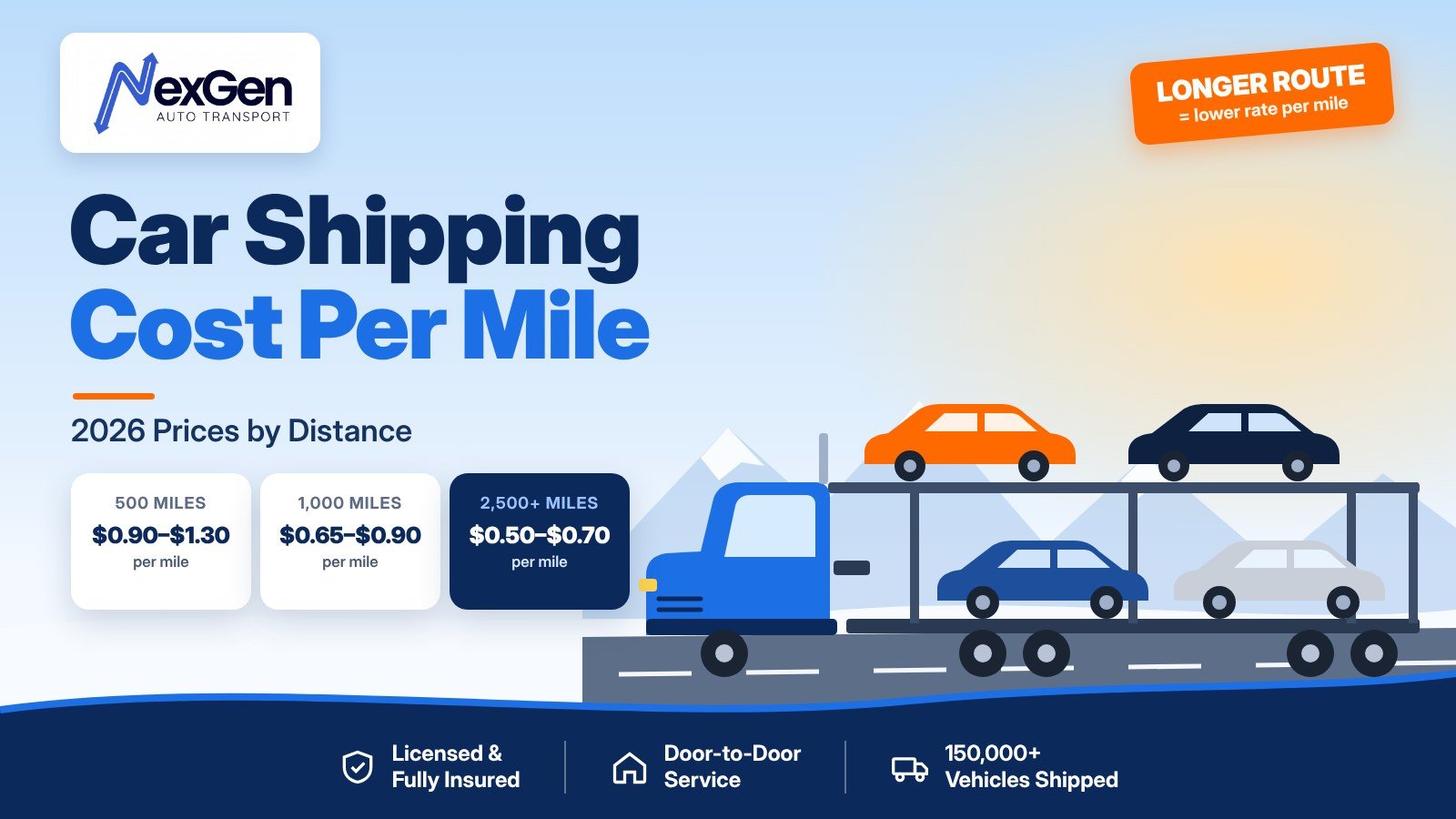
Quick answer: In 2026, car shipping costs about $0.50–$0.70 per mile for cross-country routes of 2,500 miles or more, about $0.65–$0.90 per mile for a 1,000-mile trip, and $1.80 or more per mile for short trips under 300 miles. The longer the route, the lower the cost per mile. Most companies also have a minimum price; with NexGen, short open-carrier trips start at about $450.
“How much does it cost per mile to ship a car?” is one of the most common questions we hear. The honest answer is that there is no single per-mile rate. A 200-mile trip and a 2,800-mile trip are priced very differently, mile for mile. This guide shows real 2026 per-mile costs by distance and on popular routes, explains why the rate changes, and walks you through estimating your own price before you request a quote.
All prices below are NexGen Auto Transport estimates for a standard running sedan on an open carrier. They are the same ranges we use on our state and city pages, so you will see consistent numbers across our site.
Average Car Shipping Cost Per Mile in 2026
This table shows the total price and the cost per mile at common distances. Notice how quickly the per-mile rate falls as the distance grows.
| Distance | Total price (open carrier) | Cost per mile | Transit time |
|---|---|---|---|
| 100 miles | $450 – $650 | $4.50 – $6.50 | 1–3 days |
| 250 miles | $450 – $650 | $1.80 – $2.60 | 1–3 days |
| 500 miles | $450 – $650 | $0.90 – $1.30 | 2–4 days |
| 750 miles | $550 – $750 | $0.73 – $1.00 | 2–4 days |
| 1,000 miles | $650 – $900 | $0.65 – $0.90 | 3–5 days |
| 1,500 miles | $850 – $1,200 | $0.57 – $0.80 | 4–7 days |
| 2,000 miles | $1,050 – $1,450 | $0.53 – $0.72 | 4–7 days |
| 2,500 miles | $1,250 – $1,750 | $0.50 – $0.70 | 6–9 days |
| 3,000 miles | $1,450 – $2,000 | $0.48 – $0.67 | 6–9 days |
Two things stand out. First, every trip under about 500 miles costs roughly the same in total, because every load has a minimum cost to cover. Second, a 3,000-mile trip costs only about three times as much as a 500-mile trip, even though it covers six times the distance. For a broader view of total prices, see our main car shipping cost guide.
Why Long Routes Cost Less Per Mile
Every car shipment has costs that do not depend on distance. On a short trip, those fixed costs are spread over only a few miles, so the per-mile rate looks high. On a long trip, they are spread over thousands of miles.
- Loading and unloading. Securing a car on a trailer, inspecting it, and completing the bill of lading takes the same time whether the trip is 100 miles or 3,000 miles.
- Pickup and delivery detours. Driving a large carrier to your door, then back to the highway, takes time and fuel on every load.
- Dispatch and paperwork. Matching your car to a carrier, confirming dates, and handling insurance documents is the same work for any distance.
- Driver time. A short-haul carrier may only complete one or two pickups a day. A long-haul carrier spends most of its day driving, which is the most efficient use of the truck.
- Highway miles are cheaper miles. Long routes run mostly on interstates, where trucks get their best fuel economy and make steady progress.
This is also why short trips sometimes surprise people. A 150-mile move across Texas can cost almost as much as a 500-mile move. We explain this in more detail in is car shipping cheaper short distance or long distance.
Cost Per Mile on Popular Routes
Here is what the per-mile rate looks like on some of the routes we ship most often. Distances are approximate driving miles between the cities.
| Route | Approx. miles | Total price (open) | Cost per mile | Transit time |
|---|---|---|---|---|
| Houston to Dallas | 240 | $450 – $650 | $1.88 – $2.71 | 1–3 days |
| Houston to Atlanta | 790 | $550 – $800 | $0.70 – $1.01 | 2–4 days |
| New York to Miami | 1,280 | $750 – $1,050 | $0.59 – $0.82 | 3–5 days |
| Dallas to Miami | 1,310 | $750 – $1,050 | $0.57 – $0.80 | 3–5 days |
| Chicago to Miami | 1,380 | $800 – $1,100 | $0.58 – $0.80 | 3–5 days |
| Houston to Los Angeles | 1,550 | $850 – $1,200 | $0.55 – $0.77 | 4–7 days |
| Los Angeles to New York | 2,800 | $1,350 – $1,900 | $0.48 – $0.68 | 6–9 days |
| Seattle to Miami | 3,300 | $1,550 – $2,150 | $0.47 – $0.65 | 6–9 days |
Busy routes between large cities, like Dallas to Miami or Los Angeles to New York, often price toward the low end of the range because carriers run them every week. Routes to small towns, or between two rural areas, usually price toward the high end.
How to Estimate Your Own Car Shipping Cost
You can get a solid ballpark in under a minute with four steps:
- Find your distance. Use the driving distance between your pickup and delivery ZIP codes in any map app.
- Pick your per-mile range. Match your distance to the closest row in the table above.
- Multiply. Multiply your miles by the low and high per-mile rates. If the result is under $450, use $450–$650, since that is the minimum for most open-carrier trips.
- Adjust for your situation. Add for a larger vehicle, enclosed transport, a non-running car, a rural address or a rush pickup (see the next section).
Example: You are moving a sedan about 1,100 miles from Houston to Chicago. At the 1,000-mile rate of about $0.65–$0.90 per mile, a fair estimate is roughly $700–$1,000 on an open carrier, with 3–5 days in transit. If it is a full-size pickup truck, expect to pay more. If you want enclosed transport, multiply by about 1.4–1.5.
An online estimate is a starting point. Your actual quote depends on your exact addresses, vehicle and dates, which is why it is worth getting a free quote before you budget.
What Changes Your Cost Per Mile
Distance sets the baseline. These factors move your price up or down from there.
Open vs enclosed transport
Enclosed carriers hold fewer cars and protect them from weather and road debris, so they cost about 1.4–1.5 times as much as open carriers. On a 1,000-mile trip, that means roughly $900–$1,350 instead of $650–$900. Read our comparison of open vs enclosed car transport to decide which you need.
Vehicle size and weight
A carrier can only fit so much weight and length on a trailer. Midsize SUVs, full-size pickups, vans and lifted or modified vehicles take more space and weight than a sedan, so they cost more per mile. Expect a higher quote for heavy trucks and oversized vehicles.
Running condition
If your car does not run, it must be winched on and off the trailer, which takes special equipment and extra time. Learn more about shipping a car that doesn’t run.
Route popularity and location
Carriers travel the busiest interstate corridors every week, so prices there are competitive. A pickup in a small town far from the highway means extra miles and time for the driver, which raises the per-mile rate.
Season and demand
Summer moving season and snowbird season (fall south, spring north) push prices up. Late fall and winter, outside the holiday weeks, are usually cheaper. See the cheapest time of year to ship a car.
Fuel prices
Diesel is one of a carrier’s biggest costs, so rate changes often follow fuel prices. You can track national diesel prices on the U.S. Energy Information Administration website.
Pickup timing
A flexible pickup window lets us match your car to a carrier already heading your way, which keeps the price down. A guaranteed or same-week pickup costs more. If you are short on time, see our expedited auto transport options.
Get your free quote and see your real rate per mile
Call Now: + (832) 886-1321 Get a Free Instant QuoteWhy Car Shipping Companies Don’t Quote by the Mile
Although cost per mile is a useful way to compare prices, carriers do not actually bill by the mile. They price each load as a whole route, based on the factors above and on what other carriers are being paid for similar loads that week.
That is why one company’s quote can look much cheaper than another’s. A price far below the ranges in this guide is often too low to attract a carrier, which can lead to long delays or a higher price after you book. If that has happened to you, read why car shipping quotes go up after booking, and learn which auto transport companies to avoid.
At NexGen, we quote realistic prices that carriers will accept, so your car gets picked up on time. You pay with a card or electronic reservation hold to book, and the balance is due on delivery.
How to Lower Your Cost Per Mile
- Choose an open carrier unless your car is high-value, classic or freshly restored.
- Book 2–3 weeks ahead so we have time to find a carrier on your route at a good rate.
- Be flexible by a few days on pickup, which is often the single biggest money-saver.
- Meet near a major highway if you live somewhere hard for a large truck to reach.
- Ship in the off-season when you can, avoiding peak summer and the busiest holiday weeks.
- Ship more than one car together. Multi-car shipments on the same route usually cost less per vehicle.
For more ideas, see the cheapest way to ship a car: 10 ways to lower your quote.
Is Shipping Cheaper Than Driving Per Mile?
For short trips, driving is almost always cheaper. For long moves, it is closer than most people think. Driving 2,800 miles costs about $1,390 in gas, hotels and meals, or roughly $0.50 per mile, before you count six days of your time and the wear on your car. Shipping the same route costs about $0.48–$0.68 per mile with none of that wear. We compare both in detail in shipping a car vs driving cross-country.
Why Ship With NexGen Auto Transport
- Experience: in business since 2021, with more than 150,000 vehicles shipped and 100,000+ customers served.
- Licensed and insured: FMCSA MC 1482694 and USDOT 3969190, with cargo coverage up to $250,000 on open carriers and $500,000 on enclosed carriers. See our insurance details.
- Fair booking terms: a reservation hold to book, the balance due on delivery, and free cancellation before a carrier is assigned.
- A real team: based in Stafford, Texas, and available by phone from quote to delivery.
Frequently Asked Questions
What is the average cost per mile to ship a car?
In 2026, the average is about $0.50–$0.70 per mile for cross-country trips, $0.65–$0.90 per mile for about 1,000 miles, and $0.90–$1.30 per mile for about 500 miles. Trips under 300 miles cost $1.80 or more per mile because of the minimum price.
How much does it cost to ship a car 1,000 miles?
Shipping a standard sedan 1,000 miles costs about $650–$900 on an open carrier and $900–$1,350 on an enclosed carrier, with 3–5 days in transit.
How much does it cost to ship a car 2,000 miles?
Shipping a sedan 2,000 miles costs about $1,050–$1,450 on an open carrier, or about $0.53–$0.72 per mile, with 4–7 days in transit.
Why is short-distance car shipping so expensive per mile?
Every shipment has fixed costs for loading, pickup, delivery and paperwork. On a short trip, those costs are spread over only a few miles, so the per-mile rate is high even though the total price is low.
Does enclosed transport cost more per mile?
Yes. Enclosed transport costs about 1.4–1.5 times as much as open transport, because enclosed trailers carry fewer vehicles and offer more protection.
Is there a minimum price to ship a car?
Yes. Most open-carrier trips have a minimum price because of fixed costs. With NexGen, short trips start at about $450–$650 for a standard sedan.
Get Your Car Shipping Quote
Cost per mile is a great way to sanity-check a price, but your exact route, vehicle and dates decide the final number. Get a free quote from NexGen in minutes, or call our team and we will walk you through your options.
About the authors
This guide was written and reviewed by the NexGen Auto Transport team in Stafford, Texas. Since 2021 we have arranged transport for more than 150,000 vehicles nationwide (FMCSA MC 1482694, USDOT 3969190). Prices and transit times reflect our current rates. Read our editorial policy.
